
US Department of Health and Human Services announced a declaration to provide immunity to legal claims made in the US in relation to three investigational Ebola vaccines.
The evolution of therapeutic modalities drives the adoption of single-use technologies.
Despite a growing number of biosimilar approvals, market uptake remains a challenge.

Given the criticality of fill/finish processes, it is clear that automation is the next technological step.
US Department of Health and Human Services announced a declaration to provide immunity to legal claims made in the US in relation to three investigational Ebola vaccines.
On December 8, Pfizer announced that it will establish a research program in gene therapy, and collaborate with Spark Therapeutics in Philadelphia, to develop potential gene therapy treatments for hemophilia.
Under an NIH contract, Paragon Bioservices will design a manufacturing process for recombinant human rhE-selectin protein.
Amgen's bispecific T-cell engager (BiTE) antibody constructs help the body fight malignant cancer cells.
Ranbaxy and Epirus announce the launch of India's first biosimilar for Remicade.

Outsourcing is taking on a greater role in the biopharmaceutical manufacturing industry.

MedicalRF.com/Science Photo Library-ANDRZEJ WOJCICKI/Henrik Jonsson/Stocktrek Images; Dan Ward
Dalton Pharma Services announced it was awarded funding from ISTPCanada for its project to develop vaccines for respiratory syncytial virus and parainfluenza type 3.
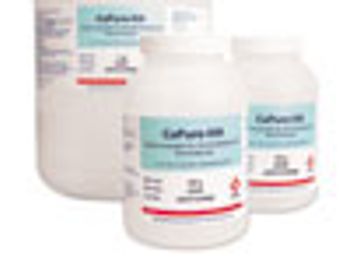
Tosoh Bioscience’s CaPure-HA hydroxyapatite chromatography resin is designed for the purification of monoclonal antibodies, polyclonal antibodies, and antibody fragments, and the separation of antibody isoforms and isozymes.
Opdivo and investigational agent FPA008 will be tested in combination for their efficacy in boosting antitumor immune response.
The more than $200 million project will increase production capacity at the facility to support AstraZeneca?s maturing pipeline.
The United States government is ramping up support for formulation, production, and packaging of Ebola treatments.
The $200-million project will expand Amgen's single-use/disposable manufacturing capabilities.
Grand River Aseptic Manufacturing has announced that the company executed two commercial production contracts in one day.
New technologies facilitate enhanced single-use processes and procedures.
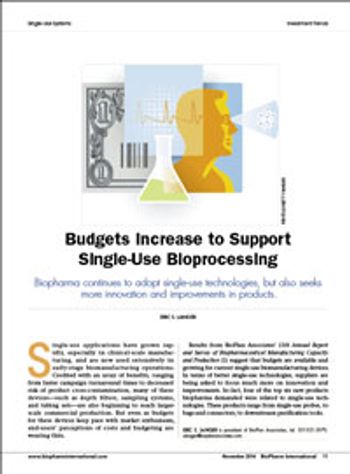
Biopharma continues to adopt single-use technologies, but also seeks more innovation and improvements in products.
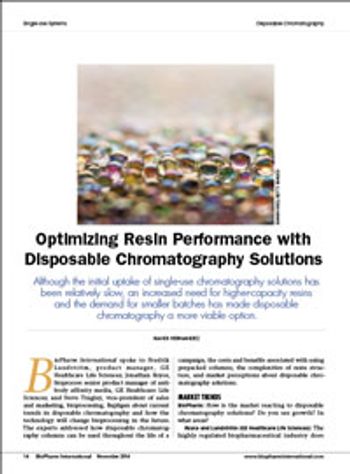
An increased need for higher-capacity resins and the demand for smaller batches has made disposable chromatography a more viable option.

Dual sourcing is one of many possible solutions to securing the supply chain.
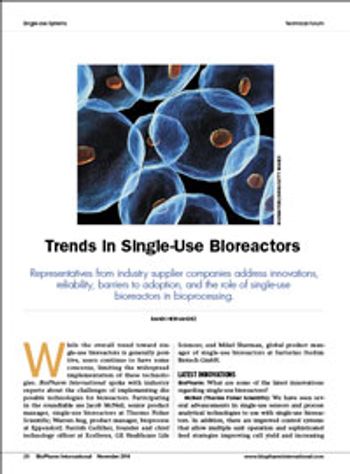
Representatives from industry supplier companies address innovations, reliability, barriers to adoption, and the role of singIe-use bioreactors in bioprocessing.

New publications from BPSA and PDA highlight best practices for particulate control, quality agreements, and implementation strategies.
The new location will increase Bristol-Myers Squibb's biologics manufacturing capacity.
Construction has started on Novo Nordisk's laboratories for diabetes research in Denmark.
For cellular therapies to become a viable treatment for large-sized patient groups, steps need to be taken to develop an efficient manufacturing and supply system to minimise the cost of goods.
Sartorius opened a new application center at its offices in Shanghai for product demonstrations, trial runs, and training sessions.
Cellular therapy developers learn process development strategies from pharma industry experiences.