Register Now: From Clinical to Commercial: Accelerating ADC Late-Stage Development with Technology Innovation and Integrated Platform

Podcasts

Intensified continuous chromatography, a type of Multi-Column Chromatography (MCC), has emerged as a valuable technique in downstream bioprocessing that enables increases in productivity. In this podcast, MCC Product Specialist, Jennifer Knister, will discuss how adopting MCC can reduce costs, decrease suite time, and lead to higher resin utilization, along with why these benefits are particularly worthwhile in multi-product facilities.
Biopharma Resilience is declining. The 2023 Global Biopharma Resilience Index from Cytiva offers insights into the current state of the industry, shining a light on both areas of strength and opportunities for collaborative growth. By working together, biopharma leaders, academia, and policymakers can create lasting improvements. Join Ludovic Brellier, President of Biotechnology Integrated Solutions and Business Operations Leader at Cytiva, as he delves into this year’s Index findings. Specifically, he’ll highlight where the industry should turn their focus to ensure that patients are continuing to get the essential life-changing therapies they need.

Creating a new therapeutic drug can take a decade or more to get to patients. Antibody production and discovery play an integral role in setting the stage for success at later stages of development. If a high affinity, functional antibody candidate is discovered early, the timeline to a finished targeted and effective therapeutic drug may be significantly reduced. In this podcast we will go through the untold tales of antibody production and discovery, as well as how Twist has optimized a process for antibody production and screening for potential therapeutics.

Adeno-associated virus (AAV) is a widely used viral vector for the delivery of genetic material in gene therapy. Vector development and production at an industrial scale requires an efficient method for accurate quantification of viral capsids. Unfortunately, traditional techniques such as ELISA, HPLC, and ddPCR are time consuming and labor-intensive. This podcast introduces a rapid, label-free method for the direct capture and quantitation of various AAV serotypes using the Octet® Bio-Layer Interferometry (BLI) platform with Octet® AAVX Biosensors. These biosensors deliver results in as little as 15 minutes and can be used to quantitate AAV capsids in both crude and purified samples.

Multi-column continuous chromatography (MCC) offers significant economic advantages over traditional batch methods for the purification of monoclonal antibodies (mAbs), including increased resin capacity utilization, smaller columns, reduced buffer consumption, and faster processing time. For mAb productivity, the Protein A capture step is a primary target to apply MCC due to its high cost, which is driven even higher as improvements in upstream processing have produced a steady increase in mAb titers. The multi-column continuous chromatography method has demonstrated that mAb productivity can be increased by 400 to 500% compared to batch-mode.

For years pharmaceutical and biopharmaceutical manufacturers have invested in rigid stainless-steel equipment for upstream bioprocessing. With new and innovative single-use products now on the market, manufacturers have access to flexible, safe solutions that offer a myriad of advantages over the traditional solutions. Single-use technology offers less risk of contamination, more operator safety, and less negative environmental impact than the stainless-steel alternatives. In this podcast, we will discuss the challenges associated with handling powders in upstream biopharm processes and how single-use technology can benefit manufacturers from an environmental, cost, and safety perspective.

Sponsored Podcast

This is the year in which manufacturers will have the courage to bet on data aggregation and AI solutions that help them grow their capacity, moving away from pilot mode and embedding those tools as foundational assets. These have become critical levers to support the expanded demand for drug manufacturing, especially exacerbated with the pandemic. Join John Vitalie, CEO at Aizon, as we discuss how Pharma 4.0 is transforming the pharma landscape to bring gains to manufacturers and to the patients they serve.

Sponsored Podcast

Fill finish (sterile filtration) operations are critical and often the only means to produce sterile liquid biopharmaceuticals as other means of sterilization will degrade the product(s). This complex packaging process has become more regulated and controlled in an effort to reduce the risks of contamination (with the greatest risk potential coming from cleanroom operators). This episode reviews current market trends and provides some characteristics expected of a top notch Fill Finish CMO, like Samsung Biologics in Incheon, South Korea.

Sponsored Podcast

Lipid-based formulations are gaining global awareness, notably with lipid nanoparticles (LNPs) being a key component in several current COVID-19 and mRNA vaccines. Lipid-based formulations, including liposomes and LNPs, are an effective drug delivery system for a variety of active pharmaceutical ingredients (APIs), notably for complex parenteral drug products including cancer, viral, and gene therapeutics. In this podcast, we discuss how Emergent has been involved in the manufacturing of lipid-based formulations over the past two decades, along with factors to consider when partnering with a CDMO for lipid-based formulation manufacturing.

Perfusion technology is a tool to increase productivity that can be applied at different stages during upstream cell culture for biotherapeutics products. Perfusion allows removal of waste by-products and replenishment of fresh nutrients so that the cells are able to grow and reach higher cell densities and higher productivity. N-1 perfusion, the application of the perfusion technology in the step immediately before the production bioreactor, is a good option for processes that exhibit low productivity. Join Claudia Berdugo, Ph.D., Director of Process Development at Catalent Biologics, for a podcast where she discusses N-1 perfusion and how Catalent Biologics works toward process improvements for each client to enable them to move their pharmaceutical products forward with confidence.

Sponsored Podcast

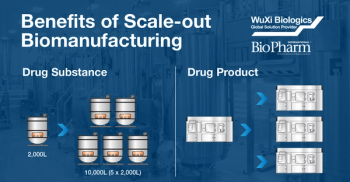
Changes in production scale required due to increasing product needs throughout clinical trials introduces risk to the product development timeline. Both the process and the product can be dramatically impacted from scaling-up to larger production volumes. Once in commercial manufacturing, sudden changes to product demand in either direction can have costly consequences if the scale of production chosen is not adequate to meet the changing material requirements. Adapting a “scale-out” instead of “scale-up” strategy for clinical and commercial production can greatly minimize these risks. This podcast will review the scale-out biomanufacturing approach and the significant benefits of this production paradigm.

Sponsored Podcast

The past few years have been filled with seminars discussing viruses, with COVID-19 stealing most of the headlines. Not all viruses are created equal; some are actually beneficial for human health and biotherapeutics delivery. Adeno-associated virus (also referred to as AAV) vectors fall into this category. AAVs are “hot” right now, as they are currently one of the most promising systems for human gene therapy. There are many types of AAVs and purification and analysis of these types of viruses can present challenges. In this dedicated dialogue, we will discuss the most efficient workflow for AAV purification and analysis.

Sponsored Podcast

Choosing the right sterilization technique for your drug product and its packaging is not always a simple decision. While most packaged drug products have specific requirements, newer sterilization techniques offer innovative ways of ensuring sterility that may be more suitable than standard sterilization processes. In this dedicated dialogue, the audience will learn about standard sterilization processes, be introduced to newer techniques, and understand how these techniques have been applied to parenteral packaging components.

Sponsored Podcast

Astrea Bioseparations joins Biopharm International for a discussion about the evolving challenges of downstream processing for advanced therapies, and what the future might hold. We talk about the company’s evolution over the last three decades, including the Discover. Develop. Deliver. approach to customer alignment. The latest industry trends are reviewed, along with considerations to keep in mind during the selection of off the shelf or customized downstream solutions.

Sponsored Podcast

The entire clinical supply chain — from manufacturer to shipper to clinician to patient — is united in its reliance on cold chain solutions to consistently deliver quality of life and potentially lifesaving treatments. Learn more about how to navigate a vast array of temperature-controlled shipping options across five specific temperature ranges while ensuring product integrity and patient safety.

Sponsored Podcast

In this podcast, Catalent Biologics regulatory expert, Kelly Davis shares her insights on why companies choose to repurpose drugs, what the main considerations are when doing so, how companies can overcome the challenges they face, and how Catalent supports companies going through this process.

Sponsored Podcast

Inline dissolved CO2 measurement & monitoring during cell culture and fermentation scale up offers significant benefits for process control, impacting productivity and quality attributes. Real-time dCO2 measurement complements routine dissolved CO2 measurements with a BGA during pre-clinical and commercial operations. This podcast explains why dCO2 should be measured as a critical process parameter, what actions can be taken based on dCO2 measurements, and how to implement real-time dCO2 measurement.

Sponsored Podcast

In this podcast, we speak with Austin Mogen, Ph.D., Sr. Field Application Scientist and Cat Siler, Ph.D., Field Application Scientist both from Corning Life Sciences about the available platforms for adherent cell culture scale-up. These platforms offer the potential to reduce time and cost while delivering high efficiency for a variety of adherent applications.

Sponsored Podcast

Cell therapy market has been experiencing double digit growth in recent years stemming from the promising success of the first autologous CAR-T products. However, manufacturing these therapies at scale continues to be a challenge. This podcast will focus on the specialized needs of manufacturing cell therapies at scale and how Custom Manufacturing Organizations are stepping in to drive process efficiencies and standardization.

Sponsored Podcast

Infectious disease surveillance from wastewater and fecal samples has been recently adopted as a method for monitoring emergence and re-emergence of infectious diseases. This method allows public health agencies, universities, hospitals, cruise lines, and more to detect a pathogen and respond before there is a community outbreak. Thermo Fisher Scientific has partnered with many labs globally to implement new wastewater testing systems and optimization of existing wastewater monitoring processes. Listen in to learn about importance of wastewater.

Sponsored Podcast

Sue Marchant, director of product at MasterControl, will discuss how AI technology is helping pharmaceutical companies address CAPA and root cause investigations. The CAPA process has historically been more corrective than preventive, hard to track and implemented without context. During the podcast, we will be discussing the options available today to connect quality data and subsequently what problems can be solved using AI. These technologies will turn the tables making CAPA more preventive than corrective with the ability to track process in real time and understand the contributing factors and considerations surrounding an event. Additionally, Marchant will explain how AI combines and analyzes data, pinpoints relationships, and provides valuable process improvement. Companies should not be intimidated or hesitant about implementing AI technology. Today’s technology has AI capabilities embedded in the software to accelerate AI development. Companies no longer need specialists to get started and take advantage of the benefits.