
The Mutual Recognition Agreement will allow FDA and EU inspectors to recognize each other’s work and avoid the duplication of drug inspections.
The evolution of therapeutic modalities drives the adoption of single-use technologies.
Despite a growing number of biosimilar approvals, market uptake remains a challenge.

Given the criticality of fill/finish processes, it is clear that automation is the next technological step.

The Mutual Recognition Agreement will allow FDA and EU inspectors to recognize each other’s work and avoid the duplication of drug inspections.
The process control and automation requirements of single-use systems differ from those of stainless-steel equipment.

The decision to use disposable bioreactors is now driven by commercial rather than technological considerations.

Manufacturing for originator molecules is restricted by regulations, but drug makers can exploit newer technologies for the manufacture of biosimilars.

As the November 2017 deadline nears, a surprising number of companies still don’t have a serialization plan in place. New programs aim to get them compliant in time.

Communication and taking the time to develop the process are key to successful transfer and scale up of biologics
Johnson & Johnson Supply Chain (JJSC) and the distributor AmerisourceBergen launched a four-week pilot program to test GS1’s EPCIS standards and to see how effectively data could be transferred between the two partners.
The author discusses the results from TraceLink and Actionable Research's Global Drug Supply, Safety and Traceability Report.
Avella issued a nationwide recall of sterile products produced at the Advanced Pharma Houston location due to inaccurate labeling.
Sanofi and Lonza formed a joint venture to build and operate a large-scale mammalian cell culture facility for monoclonal antibody production in Visp, Switzerland.
The company is voluntarily recalling one lot of Edex due to a lack of container closure integrity.
The companies have developed a Level 4 traceability solution to manage pharmaceutical regulatory requirements.
FDA granted inotuzumab ozogamicin priority review and accepted its BLA for filing.
CellGenix will add R&D, production, and warehouse space in Freiburg, Germany for GMP-grade raw materials for cell therapy, gene-therapy, and tissue-engineered products.
In a press release, Momenta announced on Feb. 16, 2017 that Momenta/Sandoz’s fill/finish contract manufacturer, Pfizer, received a warning letter for the manufacture of the 40 mg of Glatopa (glatiramer acetate injection), Momenta’s generic version of the drug Copaxone. Pfizer said in the statement that the warning letter does not affect the production or shipment of the 20 mg version of the drug, which is already approved by FDA.
Under the agreement, Abzena will manufacture magacizumab, an antibody created using the ‘Abzena inside’ Composite Human Antibody technology.

Process controls get some upgrades to better reflect real-time conditions.
FDA sent a warning letter to Sato Pharmaceutical Co., Ltd. after inspectors found deviations in the facility’s aseptic processes.
The company has voluntarily recalled all lots of of human chorionic gonadotropin because of a lack of sterility assurance.
The agency sent a warning letter to Resonance Laboratories Pvt. Ltd. after an inspection found possible contamination problems.
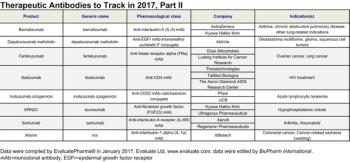
Evaluate and BioPharm International highlight the antibody-based therapeutics that may have 2017 launch dates in the United States.
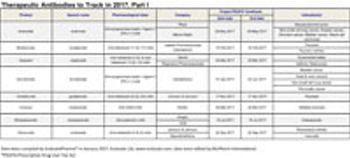
EvaluatePharma and BioPharm International highlight the antibody-based therapeutics that may gain United States Regulatory approval in 2017.
Modular Automated Sampling Technology (MAST) allows direct aseptic transfer of bioreactor samples to analytical devices, providing rapid and reliable data in bioprocessing.
This three-year partnership will explore and identify new tools and methods to modify and optimize the Chinese hamster ovary (CHO) cell line performance.
On a recent call, Catalent revealed that it has reached more than 90% of its current capacity and discussed how tax policy changes could affect the outsourcing industry.