

Building up relevant expertise in-house will make writing spec sheets for software easier, according to Siegfried Schmitt, principal consultant at PAREXEL.
Building up relevant expertise in-house will make writing spec sheets for software easier, according to Siegfried Schmitt, principal consultant at PAREXEL.

Industry is searching for ways to deal with the criticality of ensuring data integrity.

This article will explore the requirements for media and supplements needed to maintain newer cell lines, such as those based on human cells and fungal cells.

The second half of this article describes the testing methods used by the authors to demonstrate the applicability of single-use mixing technology for virus inactivation.
Mock inspections-if conducted properly-can prepare a pharma company for the day FDA knocks on the door.

Providing analytical data on the comparison between a biosimilar and the reference product is a primary consideration in the development of biosimilars.

The testing of raw materials is essential as raw material quality determines the outcome of biologic product quality.

This article explores the use of single-use mixing technology in a detergent-based virus inactivation step during a monoclonal antibody production process.

Analytical exoglycosidases are transitioning from being largely academic tools to being suitable for glycan analytics in biopharmaceutical manufacturing.
Susan Schniepp, executive vice-president of Post-Approval Pharma and Distinguished Fellow, Regulatory Compliance Associates, takes a look at the regulations around data integrity and how they relate to the concept of quality culture.
The agency sent a warning letter to the Indian company after an inspection found CGMP violations that included a lack of written procedures and analytical testing.
The agency announced that differences in strength expression on product labels of compounders and conventional manufacturers may lead to dosing errors.
FDA sent a warning letter to Lernapharm (Loris) Inc. detailing the company’s lack of procedures to prevent microbiological contamination.
FDA testing has found an additional impurity, N-Nitrosodiethylamine, in the API valsartan.
FDA is revising its inspection process and seeks harmonization of standards for US and foreign regulatory oversight to ensure the safety of medicines.
FDA, innovator companies, and biosimilar developers maneuver over exclusivity, naming, interchangeability, and more.
Gore’s new flexible freeze containers are designed to protect high-value drug substances from container breakage or leakage.
More consistent and reliable production processes are critical for advancing innovative treatments.

Automation can improve many aspects of bioprocessing, but several hurdles must be overcome before the full range of benefits can be realized.
Detailed process descriptions and robust documentation aid in compliance as well as training, says Siegfried Schmitt, principal consultant at PAREXEL.

Trace elements in raw materials may impact the quality and safety of the finished biologic product, according to industry experts.

Viral vaccines and viral vectors used in biotherapeutic applications carry the risk of microbial contamination, which must be addressed.
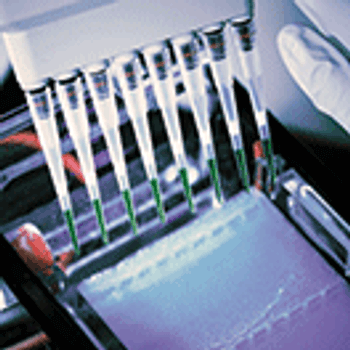
This study was successful in establishing a reliable and effective method for evaluating cleaning processes based on risk. Click here to view a PDF of this article.
The US Pharmacopeial Convention (USP) is developing a new chapter for rapid sterility testing of short-life products based on the recommendations of a panel of experts and stakeholders.
FDA sent a warning letter to Kyowa Hakko Bio Co., Ltd. after inspectors found data integrity problems at the company’s Yamaguchi, Japan facility.