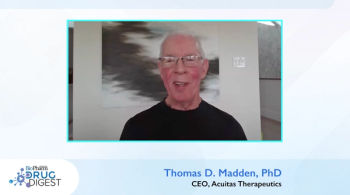
Acuitas CEO Dr Thomas Madden and NanoVation co-founder and president Dr Dominik Witzigmann discuss how LNP engineering is expanding genetic medicine applications to traditionally undruggable targets.
The complications of conjugate molecules, such as oligonucleotides, are explored in this second portion of an interview with Abzena experts.
Now, in part two of three of this video exclusive to BioPharm International®, Dieterich and Mocny get into more specifics about the types of molecules that CDMOs such as Abzena are trying to advance in the current biologics space—namely oligonucleotides.
“They're not very bioavailable,” Dieterich says in the interview. “They will need different analytical techniques to consider them, and while we can put them onto our conjugation platform, we have to pivot quite significantly when we're talking about purification.”
As in the first portion of the interview, Mocny says this brings regulatory considerations as well.
“In the regulatory arena, while oligonucleotide therapies have been on market for some time, and there's been regulatory guidance around how those molecules are manufactured in the aggregate, in the conjugate space, it's a little less defined,” Mocny says. “So what we've worked very diligently on is to provide a platform or a thinking approach, to be able to get these large conjugate molecules that are novel in their therapeutic construct to comply with regulatory requirements.”
Dieterich also stresses the importance of getting the basics right; that Abzena has a strong platform from which to build, and so when more complicated molecules need to be dealt with, scientists know how to handle their peculiarities quickly and efficiently.
The second part of BioPharm International®’s interview with Dieterich and Mocny can be viewed above. Part one is available
Editor's note: This transcript is a lightly edited rendering of the original audio/video content. It may contain errors, informal language, or omissions as spoken in the original recording.
Petra Dieterich
We have a strong platform to build on, and I think that's really important, the basics are established. We have routine processes that we can follow, but so that when the more novel molecules come along, we can quickly fill those gaps, because we have the scientific acumen and the experience to handle it really quickly.
Let's take oligonucleotides for example. Oligos are large, negatively charged molecules. They're not very bioavailable. They will need different analytical techniques to consider them, and while we can put them onto our conjugation platform, we have to pivot quite significantly when we're talking about purification. We use HIC chromatography very routinely on our ADC conjugation platform. That's not going to work because of, again, the physiochemical properties of oligonucleotides being quite different. In those instances, we have to use anion-exchange chromatography.
Now that's not—we can't just bolt that on. It's just not a platform we have available. It's not something we can just make a shift on. It's something that we have to develop. But because we've been doing this a long time, and we have the scientific acumen and experience, we can set about that relatively rapidly, and then, of course, have the correct analytical techniques in place as well to make that happen.
Jeffrey Mocny
One of the complicating factors around some of these advanced conjugate molecules, like as Petra mentioned, oligonucleotide conjugate molecules, is that in the regulatory arena, while oligonucleotide therapies have been on market for some time, and there's been regulatory guidance around how those molecules are manufactured in the aggregate, in the conjugate space, it's a little less defined.
So what we've worked very diligently on is to provide a platform or a thinking approach, to be able to get these large conjugate molecules that are novel in their therapeutic construct to comply with regulatory requirements in the development activities and a phase-appropriate approach, like, for example, AOCs, while there are some ICH guidance documents that are available, European documents that are available, that guide some of the thinking around oligonucleotides, applying that to the larger molecules requires some thought and good old-fashioned scientific justification, and that's where we draw on our experience with ADCs to be able to extend those capabilities into novel modalities, coupled, of course, with understanding of what the regulators are looking for in the criticalities at each stage of development.
So I think when you combine those things together, a strong foundation gives you quite a bit of latitude to be able to expand the sphere of influence and the manufacturing activities that Abzena is able to address, plus we've got some pretty cool scientific equipment that we can draw from to give us that analytical data utilizing these novel techniques that Petra spoke about. So there's, as we look at the future modalities of therapeutics, I think it's critical to draw on a sound base to be able to extend that out further.