


Prefilled-syringe line features automation and novel disinfection techniques.
Prefilled-syringe line features automation and novel disinfection techniques.
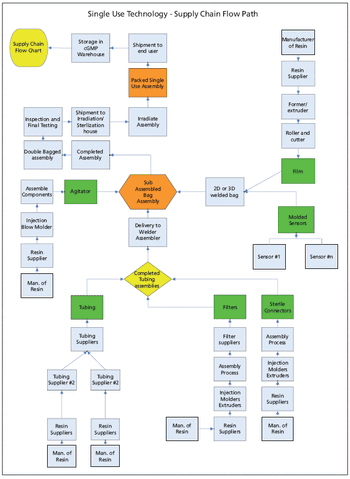
The authors suggest techniques for mitigating risk and securing the supply chain for single-use components used in biopharmaceutical manufacturing.

EU authorities are stepping up their efforts to incorporate QbD principles.
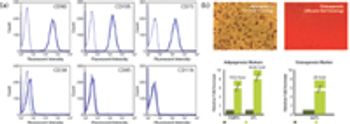
The authors describe the growth characteristics of human mesenchymal stem cells cultured in a stirred-tank bioreactor.
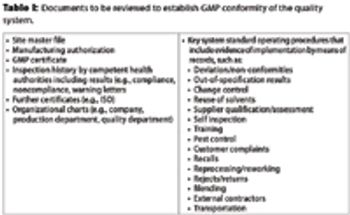
The authors present solutions based on a review of current service offerings and their audit experience.
Aggregate formation is influenced by multiple aspects of the bioproduction process but can be mitigated by good process design and control.
BioPharm International spoke with industry experts about the effect FDA's 2011 process validation guidance has had on industry.
USP's focus in 2013 involves standards relating to organic impurities, measurement of residual DNA and host-cell proteins in biotechnology products, and elemental impurities.

Shortages spur efforts to overhaul manufacturing oversight.

Eastern Europe is moving towards a goal of harmonized regulations.
Two general chapters on elemental impurities? limits and procedures are to become official Feb. 1, 2013, with implementation proposed for May 1, 2014.

Neil Lewis, chief technology officer at Malvern Instruments, talks about the challenges associated with biologics.
A recent ISPE guidance provides a baseline for the design of quality laboratory facilities.

An introduction to a new series on manufacturing within global markets.
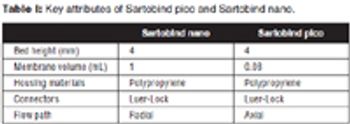
The authors describe the development of an ultra scale-down anion exchange membrane adsorber, and demonstrate scalability to larger-scale devices.

This month, Sharon Strause, an industry consultant, provides a look back at "Computer System Validation Part I: Testing and Verification of Applications Software" by Leonard J. Goren.
USP revises labeling requirements for Heparin.
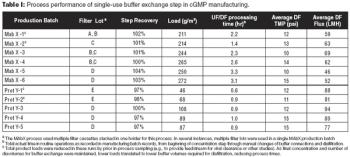
This case study describes the process used to transition from a multi-use system to single-use tangential flow filtration for performing final buffer exchange steps.
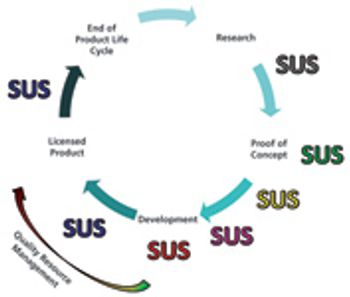
Insights on single-use systems implementation and exploitation in biopharmaceutical manufacturing and processing, based on a QbD approach.
NIBRT's Jayne Telford provides an overview of biopharmaceutical analytics and their accompanying qualification and validation steps.

Patrick Jackson of Vindon Scientific offers key considerations for choosing an outsourced sample storage facility.
New US Pharmacopeial Convention (USP) standards provide a universal approach to organizing labels for prescription containers dispensed by US pharmacists in an effort to improve patient understanding.
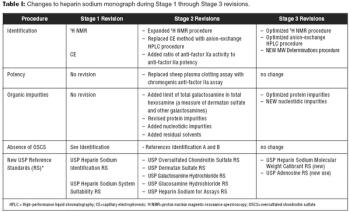
USP optimizes identification tests and impurities procedures.
USP Hosts Symposium on Science and Standards

Using a competency-based approach to effectively train biopharmaceutical industry staff.