
Excipient selection strongly influences lyophilization performance for biologic drugs.
Excipient selection strongly influences lyophilization performance for biologic drugs.

John Ward, vice-president of Engineering at Patheon, discusses the potential for cross contamination in the manufacture of biopharmaceuticals.
Susan Schniepp, distinguished fellow at Regulatory Compliance Associates, discusses the assessment of risk in the processing of intravenous injectable drugs.

Laser-induced fluorescence, a rapid microbiology method for real-time airborne particle and microbial monitoring, enhances sterility assurance in pharmaceutical manufacturing.
Wells Pharmacy Network is voluntarily recalling all of its products due to sterility concerns.
FDA sent a warning letter to an Illinois compounding pharmacy for violations of the Federal Food, Drug, and Cosmetic Act.

Improvements to aseptic manufacturing procedures are long overdue. But how feasible is it for manufacturers to modernize fill lines of legacy products?
Industry experts discuss the challenges of using single-use systems in biopharma manufacturing.
FDA issued a warning letter to the Worthing, UK facility for cross contamination and microbial contamination cGMP violations.
Revised versions of ISO 14644 Parts 1 and 2 introduce changes to sampling procedures and monitoring plans for cleanrooms and clean zones.
The agency cited the company for sterile manufacturing violations.
Material compatibility, material sourcing, facility layout, and training are crucial aspects of a successful disposable fill-finish system.
Two experts discuss best practices to achieve acceptable sterility assurance levels for aseptically filled products.
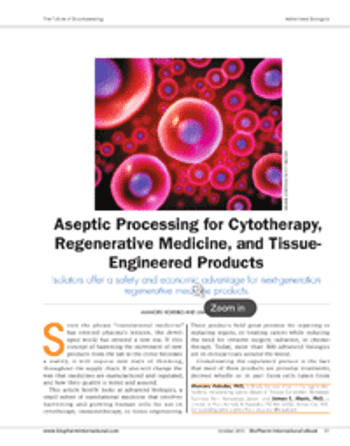
Isolators offer a safety and economic advantage for next-generation regenerative medicine products.
Preventing contamination requires quality systems to be in place, including routine cleaning, a robust cleaning validation program, and preventive maintenance.
FDA announced the recall, citing deficiencies in Medistat’s aseptic processing areas and in its environmental monitoring procedures.

Process maps and risk assessments are among the valuable tools operators can apply to reduce the risk of microbial contamination.
Industry experts discuss challenges, trends, and innovations in fluid handling.
Baxter has initiated a voluntary recall of two lots of IV solutions due to the potential presence of particulate matter.
BioPharm International Multimedia
Bill Hartzel, Director Strategic Execution, Advanced Delivery Technologies at Catalent Pharma Solutions, spoke with BioPharm International about blow-fill-seal for aseptic processes.
NIH provides an interim corrective action plan to correct deficiencies found in its Clinical Center Pharmaceutical Development Section.
Drug quality issues have forced the National Institutes of Health to shutter its in-house facility for producing clinical supplies for certain clinical trials.
FDA cites 17 observations including air handling, quality control, and deficient microbial monitoring at NIH’s Clinical Center Pharmaceutical Development Section.
Removal of microorganisms is crucial when working with biologics. Sterile filtration offers a reliable, safe, and effective way to ensure product integrity.