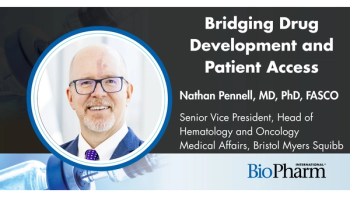
Bristol Myers Squibb's Nathan Pennell explains how the MRD endpoint supports accelerated approval in multiple myeloma without changing how clinicians monitor patients.
AI, biomarkers, and novel oncology modalities are driving evolution in biopharma pipelines, according to Nmblr CEO Janice MacLennan.
*Full transcript available below
In an interview with BioPharm International®,
A central theme MacLennan considers is the need to invest only in assets with clear, sustainable competitive advantage. “Probably the most important thing is any investment in R&D or acquisition has got to be around differentiation that is defendable,” she emphasizes.
This requirement includes first-to-market or best-in-class molecules anchored in biomarker-defined or otherwise selective populations, with outcomes that are clinically and commercially meaningful. To bridge looming patent cliffs, MacLennan observes that mergers and acquisitions will remain critical, as external assets can typically be integrated faster than internally generated innovation.
MacLennan explains that regulators, particularly FDA, are directly influencing how AI will be deployed across development, clinical trials, and manufacturing, with the expectation of materially shorter timelines. In parallel,
MacLennan additionally notes that lifecycle management is moving from a post-launch activity to a decade-long strategic discipline. “We've kind of started thinking about lifecycle,” she stresses. “Once we're in the market, I'm going to say you need a 10-year horizon for your lifecycle management.”
Two therapeutic areas that illustrate these dynamics are cardio-metabolic disease and oncology. In cardio-metabolic disease today, continuous, app-based patient data may create a truly consumer-like market, and in oncology, novel modalities such as bispecifics are delivering unprecedented gains in progression-free and overall survival when used earlier in the treatment paradigm, according to MacLennan.
Editor's note: This transcript is a direct, unedited rendering of the original audio/video content. It may contain errors, informal language, or omissions as spoken in the original recording.
Speaker 1
Probably the most important thing is any investment in R and D or acquisition has got to be around differentiation that is defendable. And by that, I mean you'd be investing in molecules or assets that are first market or best in class, that actually have got a biomarker, selective population that they focusing on. It could be that the outcomes that they are delivering are extremely meaningful, that sort of thing. So it has to be defendable differentiation. The other thing that's going to be really important is managing that, be it revenue, profit, that that gap between things going off patent and where you currently are. So I think mergers and acquisition is going to be extremely important acquiring products to address that gap, because typically internal innovation takes a lot longer than actually buying it in from external so it's all going to be largely externally driven, I would say, compete on evidence. So evidence is a big thing moving moving forward, having a really strong evidence strategy, you know, what's the evidence we're going to produce next week, in a year, in five years time, to really keep the value or perceive value around this particular asset or product is really important. So that's extremely important. Life Cycle Management, again, it's not something so historically, we've kind of started thinking about life cycle. Once we're in the market, I'm going to say you need a 10 year horizon for your life cycle management. You're thinking about formulations, devices, delivery systems, what other drugs you might combine with land extension. There's so much going on in life cycle that that's a key piece of how you'll compete to maintain the value of your asset or molecule.
So I'm going to continue with AI, but in a different, slightly different way. So I think what's really interesting about AI is that regulators like the FDA are actually shaping how AI is going to be used in development, in clinical trials, in manufacturing, so that that's that's key and and how that impacts innovation is it's actually going to shorten times, so it actually makes a lot of things just faster. So that's one area. Another trend that I think is really moving forward is going to be different, is this move away from animal models into other areas which get us closer to, well, I say, get us closer to human, but potentially accelerate the opportunity of the asset to get to first in human faster. So again, that is being driven largely by the FDA, but it is a trend away from animal into other, other sort of models. One big one is is, well, actually two other big ones. One is the whole cardio metabolic space. So what's particularly interesting about that this is probably the first space which is really going to start acting like a consumer driven market, only because diabetes, heart health, blood pressure, all of these can be measured through apps. You can share information with your physician through so this idea of seeing a doctor once every six months or every 12 months for checkup is gone. It's going to be daily. How's my pressure doing? What's happening? You know, it's a very different model actually for the pharmaceutical industry, and our ability to learn from that data and innovate faster is going to be huge. And then the last one is going to be oncology, where we're increasingly using exploring novel modalities. And these novel modalities actually are better at targeting the tumor, they better at fighting resistance to the treatment they are potentially offering, I say broader, if like, they will last for longer. So they actually, I know, even with bispecifics at the moment in cancer, which aren't approved yet, but if they are used in earlier lines, the data that we have seen is significantly different in terms of progression, free survival, overall survival. It's quite remarkable. Nothing that we've seen before, and these are just new modalities, and there are lots of them that are being explored.