
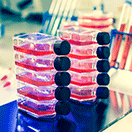

The new resin used a combination of “jetting” technology and a high-performance Protein A ligand.
The new resin used a combination of “jetting” technology and a high-performance Protein A ligand.
The company’s next-generation ultraperformance liquid chromatography platform is designed to meet the evolving laboratory requirements for chromatographic performance.
Minakem’s facility in Belgium enhances capacity to scale production of highly potent ingredients for small to full GMP batches.
The company has completed the first phase of expansion at its headquarters in Freiburg, Germany, in anticipation of increasing demand as cell and gene therapies approach commercialization.
The contract development and manufacturing company has received an additional approval from Health Canada to manufacture monoclonal antibody drug substance at its first plant in Icheon, South Korea.
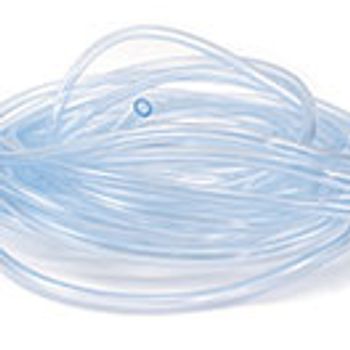
Silicone is one of the polymeric materials that can be used for single-use components and assemblies in biopharmaceutical manufacturing.
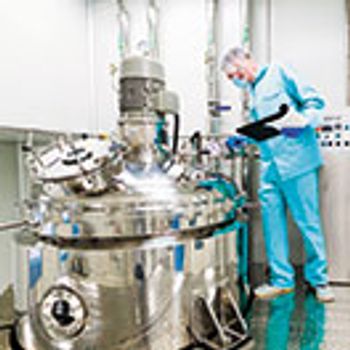
Understanding differences in bioreactor lifecycle, design space, and product platforms is important for selecting a bioreactor type.
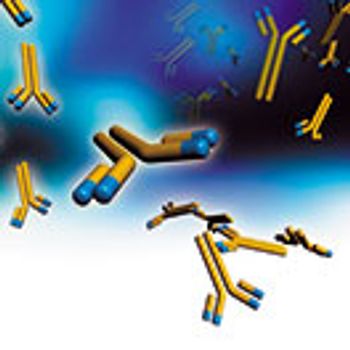
Biosimilars and biobetters have their own unique manufacturing strategies and challenges.
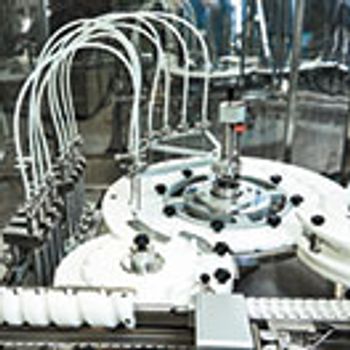
Single-use technologies have become increasingly prevalent in final fill/finish operations for biologics.
WuXi Biologics will invest $60 Million to establish a biologics production facility in Massachusetts.
The company will provide the first FlexFactory manufacturing platform for cell therapy manufacturing.
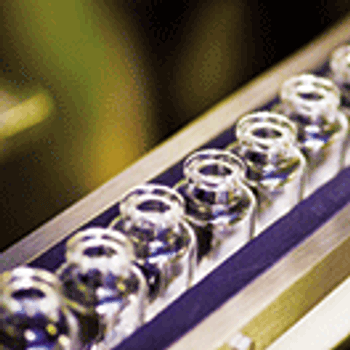
Aseptic fill/finish is crucial in biopharma manufacturing and is optimized through automated technology.
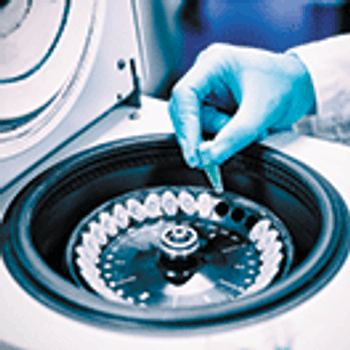
Higher cell titers and cell densities have posed a challenge to cell harvesting, a crucial step in biologics manufacturing.
Rentschler Fill Solutions and Ultragenyx announce fill and finish agreement for the US commercial supply of Mepsevii.
GE Healthcare and the Centre for Commercialization of Regenerative Medicine (CCRM) will support scale-up efforts by DiscGenics for a new cell therapy intended to treat back pain.
The European Commission has approved Zessly (infliximab), a biosimilar to Johnson & Johnson’s blockbuster Remicade (infliximab).
This marks the third FDA approval for the company’s second biomanufacturing plant in Incheon, Korea.
The gene therapy company is expected to invest $55 million in a new manufacturing facility that will produce therapies for rare neurological genetic diseases.
WuXi Biologics will build a biologics manufacturing facility in Singapore that will use both fed-batch and continuous perfusion-based single-use bioreactors.
The new company will develop proprietary RNA-based therapeutics and will provide broad lentiviral development and manufacturing expertise and support.
The company is increasing its cell culture media production capacity at its facilities in Pasching, Austria, and Logan, Utah.
Lonza announces addition of mid-scale biologics manufacturing capacity and cell-therapy suites at Portsmouth, NH site.

More published data and initial regulatory approvals are needed to drive adoption of continuous bio-manufacturing.
Process understanding and careful assessment of risks are essential in developing viral clearance programs.
Thermo Fisher Scientific invests $50 Million to expand biologics drug development and manufacturing capabilities in St. Louis, MO.