
Under the new long-term agreement, Sartorius Stedim Biotech will continue to offer Lonza media and buffer products under non-exclusive terms.
Under the new long-term agreement, Sartorius Stedim Biotech will continue to offer Lonza media and buffer products under non-exclusive terms.
Improving the manufacturing of gene therapy vectors will be crucial to making advanced treatments accessible to more patients who need them, agreed panelists at the 2018 Galien Forum.
Experts believe that the contract development and manufacturing organization market will reach $17.38 billion by 2022, with disruptive business models using Industrial Internet of Things (IIot) and single-use technologies proving more profitable and efficient in the long term.
GE Healthcare will collaborate with Wego Pharmaceutical in China for local production and supply of GE Healthcare’s Fortem single-use consumables.
The new program will provide cell and gene therapy companies a more efficient way to ensure quality compliance across collection center networks and to minimize quality system audit burden on these centers.
The company has rolled out the first batch of TRACON Pharmaceutical’s lead product candidate from its Singapore-based single-use bioreactor.
The expansion adds new capabilities and enhances existing service offerings for both oral and parenteral dosage forms.
New data highlights ability of the SQZ cell therapy platform to preserve cellular functions.

Recent equipment and updated product options offer improvement to a range of biopharmaceutical manufacturing tasks.

This article will explore the requirements for media and supplements needed to maintain newer cell lines, such as those based on human cells and fungal cells.

The second half of this article describes the testing methods used by the authors to demonstrate the applicability of single-use mixing technology for virus inactivation.

Advanced therapy medicinal products pose unique manufacturing challenges that will require appropriate and thoughtful facility design and equipment.
A project funded by BioProNET will investigate optimization for bioprocessing of gene therapy vectors using hydrodynamic fluid flow fields.
A statement from FDA Commissioner Scott Gottlieb and Deputy Commissioner Anna Abram detailed FDA’s new plan to advance plant and animal biotechnology innovation.
The acquisition will allow Lonza to further develop technology for scalable autologous cell-therapy manufacturing.
Bioconjugation requires aseptic manufacturing and containment for cytotoxic payloads.
The company will collaborate with GlycoBac to offer an insect cell line for the development of viral vaccines and gene therapies.
The new facility will include comprehensive mammalian process development and manufacturing capabilities.
The UCL-Pall Biotech Centre of Excellence will address industry challenges and provide workforce training.
The companies will work together to discover, develop, and commercialize immunotherapies for patients with solid-tumor cancers in a collaboration worth $695 million per program.
The companies partnered to build a 500-L single-use pilot-scale plant for biologics production.

The maturation of single-use technologies presents commercial bioprocessing options for small-volume drug products.

This article explores the use of single-use mixing technology in a detergent-based virus inactivation step during a monoclonal antibody production process.
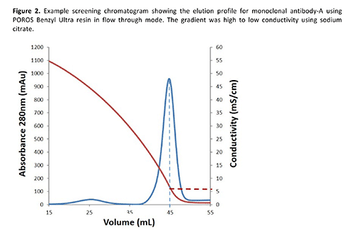
Hydrophobic interaction chromatography (HIC) in flow-through mode offers a more efficient and cost-effective polishing/purification process to remove monoclonal antibody aggregates while maintaining purity at ≥99% than a mixed-mode bind/elute procedure.
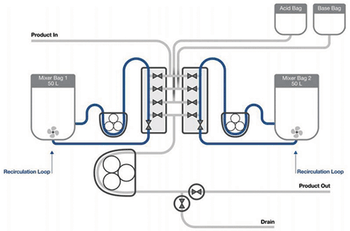
Testing demonstrates an automated semi-continuous process strategy for viral inactivation with steps that mimic batch processing.