





Development
Latest News
Advertisement
Research into Cold Cancers Heating Up
Accurately targeted immunotherapies through reliable neoantigen recognition enable personalized medicine development.
Proprietary Cell-Line Development for High-Titer AAV Manufacturing
Proprietary cell lines offer opportunities for achieving high AAV titers.

Bracing for a Future Wave of Advanced Therapies
In the ATMP space, CGTs are hitting their stride with unprecedented approvals in the past year alone.

Latest Videos


Advertisement
More News

The FDA has accepted Sarepta's supplemental New Drug Applications seeking to convert casimersen (Amondys 45) and golodirsen (Vyondys 53) from accelerated to traditional approval in Duchenne muscular dystrophy, with a PDUFA target action date of February 28, 2027, backed by ESSENCE confirmatory trial data and years of real-world evidence.

The FDA has granted priority review to Genentech's sBLA for Enspryng (satralizumab), an IL-6 receptor-targeting monoclonal antibody, as a potential first at-home subcutaneous treatment for thyroid eye disease, based on Phase III SatraGO data showing significant proptosis reduction, with an FDA decision expected by October 15, 2026.

ADC Therapeutics Completes Enrollment in LOTIS-7, Advancing ZYNLONTA-Glofitamab Combination in DLBCL
ADC Therapeutics has completed enrollment of 100 patients in the Phase 1b LOTIS-7 trial evaluating loncastuximab tesirine-lpyl plus the bispecific antibody glofitamab in relapsed/refractory diffuse large B-cell lymphoma, with full data expected in Q4 2026 following earlier results showing an 89.8% overall response rate.
From his presentation at BIO 2026, Infinimune CEO Dr Wyatt McDonnell makes the case for how human-derived antibodies and human-trained AI models eliminate species translation failure and compress time to IND.

52-abstract package includes first reported real-world at-home subcutaneous administration data and phase 2 combination findings with anti-tau antibody.
Dr Wyatt McDonnell, Infinimune CEO, details how FDA's non-animal model guidances are reshaping non-clinical safety strategies for mAb developers in his talk at BIO 2026.
New York-based biotech enters Nasdaq through JATT II merger, betting IL-13 × IL-18 dual blockade can break the efficacy ceiling in I&I

Lumvoa gains FDA approval for thyroid eye disease, adding an IGF-1R antagonist supported by phase 3 active and chronic TED trials.
Industry experts from Sanofi, GxP Frame, and Open Biopharma outline how AI is transforming drug discovery, manufacturing, and workforce strategy through biopharma partnerships in the latest episode of Drug Digest.
Crystalys Therapeutics CEO Dr James Mackay explains at BIO 2026 that gout remains an underserved therapeutic are and represents a compelling drug development target due to its unmet need and simple biology.
At BIO International Convention 2026, Sabeen Mekan, MD, of Zymeworks discussed how novel payloads, pathway-targeted ADCs, and multispecific antibody technologies are helping shape the next generation of antibody-drug conjugates for cancer treatment.

MilliporeSigma's Sebastian Arana identifies process characterization gaps, tech transfer complexity, and analytical lag as top CGT manufacturing scale-up barriers at BIO 2026.

Speaking from the show floor at BIO 2026, Dr Anil Kane, Thermo Fisher Scientific's global head of technical and scientific affairs, details how AI partnerships are accelerating drug development decisions across the CDMO continuum.
At BIO 2026, Dr Howard Berman, ReAlta Life Sciences’ CEO, explains how an astrovirus-derived anti-inflammatory peptide targets multiple pathways that drive neonatal hypoxic-ischemic encephalopathy (HIE).

AI models can deliver transformative insights into drug manufacturing, but only when fed complete, traceable, and representative datasets.
At BIO International Convention 2026, Sabeen Mekan, MD, Vice President of Clinical Development at Zymeworks and panelist for The Next Generation of ADCs: Building Kinder, Gentler Cancer Therapeutics, discusses why safety is becoming an increasingly important differentiator in antibody-drug conjugate development and how biomarker-driven patient selection may help guide future treatment decisions.
Mediar Therapeutics has dosed the first participants in a Phase 1 trial evaluating MTX-439, a first-in-class monoclonal antibody targeting SMOC2 for fibrosis associated with chronic kidney disease. The study marks the company's third anti-fibrotic program to enter clinical development and highlights growing interest in fibrosis-directed biologics.
China's National Medical Products Administration has approved izalontamab brengitecan (iza-bren) for recurrent or metastatic nasopharyngeal carcinoma, making it the first bispecific antibody-drug conjugate to receive regulatory approval anywhere in the world.

AbbVie has entered a definitive agreement to acquire Apogee Therapeutics for $10.9 billion, adding zumilokibart, a subcutaneous half-life extended IL-13 monoclonal antibody in Phase 3 development for atopic dermatitis, asthma, and eosinophilic esophagitis.
Speaking at BIO 2026, Infinimune's Dr Wyatt McDonnell explains how the company’s human-derived antibody platform enables multi-objective optimization that AI alone and transgenic models cannot replicate.
At BIO International Convention 2026, Dr. Sabeen Mekan of Zymeworks, Inc., discusses how advances in ADC conjugation, payload selection, and antibody engineering could improve tolerability and therapeutic index for cancer patients.

Innovent Biologics has dosed the first patient in TriadicMM-1, a pivotal phase 3 trial evaluating IBI3003, a GPRC5D/BCMA/CD3 trispecific antibody, for relapsed or refractory multiple myeloma — marking the second trispecific antibody globally to reach pivotal phase 3 development in this setting and the first with independent intellectual property rights in China.

Newly launched Bionyra Pharma has raised $165 million in Series A financing and secured exclusive global rights to two TL1A-targeting biologics from China's TrueLab Biopharmaceutical — an anti-TL1A monoclonal antibody and a TL1A×IL-23p19 bispecific antibody — in a deal worth up to $985 million, positioning the company to compete in an IBD drug class already drawing attention from Merck, Roche, and the Sanofi/Teva partnership.

The deal, announced at BIO 2026, carries total potential value exceeding $2.5 billion and will use Insilico's Pharma.AI platform to drive target-to-candidate discovery across neuroinflammatory, neurodegenerative, and rare neurological indications.
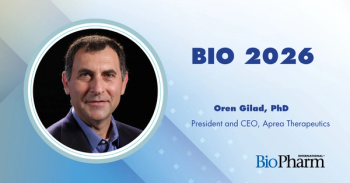
Speaking prior to the start of BIO 2026, Aprea Therapeutics CEO Dr Oren Gilad explains how biomarker-driven oncology strategies are advancing targeted therapies designed to improve efficacy while reducing treatment-related toxicity.
Advertisement
Advertisement
Trending on BioPharm International
1
BioPharm Brief: Gene Therapy Progress, FDA Approval, and $103M Funding
2
Opus Genetics’ OPGx-LCA5 Gene Therapy Shows Sustained Vision Gains Ahead of Phase 3
3
Estuary Biotherapeutics Launches With $103 Million for ADPKD Gene Therapy
4
FDA Approves Roche’s Enspryng as First At-Home Subcutaneous Treatment for Thyroid Eye Disease
5