

IT, payroll, manufacturing, and clinical-trial data management are key areas for growth in biopharm outsourcing efforts.

IT, payroll, manufacturing, and clinical-trial data management are key areas for growth in biopharm outsourcing efforts.

Formal process and operation improvement activities are being employed in almost every biopharmaceutical manufacturing company, according to a recent survey conducted by Tefen Ltd and Millipore Corporation. The industry-wide survey was conducted to assess current biopharmaceutical operations excellence (OpEx) trends and needs, as well as OpEx perceptions and expectations related to industry suppliers.

As a company that performs site selection for biopharmaceutical companies worldwide, Fluor Global Location Strategies has witnessed one country truly distinguishing itself from the competition as a worldwide leader in the industry: the United Kingdom. The global competition for biotech investments has been at a fever pitch over the past few years, with varied results.

...biopharmaceutical companies still face rampant piracy and counterfeiting of patented products.

Daunting but common challenges currently face many biotech, pharmaceutical, and device firms. These companies are encountering a restless public, worried investors, and a skeptical, publicity-hungry Congress that are all concerned about product safety and the reliability of regulators' scrutiny.

Part of the problem with cancer drugs as investment picks is that investors don't trust the underlying studies that seem to prop up vaccine maker stocks.

Historically, the big pharmaceutical companies (Big Pharma) have sought to feed their marketing machines by manufacturing blockbuster drugs—chemical-based, one-type-fits-all products that treat chronic conditions such as heart disease or arthritis. This approach has yielded recurring revenue streams from large patient populations. In contrast, biotechnology companies typically have created protein-based drugs,or biologics, to treat acute or niche conditions and diseases. With few exceptions (such as the biotech giant Amgen), biotech companies have foregone doing the marketing and sales of their drugs themselves, and have, instead, relied on others to perform their marketing and sales functions.

The Interface of America's Antitrust and Intellectual Property Laws

Patents are litigated in the biopharmaceutical industry perhaps more often than any other form of IP

Trademark protection in the US is based on a dual system of federal and state laws.

Biopharmaceutical companies need to consider intellectual property issues early on, even at the start-up stage.

Your research and development team has just shouted "Eureka!" after long and expensive years of research, exclaiming they have developed a next-generation pain reliever. What do you do next? This article explores and suggests your next steps and identifies pertinent questions to ask a patent attorney. The focus is on intellectual property; this article does not address the myriad regulatory issues that must be resolved.

It's summer and the living is easy if you don't mind heat, insects, and thunderstorms. The biopharm indexes are listless, because August and September are notorious for inactivity in the various life sciences stock market indexes. Earnings announcements taper off and life sciences companies keep their gunpowder dry by holding off new announcements until after Labor Day. As of mid-July, the American Biotech Index (Symbol: BTK) has leveled off at the tail end of a year of unbridled growth. If history is any indication, the autumn months will see another rise from the 550 or so levels we're now seeing in the BTK.

The pharmaceutical and biotechnology industries are at a critical point in their evolution. Industry experts at Datamonitor, an independent market analyst firm, say that in 2002 about $30 billion worth of blockbuster drugs lost patent protection. By 2008, an additional $35.5 billion worth of products is expected come off patent. At the same time, a host of scientific innovations in drug discovery including the use of high-throughput screening techniques, new classes of therapeutics such as aptamer technology and RNAi, and genomics-driven discovery methods, have resulted in large numbers of new drug candidates.

Scotland has a ready pool of skilled workers for companies seeking to conduct business in our country.

Successful acquisition of funding from venture capital (VC) partnerships requires a carefully planned, well-executed marketing campaign. You are, after all, selling ownership interests in your company when you seek VC investors. This sale requires an attractive product, nicely packaged, and presented in a way that allows the potential customer to understand and appreciate its value. The attractiveness of your company is the sum of many factors including revenue potential, intellectual property estate, time-to-milestones, existing competition, ease of entry, quality of management, and the perceived interest in your work by "the big guys" in your sector. Every potential venture investor will not perceive your company the same way.

I was playing tennis recently with my friend Ron who, in addition to a wicked backhand, is well-versed in new technologies and gadgets.

As the fourth largest center for biotechnology and life sciences in the US, New Jersey is home to 15 of the world's 20 largest pharmaceutical companies. More than half of all new medicines approved in the US are developed by New Jersey companies. New Jersey is an ideal location because it offers close proximity to the financial markets in New York and Philadelphia, and a highly skilled workforce, strong funding, government support, and academic expertise.

One of the very last sessions on the very last day of BIO 2005 drew quite a crowd. It was titled, "The Five Worst Mistakes You Can Make When Creating a Collaboration or Strategic Alliance."

Our society's penchant for prescription drugs has torn a gaping hole in our collective wallets. According to the US government, overall US health spending has risen to $1.9 trillion in 2005.

As the bustle of Sarbanes-Oxley (SOX) 2004 compliance deadlines for companies winds down, executives have an opportunity to reconsider their company's compliance strategy.

Utilizing a measured approach can increase the probability for identifying search criteria that fulfill a company’s strategy.

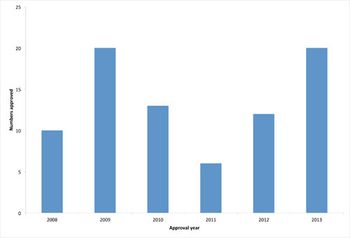
Cancer remains the primary indication (three products), again mirroring recent approval trends.

Your company's job is to make biopharmaceutical products. Managing facilities is a function supporting the main task. General manufacturing companies discovered this long ago, but pharmaceutical producers have been lagging. Once you consider the outsouring of non-core activities like facility management (FM), office services, space planning, and utilities management, you can focus on core business functions that make profits.

Three meetings of the BioPharma Operations Excellence Consortium, facilitated by Tefen Operations Management Consulting, were held recently. The east coast meeting was hosted by Genzyme at its headquarters in Cambridge, MA; the west coast Chapter met at the Genentech campus in South San Francisco, CA; and the European forum held its meeting in Frankfurt, hosted by Aventis.