


The rapid testing of biologic raw materials can lead to greater efficiency.
The rapid testing of biologic raw materials can lead to greater efficiency.
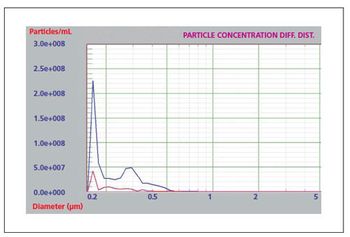
Liquid particle counters are ideal for protein aggregation studies.
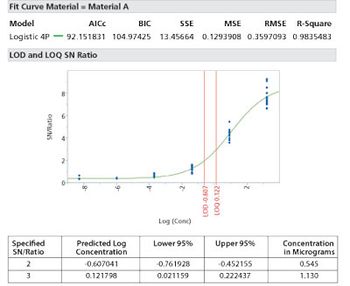
Care needs to be made to match the method of limit determination to the analytical method.
The thorough analysis of a therapeutic protein product’s propensity to aggregate may be a necessary step in the prevention of a cell-mediated immune response.
MedImmune will provide funds and access to monoclonal antibodies to seven postdoctoral associates for the creation of protein measurement and characterization tools.
As ADCs move through the drug-development process, different analytical methods are often required.
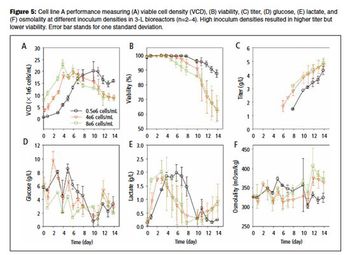
The use of commercially available media to achieve high titer in early process development is discussed.
The author discusses the various ways in which a quality-by-design program can enhance the extractable and leachable assessment of a drug product.
A new study conducted by the National Institutes of Health found that a certain vector used in gene therapy (and its insertion site in the genome) may be associated with an increased risk of liver cancer.
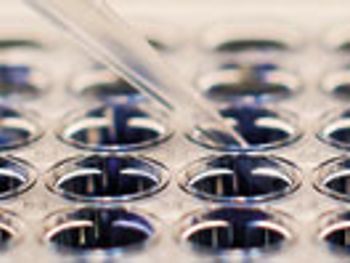
Ligand-binding assays are fundamental to characterizing biosimilars.
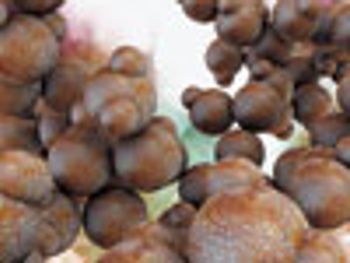
The use of orthogonal methods to SEC is discussed and examples are presented showing how analytical ultracentrifugation, AF4, and SEC compare in aggregate quantitation.
A Q&A on bioanalytical method integrity with Roger Hayes of MPI Research.
Methods must be suitable at each development phase, robust, and effective on multiple platforms.
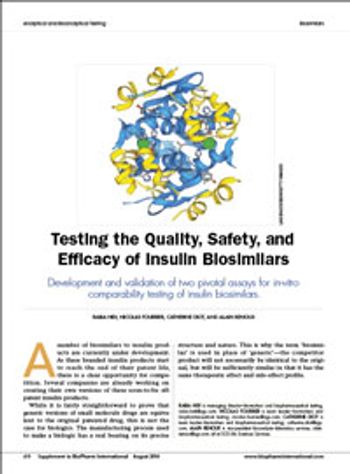
Development and validation of two pivotal assays for in-vitro comparability testing of insulin biosimilars.
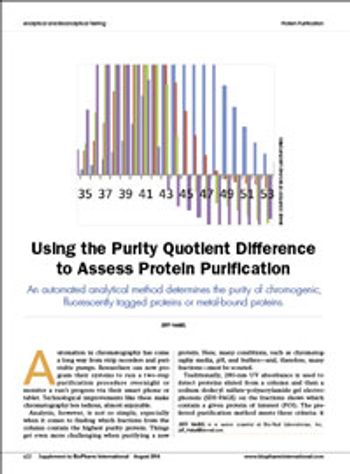
An automated analytical method determines the purity of chromogenic, fluorescently tagged proteins or metal-bound proteins.
Industry players form Allotrope Foundation to solve analytical data management problems.
Rita Peters, Editorial Director for Pharmaceutical Technology and BioPharm Inernational talks with Ferdinand Dabu, director of marketing at SGS live at Interphex 2013 about extractables and leachables. In this interview they discuss special considerations for testing for extractables and leachables for both small molecule and biological drug development.
Rita Peters, Editorial Director for Pharmaceutical Technology and BioPharm Inernational talks with Ferdinand Dabu, director of marketing at SGS live at Interphex 2013 about extractables and leachables. In this interview they discuss the key elements of an effective testing program to identify extractables from materials and leachables in drug products.
Rita Peters, Editorial Director for Pharmaceutical Technology and BioPharm Inernational talks with Ferdinand Dabu, director of marketing at SGS live at Interphex 2013 about extractables and leachables. In this interview they discuss new analytical testing procedures and instruments that are facilitating the testing processes or improving results.
Editorial Director Rita Peters talks to with Ferdinand Dabu Director of Marketing at SGS live at Interphex
The author describes a method to avoid protein aggregation when using light scattering systems.
As biopharmaceutical/pharmaceutical companies increase their development of biologic-based drugs, companies providing analytical instrumentation and laboratory testing goods and services are, in turn, offering improved tools for biologic characterization, biomanufacturing, and related testing.
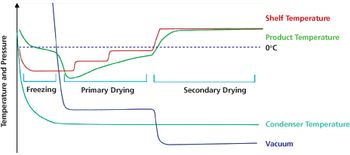
Optimized freeze-drying cycles can offer scientific and business advantages.
BioPharm International spoke with industry experts about the effect FDA's 2011 process validation guidance has had on industry.
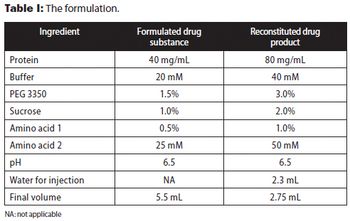
The authors present approaches used to reduce reconstitution time of a lyophilized high-concentration protein drug product.