


In addition to making technical developments, vendors are also looking at ways to improve supply-chain security. By offering standard, off-the-shelf products, vendors are able to shorten lead times and improve the security of supply.
In addition to making technical developments, vendors are also looking at ways to improve supply-chain security. By offering standard, off-the-shelf products, vendors are able to shorten lead times and improve the security of supply.

Bayer Schering Pharma AG, (Berlin, Germany) has completed the acquisition of a biologics manufacturing facility in Emeryville, CA, from Novartis.
Discovery Laboratories (Warrington, PA) could see the end of its struggle to launch its Surfaxin (lucinactant) drug on the US market soon, as the manufacturing issues it has faced have been resolved.
PAREXEL Consulting (Boston, MA) has hired three senior GMP consultants based in Europe with the hope of helping its clients address complexities of European Union directives in areas such as manufacturing regulations, quality, and safety.
SAFC (St. Louis, MO), a member of the Sigma-Aldrich Group, has announced a $29-million investment to significantly expand its drug substance capabilities in high-potency biologics at the Sigma-Aldrich facility in Jerusalem, Israel
Bristol-Myers Squibb (Princeton, NJ) will acquire privately held Adnexus Therapeutics (Waltham, MA), the developer of a new therapeutic class of biologics called Adnectins.

Favrille, a San Diego-based biopharmaceutical company, is one of a handful of firms on the forefront of personalized medicine. Because personalized treatment is tailored to an individual's biology, it has the potential to be far more effective than current approaches to disease management.

From the earliest days of the biotechnology industry, companies have grappled with the complexities of making innovative biopharmaceuticals on a large scale. Success in manufacturing begins with process science, since biotech production requires perfection in maintaining living organisms in a sterile environment under controlled physiological conditions. But unless companies can solve the challenge of planning for and managing manufacturing capacity, they will not be able to achieve the full potential of promising biotech products.

The mounting threats of pandemic influenza, bioterrorism, and emerging infectious diseases continue to be the focus of research programs and funding initiatives, not only within governmental agencies, but also universities, private research firms, and commercial manufacturing entities. With all of these efforts, however, the question of manufacturing capacity and the ability to respond to pandemic and emerging threats continues to be a major concern.
Roche (Basel, Switzerland, www.roche.com) has opened its new biotechnology production center in Basel.
The FDA issued MedImmune, Inc. (Gaithersburg, MD, www.medimmune.com), a warning letter for violating the agency's manufacturing rules and held off approving the company's influenza vaccine for use in children younger than age five until the problems are resolved.
Intas Biopharmaceuticals Limited (IBPL, Gujarat, India, www.intasbiopharma.co.in) has become India's first dedicated biopharmaceutical company to receive certification from the European Agency for the Evaluation of Medicinal Products (EMEA, London, UK, www.emea.europa.eu) or an EU-GMP certification for its manufacturing facility at Ahmedabad, Gujarat.

Discrete simulation allows the design teams to see every meaningful detail about equipment and materials flowing through the process.
Eden Biodesign (Liverpool, UK, www.edenbiodesign.com), SAFC (St. Louis, MO, www.sigmaaldrich.com/SAFC/Pharma), Midatech Group (Oxfordshire, OX, www.midatechgroup.com), Cellexus Systems (Cambridgeshire, UK, www.cellexusbiosystems.com), and BioConvergence LLC (Bloomington, IN, www.bioc.us) are sprucing up their product development and services with the construction of new manufacturing facilities.
Abbott (Abbott Park, IL, www.abbott.com) recently announced the official opening of its new biologics manufacturing facility in Puerto Rico to support the long-term supply of its leading biologic agent, HUMIRA (adalimumab), and other future biologics.
Singapore's efforts to grow its biologics manufacturing sector received a significant boost on March 28, 2007, when the Singapore Economic Development Board (EDB) announced that Genentech, Inc. (San Francisco, CA, www.gene.com) has decided to establish a commercial-scale microbial-based biologics manufacturing facility in Singapore.
Steam traps are part of a steam-in-place system. The current design allots 18 in. of vertical leg for condensate backup. A design with a sensitive bellows has been proven in laboratory tests to need only 6 in. of vertical leg during the 15 min. of 121?C sterilization. Loads of 1 to 27 lb/h are covered by the capability of the new trap, equivalent to required steam for vessels 20 to 40,000 L.

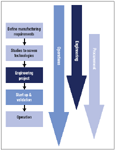
Understand your company's requirements, define responsibilities,and manage your team effectively.
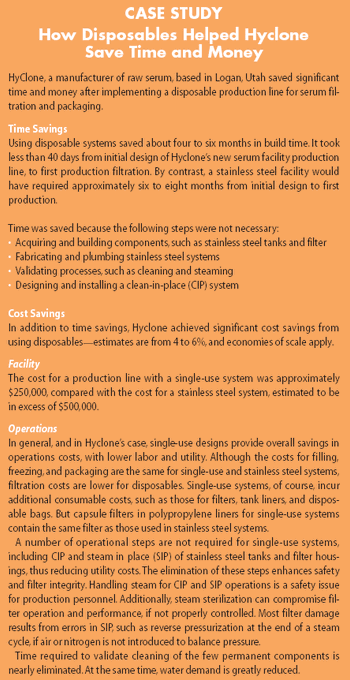
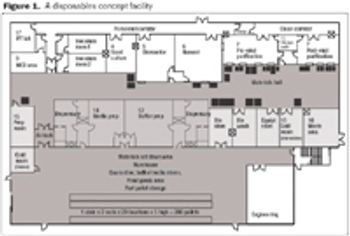
Disposables require less space than conventional equipment, and they can be assembled offsite into complete process trains.

Disposables can be used for media preparation, clarification, filling in downstream processes . . .

Once guiding principles are identified, designers can explore the most cost-effective methods for delivering a flexible, expandable site.

Operating costs are the white-hot issue in the boardrooms of our life sciences clients and they tend to rule the site selection process. A soft economy, worldwide trade competition, drug cost containment pressures from the US government, and a lean and mean message sent by the venture capital community mean that quantitative factors that focus on the cost of doing business are trumping qualitative lifestyle factors, especially when evaluating sites for a new biopharmaceutical facility.

A well-understood, validated, and correctly maintained BAS reduces the chance of a critical room parameter slipping out of specification.

As a company that performs site selection for biopharmaceutical companies worldwide, Fluor Global Location Strategies has witnessed one country truly distinguishing itself from the competition as a worldwide leader in the industry: the United Kingdom. The global competition for biotech investments has been at a fever pitch over the past few years, with varied results.