
Personalized medicine and direct-to-patient trial models have made the difficult even more challenging.
Personalized medicine and direct-to-patient trial models have made the difficult even more challenging.

Olon began construction of a GMP facility for biologic APIs in Capua, Italy.
The new cleanroom, designed and built by WHP, is part of ADC Bio’s new bioconjugation facility in the UK.
The Applications Center of Excellence in Durham, NC, will offer development studies for JSR Life Sciences customers.
Lonza Pharma & Biotech announced a binding contractual commitment for the purchase of a sterile drug product fill and finish facility.
The commercialization of cell and gene therapies has become a reality, prompting deeper considerations of logistics, technology, and design for manufacturing facilities.
The company has expanded its high-potency API capability at its Riverview, MI, facility to serve the growing antibody drug conjugates market.
The companies have signed a strategic multi-year manufacturing agreement for the future commercial production a late-phase investigational cell therapy.
The authors present a risk analysis of the impact of various business and operating risks on three facility layout strategies.
A new facility to be built in the Philadelphia Navy Yard will support commercial production for autologous tumor-infiltrating lymphocyte cell therapy products from Iovance Biotherapeutics.
The expansion will increase the company’s single-use capacity to meet growing demand.
The company announced plans to construct a 1.3 million-ft2 integrated manufacturing center in Chengdu, China.
The acquisition of GlaxoSmithKline’s manufacturing site in Cork, Ireland, will expand Thermo Fisher Scientific’s global footprint for complex API manufacturing.
The new 40,000-ft2 facility will support Bayer's growing biologics portfolio in oncology, cardiology, and additional therapeutic areas.
A solar panel installation at Novo Nordisk’s North Carolina facility was initiated in March 2019 as part of the company’s commitment to zero environmental impact globally.
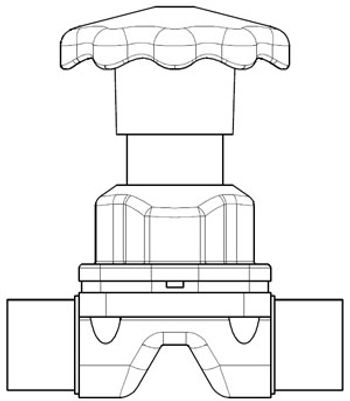
Valve design and materials affect performance and cost to maintain.
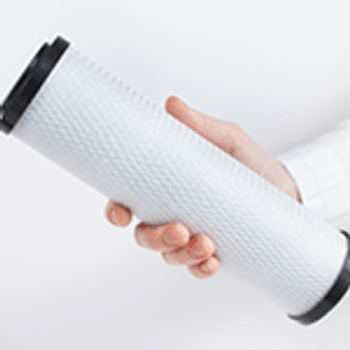
Single-use technology is gaining ground in downstream bioprocessing, but challenges stall further adoption.
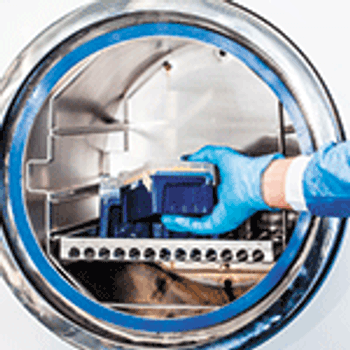
This article takes a look at current practices for cleaning and sterilizing biomanufacturing equipment used in a multi-product versus single-product setting.
The Quartic Platform is a new, AI-powered smart manufacturing platform that can be integrated into legacy facilities and manufacturing processes.
Pharmaceutical Technology and BioPharm International will present a Keynote Session on Meeting Bioprocessing Manufacturing Capacity Demands on Wednesday, April 3, 2019, during INTERPHEX 2019 at the Javits Center in New York City.
In a keynote session at INTERPHEX 2019, experts will review and debate the issues and present potential solutions for contamination issues in aseptic manufacturing.
3D printing offers a new design freedom for bio/pharmaceutical manufacturing: whether for “printing” a solid-dosage drug or for creating a piece of equipment for bio/pharmaceutical laboratories or manufacturing facilities.

Getting the science right helps biopharma startups overcome development and commercialization challenges.
A look at the skill sets and training needed to tackle the increasing levels of automation in bioprocessing facilities.
The acquisition of the site in Copenhagen, Denmark, will significantly expand Fujifilm’s capacity and capabilities.