



Amgen discussed the drug-delivery approaches to two of its biologics in a recent second-quarter earnings call.
Amgen discussed the drug-delivery approaches to two of its biologics in a recent second-quarter earnings call.
A new study examines the oral delivery of protein drugs in plant cells and hypothesizes that the cold storage and transportation of biologics could someday be eliminated.

The authors present an overview of the types of RNA-based therapeutics in existence and their optimal methods of manufacture, purification, formulation, and delivery.
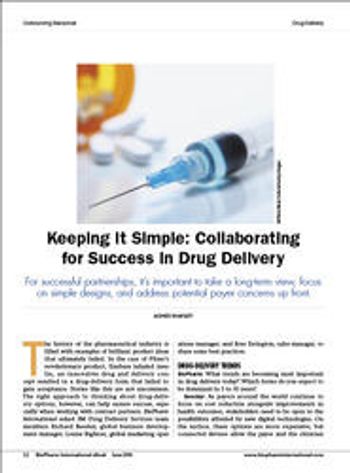
For successful drug delivery partnerships, it’s important to take a long-term view, focus on simple designs, and address potential payer concerns up front.
The wearable devices for the delivery of biologic products are now being manufactured and will be tested in clinical trials in the near future, according to the company.
The collaboration will provide GMP manufacturing ahead of future clinical studies.
A new study in Nature Communications explores how to remove the bulk of the soaps that are added to injectables to make hydrophobic drugs more soluble.
The company’s method reduces the time required to crystallize antibodies from weeks to one day.
MilliporeSigma expands its Carlsbad, California-based GMP capacity for viral and gene-therapy products by nearly 90%.

The FlexPro 50, from Groninger, is a modular filling and closing system designed to process vials, cartridges, and syringes, as well as vials in bulk and trays.
Cornell researchers reveal that an existing FDA-approved drug can facilitate the delivery of other large molecules across the blood-brain barrier.
Selecting a delivery method early on may be beneficial.
The researchers examine the top 20 cancer drugs dosed by body size in the US, and estimate that drug companies will earn $1.8 billion in 2016 in revenue from leftover cancer drugs.
A reformulated version of Rose Bengal, PV-10, may be used to treat melanoma when injected directly into tumors.
ViaCyte and Janssen Biotech have entered Phase I/Phase II clinical trials for VC-01, a candidate treatment for the treatment of type 1 diabetes.
Researchers from Oregon State University develop a new three-drug delivery system for cancer treatment.
Assembly Biosciences reported a successful clinical study validating the use of the Gemicel technology platform for the oral delivery of biologic medications.
The company plans to reformulate injectable products to make them into inhaled and intranasal medications.
Baxter expands capacity for lyophilized cytotoxic oncology therapies at its fill/finish facility in Halle, Germany.
Baxter expands capacity for lyophilized cytotoxic oncology therapies at its fill/finish facility in Halle, Germany.
A new consortium involving Arecor, FUJIFILM Diosynth Biotechnologies and the Center for Process Innovation will focus on formulation innovation as a way to improve downstream processing and reduce biopharmaceutical cost.
The company presented a portfolio of new products during the meeting in Madrid.
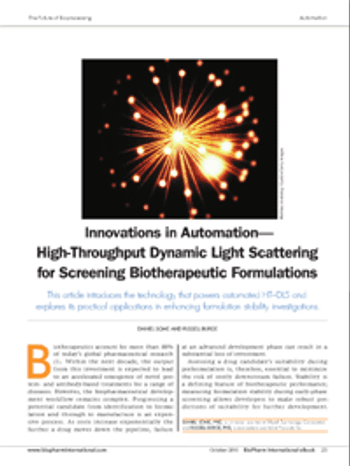
This article introduces the technology that powers automated HT–DLS and explores its practical applications in enhancing formulation stability investigations.
Although the Committee for Medicinal Products for Human Use (CHMP) gave Blincyto a positive opinion, full approval of the drug in the EMA will rely on additional clinical studies.
Under terms of the agreement, Amgen will license Xencor’s XmAb technology platform for five Amgen programs and one Xencor program.