|Articles|October 2, 2015
- BioPharm International-10-15-2015
- Volume 2015 eBook
- Issue 2
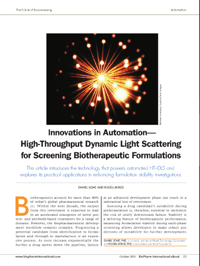
Innovations in Automation—High-Throughput Dynamic Light Scattering for Screening Biotherapeutic Formulations
Author(s)Daniel Some, Russell Burge
This article introduces the technology that powers automated HT–DLS and explores its practical applications in enhancing formulation stability investigations.
Advertisement
BioPharm International
eBooks Volume 28, Issue 14
Assessing a drug candidate’s suitability during preformulation is essential to minimize the risk of costly downstream failure. Stability is a defining feature of biotherapeutic performance; measuring formulation stability during early-phase screening allows developers to make robust predictions of suitability for further development. Read this article and other articles in
BioPharm International
's 2015
eBook.
Articles in this issue
about 11 years ago
Fluctuating Capacity and Demand Conditions in Biomanufacturingabout 11 years ago
Cleaning Validation for Biologicsabout 11 years ago
Automation of Single-Use Systemsabout 11 years ago
Are Biopharma Patents Poised on the Post-Grant Chopping Block?about 11 years ago
Raising the Bar for Biopharma TrainingAdvertisement
Related to this article

More monoclonal antibodies are moving from IV infusion to subcutaneous injection, but dose, volume, and viscosity still limit the switch. This FAQ covers the formulation science, the enabling technologies, what regulators require, and what remains unresolved.

As access to low Earth orbit expands, space-based research is opening possibilities in drug discovery, formulation, and manufacturing. In Part 1, the authors look at how microgravity changes biology and chemistry in ways that can’t be reproduced on Earth and where it fits from target discovery to life cycle management.

Detalimogene voraplasmid produced a 56% complete response rate in BCG-unresponsive bladder cancer, with an estimated 43% of responses lasting a year.

FDA has cleared Biolojic Design’s IND for BD200, a bispecific antibody-drug conjugate targeting Trop2 and Nectin-4 whose arms can each bind either target. A global Phase 1 study in solid tumors is expected to begin in the coming weeks.

Blackstone Life Sciences will fund up to $1.5 billion of development costs through 2028 for Pfizer’s monthly GLP-1 receptor agonist berobenatide, in exchange for milestone payments tied to approval and sales. Pfizer keeps full control of the program.

Gene-corrected nula-cel freed all 3 RESTORE patients from transfusions, with sickle hemoglobin below 20% in the 2 followed for over 6 months.

Matt Truppo, Richard Jaenisch, and Brian Drapeau examine AI's impact on drug success, human oversight, data governance, and biopharma's future.
Advertisement
Advertisement
Trending on BioPharm International
1
ImvivaBio’s Dual-Target Allogeneic CAR-T Sustains Lupus Remission Through 12 Months
2
Updates on Simtra BioPharma Solutions’ Bloomington Capacity Expansions
3
Blackstone to Provide Pfizer Up to $1.5 Billion for Monthly GLP-1 Berobenatide Development
4
Amgen’s Dazodalibep Reduces Systemic Disease Activity in Phase 3 Sjögren’s Trial
5