



The company’s new electron microscopy and microanalysis solutions offer scientists enhanced research capabilities.
The company’s new electron microscopy and microanalysis solutions offer scientists enhanced research capabilities.
Bristol-Myers Squibb appointed a new executive vice-president and chief commercial officer from within the company, effective immediately.
The company is certified as a manufacturer of pressure vessels and components for use in China.
The European Commission (EC) has approved Novartis’ chimeric antigen receptor T cell (CAR-T) cell therapy Kymriah for the treatment of B-cell acute lymphoblastic leukemia and relapsed or refractory diffuse large B-cell lymphoma after two or more lines of systemic therapy.
An expansion of laboratory facilities in Geneva, Switzerland expands SGS services for high-order structure analysis.
Preliminary survey results rank the United States, Germany, and Japan as tier-one nations for bioprocessing performance and potential.
The Coalition for Epidemic Preparedness Innovations (CEPI) and vaccine manufacturer IDT Biologika will collaborate to develop and manufacture a vaccine against Middle East Respiratory Syndrome Coronavirus (MERS-CoV).
The Senate approved a $159-million budget increase for FDA, to bring its resources up to $5.4 billion for 2019, including more than $2 billion in user fees.
The new Testa Center in Uppsala, Sweden is a collaborative test bed offering biotechnology equipment from GE Healthcare for process development.
Dompé Farmaceutici’s Oxervate (cenegermin), a topical eye drop, is the first treatment approved by the agency for neurotrophic keratitis, a rare disease affecting the cornea.
FDA sent a warning letter to Kyowa Hakko Bio Co., Ltd. after inspectors found data integrity problems at the company’s Yamaguchi, Japan facility.
Guidances for regulatory changes, batch testing, and reporting address situations resulting from “no-deal” Brexit scenario.
As a contingency against border delays resulting from a “no-deal” Brexit, the Department of Health and Social Care (DHSC) directs pharma companies to stock extra medicines.
Experts from the Partnership for Research on Ebola VACcination report on progress and uncertainties regarding a safe and effective Ebola vaccine.
The National Institute of Allergy and Infectious Diseases began a first-in-human trial of an experimental live, attenuated Zika virus vaccine.
FDA approved the first generic version of EpiPen and EpiPen Jr (epinephrine) auto-injector.
The acquisition will strengthen Astellas Pharma’s position in ophthalmology.
The acquisition is expected to support Emergent BioSolutions’ focus on public health threats and emerging infectious disease.
FDA grants support US research in continuous manufacturing monitoring and control techniques for bio/pharmaceutical manufacturing at Rutgers, MIT, and Georgia Tech.
FDA sent a warning letter to Apotex Research Private Limited after investigators found current good manufacturing practice violations.
The companies entered a multi-year R&D collaboration to develop mRNA-based flu vaccines.
FDA published a resource guide to promote responsible opioid prescribing in the treatment of animals.
Pharmaceutical scientist association announces upcoming term’s board of directors.
Drug product approval from FDA follows previous approvals from European and Japanese authorities.
The new drug, Onpattro (patisiran), by Alnylam Pharmaceuticals, is in a new class of drugs called small interfering ribonucleic acid (siRNA) treatment.
The agency issued a warning letter to Canadian API manufacturer, Les Produits Chimiques B.G.R, citing cGMP violations at its API facility in Pointe-Claire, Quebec.
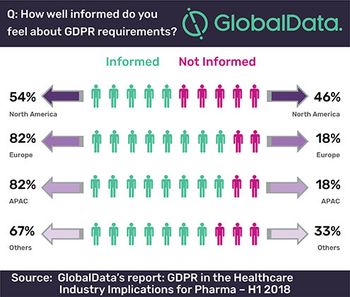
Only 54% of North Americans feel informed about the requirements of the general data protection regulation (GDPR), according to a report by GlobalData.
The Alliance for Regenerative Medicine’s (ARM) report highlights major trends and metrics from the 2018 second quarter in the regenerative medicines sector.
Ebola vaccinations by the World Health Organization began in North Kivu, Democratic Republic of the Congo, one week after the country’s latest outbreak.
The combined companies will provide research- and clinical-grade human immune cells, blood products, and related services.