



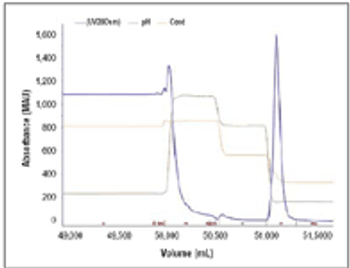
Results from a process developed for a commercial antibody.
Results from a process developed for a commercial antibody.
FDA perspectives on specs and effective control strategies.
Understanding the impact on process performance.

In the context of process validation, the confirmation of a belief must be checked repeatedly, throughout the product lifecycle.
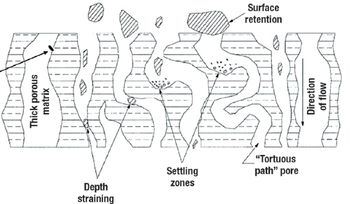
A comparison of primary harvest techniques.
The book is a useful, comprehensive, and truly an excellent reference source of biopharmaceutical information.
Manufacturing challenges surround the use of IgM monoclonal antibodies, but these can be overcome with current technology.
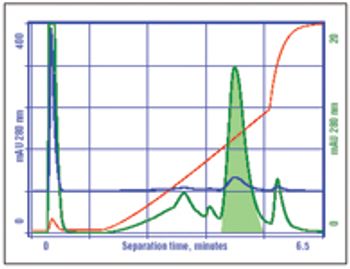
An alternative approach to traditional Protein A schemes is comparable in overall efficiency, product recovery, and quality.
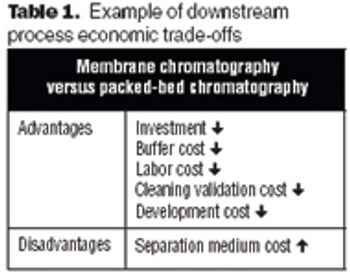
The future of therapeutic MAbs lies in the development of economically feasible downstream processes.
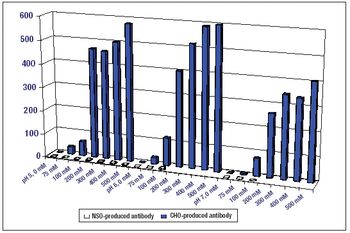
If certain engineering challenges can be addressed, precipitation may prove to be a valuable tool for antibody purification.
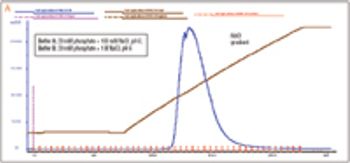
When platform processes are applied to fusion molecules, innovation and flexibility are needed.

Crucell N.V. (Leiden, the Netherlands) has discovered a set of human monoclonal antibodies (MAbs) that work to neutralize and protect against H5N1.
The US Patent & Trademark Office has issued the fifth US patent to MorphoSys AG (Munich, Germany) stemming from MorphoSys’s base HuCAL (human combinatorial antibody library) patent family, providing extended protection to MorphoSys’s core technology.

Regulatory agencies have evolved along with the biotechnology industry to define quality standards.
In one series of experiments, the glycosylation site of IgG1 was removed and an IgA glycosylation site was introduced-resulting in a total loss of biological function.


This flexible setup minimizes the number of purification process steps, buffers, and process components.
To shorten time to market for new therapeutic proteins, new and fast methods, such as high throughput screening, are needed to speed up downstream processing. The platform technology discussed in this article includes a structural approach that can be used as a general procedure to purify therapeutic proteins. The approach starts with ligand screening and selection-on-a-chip, with the Surface Enhanced Laser Desorption Ionization–Time of Flight (SELDI–TOF) mass spectrometer system. Next, resin screening and supplier selection are performed using robotics, followed by scouting studies under dynamic conditions to select the best resin. Finally, optimization studies of critical parameters are carried out with statistical design approaches (design of experiments). A few examples are presented to explain the platform approach for purification development in more detail.
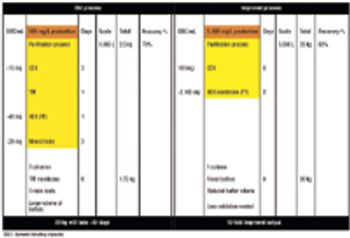
Affinity purification schemes for antibody production have certain limitations keeping up with cell culture expression levels as they reach and exceed 10 g/L. New downstream purification processes are based on low cost, long lasting, and high binding (40–100 mg/mL) cation exchange resins.

The HSV-1 and HVP-2 titers were determined by the inoculation of test solutions into Vero cell cultures and calculated using the Reed M?ench method.
Downstream process design can increase facility output through improved overall process yield or higher batch capacity in mass and volume.

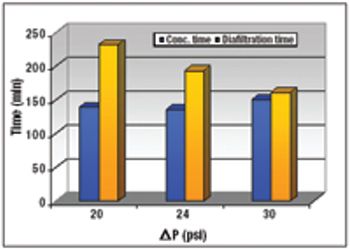
In the pharmaceutical industry, ultrafiltration (UF) membranes are used extensively in the downstream purification of recombinant proteins or monoclonal antibodies. However, the fouling of membranes after a unit operation?especially when recombinant proteins or monoclonal antibodies are highly concentrated?is a common problem. Typically, normalized water permeability (NWP) of a membrane can be reduced to about 20 percent of its original permeability at the end of an ultrafiltration-diafiltration (UF-DF) operation.

Development guidelines for MAbs serve as a blueprint for their manufacture, safety, and efficacy testing.

In a mere 30 years of development, a total of 23 MAbs and MAb-related proteins have been approved for medical treatments.