
“The best dissolution but not the best commercial formulation is no good.” – Ramesh Muttavarapu, MS, MBA, global subject matter expert, Thermo Fisher Scientific
News|Articles|October 27, 2026
Thermo Fisher Pairs In Silico Modeling With an Expanded ASD Toolbox at AAPS PharmSci 360
Author(s)Emily Schoenthaler
At AAPS PharmSci 360, Thermo Fisher Scientific scientists described how predictive modeling guides technology selection for poorly soluble drugs, and outlined plans to bring solvent-free KinetiSol technology to commercial scale in 2027.
Advertisement
At
For more on the meeting, see the BioPharm International®
Why is solubility still a bottleneck?
West estimated that about 90% of small molecules have a solubility challenge, at a time when development teams face shorter timelines and pressure to use less API.¹ Among technologies used in commercial approvals, he said,
Solubility problems can surface as poor exposure in phase 2, and phase 3 tests whether the manufacturing process can scale, he said. “When we’re selecting a formulation early on, the three things you really need to focus on are improving solubility, ensuring we can make it manufacturable, and also ensuring that the formulation is stable,” West said.¹
How does in silico modeling guide technology selection?
Thermo Fisher’s Quadrant 2 platform uses API properties, such as melting point, glass transition temperature, log P, and molecular weight, along with dose, to rank technologies in three tiers: likely to work, worth evaluating in the lab, or unlikely to succeed.¹ Lab results are fed back into the model. According to Thermo Fisher, the platform has been applied to more than 400 molecules.³
In one case study, Quadrant 2 placed a compound in Developability Classification System class IIb, meaning its absorption was solubility limited. Molecular dynamics simulations then identified four lead polymers and a maximum drug loading.¹ The team spray dried about 5 g of each formulation at low and high drug loadings and screened them for dissolution, physical and chemical stability over 4 weeks of accelerated conditions, and manufacturability. A 20% drug load with hydroxypropyl methylcellulose acetate succinate (HPMCAS) was selected, and the program reached the clinic in about 7 to 8 months.¹
“There’s not always one clear winner, and you really need to understand the risks associated with each,” West said.¹
A second case study addressed a roughly tenfold scale-up in batch size. A design of experiments on a pilot-scale spray dryer varied outlet temperature, relative saturation, and feed pressure. Dissolution performance was consistent across conditions, and all dispersions remained amorphous, West said.¹
What role do lipids and HME play?
Muttavarapu outlined
Where does KinetiSol fit?
In June 2026, AustinPx announced that it would install KinetiSol equipment at Thermo Fisher’s sites in Bend, Oregon, and Cincinnati, Ohio, making Thermo Fisher the exclusive third-party contract development and manufacturing organization offering the KinetiSol Formulator.² In September, FDA’s Center for Drug Evaluation and Research granted the technology Advanced Manufacturing Technology designation.⁴
KinetiSol relies on shear generated within the system rather than solvents or external heat, and processing takes about 10 to 20 seconds, Muttavarapu said.¹ He described it as a fit for APIs that have poor organic solvent solubility and high melting points, or that degrade during HME. The lab-scale Formulator is already installed at Bend, and a late-stage Compounder is planned for Cincinnati in the first quarter of 2027, or the second quarter at the latest.¹ He also cited a published study in which KinetiSol dispersions of abiraterone, a drug with a high melting point and poor organic solvent solubility, increased bioavailability up to 13.8-fold compared with a generic abiraterone acetate tablet.¹,⁵
What did the audience ask?
Asked whether log P can guide technology selection, West said high-log P compounds often suit lipid formulations but tend to require lower drug loading in dispersions, typically around 25%.¹
References
- Muttavarapu R, West A. Expanding the formulation toolbox: scalable solutions for solubility & bioavailability enhancement. Partner presentation at: AAPS PharmSci 360; October 2026; New Orleans, LA.
- AustinPx.
AustinPx expands KinetiSol technology commercial access through Thermo Fisher Scientific collaboration . Press release. Published June 30, 2026. Accessed October 27, 2026. - Thermo Fisher Scientific.
AI-driven drug development for poor solubility and bioavailability . Accessed October 27, 2026. - AustinPx.
AustinPx’s KinetiSol technology receives FDA Advanced Manufacturing Technology designation . Press release. Published September 15, 2026. Accessed October 27, 2026. - Gala U, Miller D, Williams RO.
Improved dissolution and pharmacokinetics of abiraterone through KinetiSol enabled amorphous solid dispersions . Pharmaceutics. 2020;12(4):357. doi:10.3390/pharmaceutics12040357. Published April 14, 2020. Accessed October 27, 2026.
Advertisement
Related to this article
Speaking at AAPS PharmSci 360, Dr Stephanie Johnson, a principal formulation scientist at Pfizer, details how platform formulations save time before commitment, shift risk downstream, and what AI tools need to earn trust.
Dr Karunakar Sukuru of Catalent explains how lipid-based softgels address physiological barriers to oral peptide delivery as approvals increase.

Anurag Rathore, PhD, professor of chemical engineering at IIT Delhi, explains how his team is making antibody manufacturing more efficient and replacing costly raw materials to cut monoclonal antibody costs to about $10 per gram.
Insilica's Dr Thomas Luechtefeld argues process traceability, not benchmark accuracy alone, determines whether AI toxicology decisions can be trusted.
Zylidac will test whether optogenetic cell lines that hit 21 g/L in small-scale CHO runs can deliver higher-yield complex biologics at GMP scale.
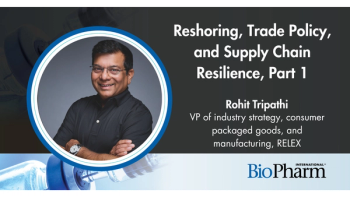
Rohit Tripathi, vice president of industry strategy, consumer packaged goods, and manufacturing at RELEX Solutions, explains what is driving biopharma reshoring, how USMCA uncertainty complicates sourcing for biologics, and where cold-chain visibility still breaks down.

METiS TechBio will apply its AI-driven AiLNP ionizable lipid platform to discover LNPs designed to deliver therapeutics beyond the liver, under a collaboration with Eli Lilly worth up to $1.1 billion in milestones.

Phase 1b data at ESMO 2026 show the TCR-based T-cell engager produced durable responses in PRAME-high melanoma, with 91% of patients alive at one year in the recommended dose range.
Advertisement
Advertisement
Trending on BioPharm International
1
Merck and Kelun’s Sac-TMT Extends Survival by Nearly 7 Months in Pretreated Endometrial Cancer
2
BMS Reports Death in Phase 1 Zolacabtagene Autoleucel MS Study
3
The BioPharm Brief: Survival Gains, a Modest ADC Win, and CAR-T in Multiple Sclerosis
4
BioNTech’s HER2 ADC Hits Phase 3 Goal, but Companies See Limited Benefit
5