

“By combining two clinically validated mechanisms in a single, half-life-extended bispecific, ZL-1503 has the potential to control inflammation, deliver rapid and durable itch relief, and enable less frequent dosing.” Rafael G. Amado, MD, president and head of global research and development, Zai Lab
News|Articles|November 13, 2026
Zai Lab’s Long-Acting Atopic Dermatitis Bispecific Points to Every-12-Week Dosin
Author(s)Emily Schoenthaler
Listen
0:00 / 0:00
Key Takeaways
- ZL-1503 simultaneously blocks IL-13–driven type 2 inflammation/tissue remodeling and IL-31Rα–mediated itch signaling, aiming to interrupt the itch–scratch–inflammation cycle with a single molecule.
- Single doses of 200–1,000 mg achieved ≥90% suppression of IL-13–stimulated pSTAT6 at Week 12, with downstream decreases in TARC, CCL26, and IgE.
A single dose of Zai Lab’s long-acting bispecific ZL-1503 produced at least 90% inhibition of an atopic dermatitis signaling biomarker through Week 12 in healthy volunteers. Its 40- to 50-day half-life supports a target of dosing every 12 weeks.
Advertisement
Zai Lab’s ZL-1503, a long-acting bispecific antibody targeting interleukin (IL)-13 and the IL-31 receptor alpha (IL-31Rα), produced near-complete and sustained inhibition of a key atopic dermatitis (AD) signaling biomarker after a single dose in healthy volunteers, according to first-in-human data presented at the American College of Allergy, Asthma & Immunology (ACAAI) 2026 Annual Scientific Meeting.¹ The antibody also showed a serum half-life of approximately 40 to 50 days, supporting the company’s goal of maintenance dosing once every 12 weeks.¹
“These first-in-human findings reinforce the potential of ZL-1503 as a differentiated, first-in-class treatment option for patients with atopic dermatitis,” said Rafael G. Amado, MD, president and head of global research and development at Zai Lab.¹
How is ZL-1503 designed?
ZL-1503 was discovered internally at Zai Lab and is designed to block two cytokines that drive AD.¹ IL-13 promotes type 2 inflammation and tissue remodeling, while IL-31 drives itch and amplifies local immune responses, and together they perpetuate the itch-scratch-inflammation cycle.¹ The antibody also incorporates serum half-life extension technology to prolong systemic exposure.¹
Both pathways are already validated by approved antibodies. FDA approved Eli Lilly’s Ebglyss (lebrikizumab), an IL-13 inhibitor, in September 2024, with maintenance dosing of one 250-mg injection every four weeks.² In December 2024, FDA approved Galderma’s Nemluvio (nemolizumab), the first approved monoclonal antibody that exclusively targets IL-31Rα.³ ZL-1503’s half-life is nearly twice as long as that of several approved anti-IL-13 and anti-IL-31 biologics, according to Zai Lab.¹
Developers are increasingly combining AD targets in a single molecule. BioPharm International® has reported on
What did the phase 1 data show?
The randomized, double-blind, placebo-controlled phase 1/1b trial (NCT07235384) evaluated single ascending doses of 50 mg to 1,000 mg of ZL-1503 or placebo in 48 healthy volunteers.¹ At Week 12, doses of 200 mg to 1,000 mg achieved at least 90% inhibition of IL-13-stimulated phosphorylated STAT6 (pSTAT6), an AD-related signaling biomarker.¹ Treatment also reduced circulating type 2 inflammatory biomarkers associated with AD, including TARC, CCL26, and IgE.¹
ZL-1503 showed dose-proportional exposure, and as of the data cutoff, no anti-drug antibodies were detected.¹ The antibody was well tolerated at all dose levels, with no dose-limiting toxicities, serious adverse events, or treatment-emergent adverse events leading to study drug interruption.¹ Most treatment-emergent adverse events were mild and associated with study procedures or intercurrent illnesses.¹
The phase 1 data build on preclinical results presented earlier this year, in which ZL-1503 provided rapid itch relief and significantly reduced inflammation in animal models of atopic disease.¹ Because the study enrolled healthy volunteers, it did not assess clinical efficacy.¹
Why does subcutaneous dosing matter?
Single doses in the study reached up to 1,000 mg, and Zai Lab is also developing a subcutaneous formulation.¹ The company has completed enrollment in an intravenous-to-subcutaneous bioavailability bridging study, with initial data expected in 2027.¹
Delivering high-dose antibodies under the skin, ideally at home, remains a formulation challenge. In a
What happens next?
Zai Lab has initiated the next phases of the study, which are evaluating the pharmacokinetics, safety, and initial efficacy of repeated doses of ZL-1503 in patients with moderate-to-severe AD.¹ Data from the Part B cohort, evaluating multiple ascending doses in patients, are expected in the first half of 2027.¹ “By combining two clinically validated mechanisms in a single, half-life-extended bispecific, ZL-1503 has the potential to control inflammation, deliver rapid and durable itch relief, and enable less frequent dosing,” Amado said.¹
References
Zai Lab presents positive first-in-human data for ZL-1503, a novel IL-13/IL-31Rα bispecific, demonstrating rapid and sustained inhibition of key atopic dermatitis biomarkers and extended serum half-life supporting less frequent dosing . News release. Zai Lab; November 13, 2026. Accessed November 13, 2026.- Halsey G.
Lilly announces FDA approval for lebrikizumab-lbkz for moderate to severe atopic dermatitis . Patient Care Online. Published September 16, 2024. Accessed November 13, 2026. - Jennings S.
FDA approves nemolizumab for treatment of moderate to severe atopic dermatitis . Patient Care Online. Published December 16, 2024. Accessed November 13, 2026.
Advertisement
Related to this article
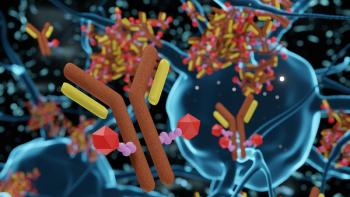
FDA has cleared Biolojic Design’s IND for BD200, a bispecific antibody-drug conjugate targeting Trop2 and Nectin-4 whose arms can each bind either target. A global Phase 1 study in solid tumors is expected to begin in the coming weeks.
Blackstone Life Sciences will fund up to $1.5 billion of development costs through 2028 for Pfizer’s monthly GLP-1 receptor agonist berobenatide, in exchange for milestone payments tied to approval and sales. Pfizer keeps full control of the program.

ImvivaBio’s off-the-shelf CD19/BCMA CAR-T cell therapy CTA313 kept 88% of evaluable patients with refractory lupus in DORIS remission at Month 12, according to longer-term phase 1 data presented at ACR Convergence 2026.

Full phase 3 OASIZ-301 results show both dosing regimens of Amgen’s CD40L antagonist fusion protein dazodalibep reduced systemic disease activity in Sjögren’s disease at Week 48. The every-four-weeks dose also improved patient-reported dryness.

Larimar Therapeutics has completed its rolling BLA for nomlabofusp, a frataxin replacement fusion protein, seeking accelerated approval based on skin frataxin as a novel surrogate endpoint. The company expects a potential US approval in mid-2027.

FDA granted RMAT and Fast Track designations to AbelZeta’s anti-CD20/CD19 CAR-T therapy prizlon-cel for relapsed or refractory large B-cell lymphoma. The company plans US studies after prior CAR-T therapy and in the second-line setting.
More monoclonal antibodies are moving from IV infusion to subcutaneous injection, but dose, volume, and viscosity still limit the switch. This FAQ covers the formulation science, the enabling technologies, what regulators require, and what remains unresolved.

A single subcutaneous dose of Janux’s CD19-targeted T-cell engager JANX011 depleted more than 90% of B cells in three of five healthy volunteers at the top dose, with only Grade 1 cytokine release syndrome. Patient studies in immune thrombocytopenia and rheumatoid arthritis are planned for 2027.
Advertisement
Advertisement
Trending on BioPharm International
1
Blackstone to Provide Pfizer Up to $1.5 Billion for Monthly GLP-1 Berobenatide Development
2
The BioPharm Brief: An AI-Designed Multibody ADC Enters the Clinic, Blackstone Backs Pfizer’s Monthly GLP-1, and enGene Readies a Bladder Cancer BLA
3
enGene Plans Year-End BLA for Detalimogene in BCG-Unresponsive NMIBC
4
ImvivaBio’s Dual-Target Allogeneic CAR-T Sustains Lupus Remission Through 12 Months
5