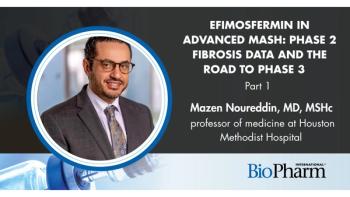
"No one really wants to inject often. Between daily and weekly, people prefer weekly, and between weekly and monthly, people definitely prefer monthly."
Your 52-week phase 2 study included patients up to compensated cirrhosis. What did the fibrosis markers show, and what stood out in the F4 patients?
Noureddin: First, let me tell you about the main paper we published in The Lancet. Efimosfermin, as we said, is a long-acting FGF21 analog given once monthly. What we published in The Lancet is that within only 24 weeks, fibrosis improved in 45% of patients on treatment vs. 21% on placebo, and MASH resolved in 68% of patients on the drug vs. 29% on placebo. That was at week 24 only, and we extended the study to week 48.
What we presented recently at The Liver Meeting, the American Association for the Study of Liver Diseases meeting, is a post hoc analysis of an open-label phase 2 cohort of 39 patients with F2 to F4 fibrosis: 24 patients with F2 or F3 and 15 with compensated cirrhosis. They received once-monthly efimosfermin at 225 or 300 milligrams for 48 weeks, with follow-up to 52 weeks. In general, these patients had advanced metabolic disease, with BMIs in the 30s and type 2 diabetes in most patients. As you would expect, liver stiffness was higher in the F4 population, about 18 to 21 kPa, consistent with cirrhosis, vs. about 15 to 16 kPa in the F2/F3 population.
The results were very encouraging and very supportive. As we saw with the biopsy results, liver fat fell durably, especially at 300 milligrams. Liver stiffness decreased, as did ELF and PRO-C3, which are fibrosis biomarkers, including in the patients with cirrhosis. Importantly, the pharmacokinetics were similar in the F2/F3 and F4 populations, with no serious adverse events related to the drug. These results support the Lancet paper and our drug development in phase 3.
Another analysis linked liver fat reduction to fibrosis improvement. What does that connection tell us, and could liver fat be an early sign that a patient is responding?
Noureddin: Absolutely. We now call liver fat a pharmacodynamic biomarker. MASH has two components: liver fibrosis and steatohepatitis, which involves liver fat. There is now a plethora of data showing that reductions in MRI-PDFF [magnetic resonance imaging proton density fat fraction] translate into histology, both steatohepatitis improvement and fibrosis improvement, and it depends on the degree of fat reduction.
In this post hoc analysis of the phase 2 study, about 62 patients with F2 or F3 fibrosis received efimosfermin for 24 weeks, and efimosfermin produced a relative reduction of about 34% compared with placebo. We looked at both 30% and 50% reductions, and both were seen at much higher rates in the efimosfermin population. Looking beyond those thresholds, you see a continuation of improvement, and a 50% reduction, in general, we believe is associated with more fibrosis reduction.
We've seen all of these reductions with efimosfermin, which is very promising and gives us confidence that the phase 3 results will eventually replicate them. And as I said, we did show improvement in histology at week 24. Usually, when you see that in a phase 2 trial with a smaller sample size, it's highly likely you'll see it in the phase 3 study.
You've highlighted the safety profile of this treatment. For a drug patients may take for years, what matters most in terms of safety and tolerability?
Noureddin: That's a very important question. Thank you for asking it. FGF21s, in general, are safe and have a low side effect profile. As everyone knows, GLP-1s are excellent drugs, and people lose weight, but unfortunately they come with a lot of nausea, vomiting, diarrhea, and other gastrointestinal (GI) side effects. That's not the case with FGF21s. They do have GI side effects, but they're not even comparable to the GLP-1s. That gives assurance that patients on FGF21s, and on efimosfermin in particular, will have a low, clean side effect profile.
People also talk about bone and FGF21s. We have looked into this, and bone biomarkers showed no reduction or change over one year when we studied this drug. That is also very promising, and it may be related to the structure of efimosfermin.
How will these results shape future trials, and what will those trials need to show?
Noureddin: We're already in phase 3 with efimosfermin, and we're already enrolling. There are two programs, with substudies, ZENITH and NEBULA, in the F2/F3 population and in patients with cirrhosis, respectively. This is very encouraging news for patients, because we are targeting the F2/F3 population and also targeting cirrhosis, which is a huge unmet need. We don't yet have approved therapies for patients with cirrhosis.
With efimosfermin's potent antifibrotic effect and its effect on steatohepatitis, we hope to see results in this patient group like those in our open-label cohort and in our randomized controlled trial in F2/F3. These ongoing studies carry huge promise for patients, with a drug that appears to be safe and efficacious, works quickly, and is long lasting. There are also things we didn't talk about, such as the favorable effect on lipids and other metabolic benefits, which we've seen in the F2/F3 cohort and the main study, as well as in subanalyses. I think the future is bright for our patients, and I look forward to the finish line for these phase 3 studies, which are enrolling very actively.
Click here to watch the first part of this two-part interview.