Pyxis’ Matrix-Targeting ADC MICVO Shows 39% Response Rate and 9.2-Month Median Response Duration in Previously Treated Head and Neck Cancer
Key Takeaways
- MICVO targets EDB+ fibronectin, a tumor neovasculature–associated extracellular matrix antigen largely absent in normal adult tissue, enabling a non-cellular ADC approach with potential stromal and immunomodulatory effects.
- Updated phase 1 outcomes at capped 5.4 mg/kg Q3W showed 39% cORR, 94% disease control, 6.7-month median PFS, and 81% 12-month OS probability in 2L+ R/M HNSCC.
Updated phase 1 data for micvotabart pelidotin, an antibody-drug conjugate that targets a protein in the tumor extracellular matrix, support Pyxis Oncology’s plan to start a phase 3 trial in recurrent/metastatic head and neck squamous cell carcinoma in mid-2027.
Micvotabart pelidotin (MICVO; Pyxis Oncology) achieved a 39% confirmed objective response rate (cORR) and a median duration of response of 9.2 months in previously treated patients with recurrent/metastatic head and neck squamous cell carcinoma (R/M HNSCC), according to updated phase 1 data that Pyxis announced on November 18, 2026.¹ Faye Johnson, MD, PhD, professor of thoracic/head and neck medical oncology at The University of Texas MD Anderson Cancer Center, presented the results on November 19 in a late-breaking oral session at the 38th EORTC-NCI-AACR Symposium on Molecular Targets and Cancer Therapeutics in Barcelona.¹
How does MICVO work?
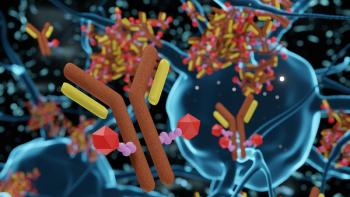
MICVO is built around a non-cellular target. The antibody-drug conjugate (ADC) binds extradomain-B of fibronectin (EDB+FN), a structural component of the tumor extracellular matrix, and Pyxis describes it as a first-in-concept ADC.¹ The company says MICVO is designed to kill cancer cells directly, reduce extracellular matrix density, inhibit tumor angiogenesis, and mobilize an antitumor immune response.¹
The extra domain B of fibronectin is rarely found in healthy adults and is expressed almost exclusively by newly formed blood vessels in tumors, according to a 2020 review in Molecular Oncology.² In a study of 82 head and neck biopsy specimens, the domain stained strongly in 87% of the 53 malignant tumors, less often in benign and nontumoral lesions, and not at all in normal control tissue.³
Where an ADC releases its payload is a central design question for the modality. In a BioPharm International®
What did the updated analysis show?
As of an October 14, 2026, data cutoff, the 33 efficacy-evaluable patients, all dosed at 5.4 mg/kg intravenously every three weeks at or below a dose cap, had a 94% disease control rate, a median progression-free survival (PFS) of 6.7 months, and a 12-month overall survival probability of 81%.¹ At the prior August 18 cutoff, Pyxis had reported a 36% cORR and a median PFS of 6.2 months.⁴

The cORR was 41% in HPV-positive disease (n = 17) and 38% in HPV-unrelated disease (n = 16). It was 33% in patients previously treated with an EGFR inhibitor (n = 18) vs 47% in those who were not (n = 15).¹ In a new intrapatient comparison, median PFS on MICVO was 6.7 months (95% CI, 4.8-9.0) vs 4.2 months (95% CI, 2.8-5.6) on patients’ most recent prior therapy.¹
On safety, Tom Civik, chief executive officer and chairman of Pyxis Oncology, said that “there have been no new cases of Grade 3 peripheral neuropathy and the six patients that experienced Grade 3 peripheral neuropathy have all improved with five of the six patients resolving to Grade 1 or better.”¹ Among patients dosed above a cap for men heavier than 80 kg and women heavier than 70 kg (n = 9), 56% discontinued for treatment-related adverse events and 67% had grade 3 treatment-related peripheral neuropathy, compared with 20% and 0%, respectively, among patients who received the capped dose (n = 5).¹
Why is this population hard to treat?
Between 60% and 80% of patients with advanced HNSCC progress after first-line immune checkpoint inhibitor-based therapy, and there is no universally accepted standard of care after progression on PD-1/PD-L1 inhibitors, according to a 2025 review in Cancers.⁵ In the pre-immunotherapy era, second-line systemic therapies achieved a median PFS of 2.2 months and a median overall survival of 6.1 months.⁵ The FDA recently granted
“For patients whose disease progresses after platinum chemotherapy and immunotherapy, there remains a substantial unmet medical need, particularly as we anticipate broader use of EGFR-targeted therapies in earlier lines of treatment,” Johnson said.¹
What happens next?
Pyxis plans to start the global phase 3 Headliner trial in second-line and later R/M HNSCC in mid-2027, with more mature overall survival data expected in the first half of 2027.¹ MICVO holds FDA Fast Track designation for adults with R/M HNSCC that has progressed after platinum-based chemotherapy and anti-PD-(L)1 therapy.¹ The results come from a single-arm phase 1 study, and several subgroups include fewer than 20 patients.¹
References
- Pyxis Oncology.
Pyxis Oncology to host live webcast on updated MICVO phase 1 monotherapy data demonstrating durable response in 2L+ R/M HNSCC following late-breaking oral presentation at EORTC-NCI-AACR Symposium . News release. GlobeNewswire. Published November 18, 2026. Accessed November 19, 2026. - Lieverse RIY, Marcus D, van der Wiel AMA, et al.
Human fibronectin extra domain B as a biomarker for targeted therapy in cancer . Mol Oncol. 2020;14(7):1555-1568. doi:10.1002/1878-0261.12705 - Birchler MT, Milisavlijevic D, Pfaltz M, et al.
Expression of the extra domain B of fibronectin, a marker of angiogenesis, in head and neck tumors . Laryngoscope. 2003;113(7):1231-1237. doi:10.1097/00005537-200307000-00023 - Pyxis Oncology.
Pyxis Oncology announces positive updated data from phase 1 monotherapy study of micvotabart pelidotin (MICVO) in second-line and beyond recurrent/metastatic head and neck squamous cell carcinoma (2L+ R/M HNSCC) . News release. Published September 9, 2026. Accessed November 19, 2026. - Abraham FF, Julian R.
Emerging and investigational systemic therapies in recurrent/metastatic head and neck cancer after progression on immunotherapy . Cancers (Basel). 2025;17(23):3817. doi:10.3390/cancers17233817
Related to this article