
Thermo Fisher is focused on investing to expand three specific areas of demand: biologics, cell and gene therapy, and drug product development and commercial capabilities.
Thermo Fisher is focused on investing to expand three specific areas of demand: biologics, cell and gene therapy, and drug product development and commercial capabilities.
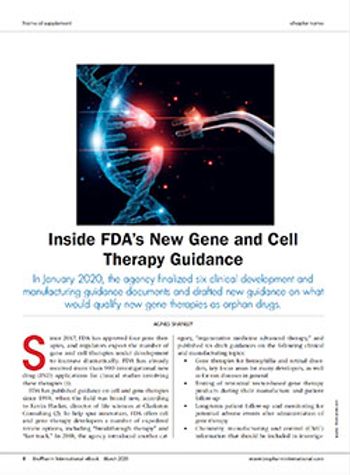
In January 2020, the agency finalized six clinical development and manufacturing guidance documents and drafted new guidance on what would qualify new gene therapies as orphan drugs.

Single-use and modular systems will meet demand for rapid implementation at different scales.
If approved, the therapy may become the first-choice treatment for relapsing multiple sclerosis patients and will be the first B-cell therapy that can be self-administered using an autoinjector pen.
The companies aim to develop novel cell therapies for treating multiple cancers.
Technology and capacity investments create opportunities in the cell and gene therapy arena for CDMOs and biopharma alike.
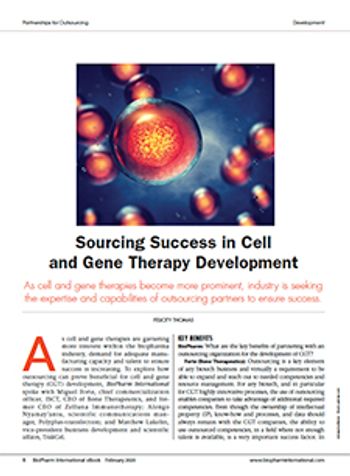
As cell and gene therapies become more prominent, industry is seeking the expertise and capabilities of outsourcing partners to ensure success.
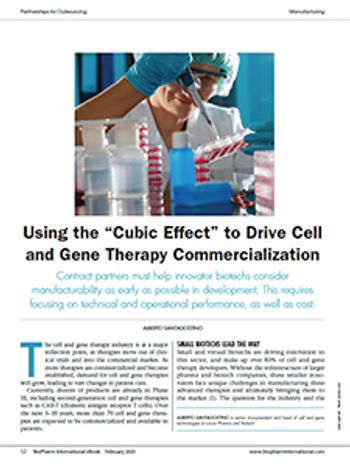
Contract partners must help innovator biotechs consider manufacturability as early as possible in development. This requires focusing on technical and operational performance, as well as cost.
The new facility includes six classified environment rooms with space to expand.

The commercialization of cell therapies is still at its infancy, but industry is facing an exciting period of development as the sector is expected to grow exponentially.

The trend toward personalized medicines includes more complex manufacturing cycles that can benefit from advanced process modeling early on in the therapeutics’ development.
The new facility, to be operated under the newly formed CDMO, The Center for Breakthrough Medicines, will be located in King of Prussia, PA, and will increase manufacturing capacity for cell and gene therapies.
The new course is directed at analyzing the skills gap in the manufacture of cell and gene therapies as they progress toward manufacturing at scale.
The new company will work to provide the manufacturing technologies and processes needed to develop and commercialize new cell and gene therapies through individual company products and expertise.
The agreement centers around the development of new stem-cell derived allogeneic T-cell therapies for the treatment of cancer.
GE Healthcare Life Sciences’ new facility for cell and gene processing supplies will be open in 2022.
The next-generation gene editing system can be applied to the development of novel cell and gene therapies.
ProBioGen and Lava Therapeutics have closed the cell line development and manufacturing agreement for Lava’s novel bispecific antibody lead candidate.

Achieving effective manufacturing processes and sufficient capacity remains a top priority across a diversified biologic drug pipeline.

While cell and gene therapies differ in many ways, some of the best practices for process development and validation are similar.
The acquisition expands Charles River’s scientific capabilities in cell therapy development.
The new software lets users choose the volume and cell concentration from initial cell preparation through transduction to final resuspension, without compromising cell viability and virus stability.
The new 50,000-square-foot facility will create 200 new jobs and accelerate commercialization of gene and cell therapies.
Accelerated approval pathways and growing demand for cell and gene therapies are putting pressure on providers of cellular starting materials, and they must ensure a steady supply.

Ensuring that viral vectors are free of viral contaminants requires a focus on prevention and control.