


EMA’s CHMP gave positive opinions on a nasal delivery for epinephrine and for a first-in-class medicine to treat pulmonary arterial hypertension, among others, including a biosimilar for treatment of autoimmune diseases.
EMA’s CHMP gave positive opinions on a nasal delivery for epinephrine and for a first-in-class medicine to treat pulmonary arterial hypertension, among others, including a biosimilar for treatment of autoimmune diseases.
The US currently relies heavily on imports from China and other overseas nations for APIs needed to manufacture drug products of critical importance to US patients.
The seven chosen sponsors will help accelerate development of novel drugs and biologics for rare diseases.
Yoni Tyberg, associate director of the Special Program Staff in the Office of New Drugs, provided an update on efforts to modernize CDER processes.

Diversity Action Plans are now required to be submitted by medical product sponsors after changes governed by the Food and Drug Omnibus Reform Act.
A new initiative will advance access to quality medicines and vaccines in Africa.

This alert follows a similar one from the European Medicines Agency in October 2023 amid a rise in demand for the diabetes medication that, in turn, created a shortage.
The guidance document provides information about the agency’s intentions for assigning a goal date for a facility’s inspection readiness under GDUFA.

The companies have completed the expansion and qualification phase and now enter a stand-by phase for five years.

Yimmugo, which was introduced in Europe at the end of 2022, could be on the market in the US within months.
The agency is evaluating risks associated with the painkiller metamizole. It is also reviewing the risk of secondary malignancies in patients treated with CAR T-cell medicines.
CDER's new program will create discussion around AI and be administered through the Emerging Drug Safety Technology Program.
Reports by USP and FDA detail drug shortage numbers and challenges through 2023.
Pharmaceutical Technology® spoke with Parviz Shamlou, senior vice-president of Science and Technology, Abzena, about the impact of the Biosecure Act on the bio/pharmaceutical industry, as well as the progress of continuous manufacturing in biopharma.

BioPharm International sat down with Himanshu Gadgil, CEO of Enzene Biosciences to discuss the benefits and challenges of continuous manufacturing of biopharmaceuticals.

BioPharm International® spoke with Jeff Clement, executive director of Technical Sales for Development and Manufacturing Group at PCI Pharma Services, about the challenges and benefits of incorporating robotics into aseptic manufacturing
CGT Catapult and CATTI have developed aligned training standards for the manufacture of advanced therapies.
BioPharm International® spoke with Stacey Treichler, senior director of Marketing and Strategy for Purolite at Ecolab, about the impact of advanced therapies, new innovations, and sustainability on the biopharmaceutical industry.

Bkemv (eculizumab-aeeb) is the first interchangeable biosimilar to Soliris (eculizumab) to treat paroxysmal nocturnal hemoglobinuria and atypical hemolytic uremic syndrome.

An ASGCT Panel titled Novel Nucleic Acid and Cell-based Vaccines for Cancer highlights promising mRNA personalized cancer vaccine work.
Regeneron’s Bari Kowal, senior vice-president, head Development Operations & Portfolio Management, gave insight into how the biopharma industry views the application of AI in R&D.

In an interview with BioPharm International® during the US Pharma and Biotech Summit, Ken Keller, president and CEO, Daiichi Sankyo, discusses what makes a good foundation for partnerships in the bio/pharmaceutical industry.
Studies conducted by a team at Oxford Biomedica demonstrated that HIC can be used to effectively separate non-deamidated capsids from deamidated capsids.
Regeneron’s work in CAR-T cell therapy development includes engineering receptor architecture to improve CAR-T cell sensitivity and improve immune response.
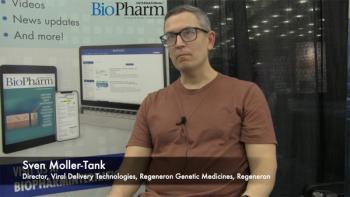
Sven Moller-Tank, PhD, director of Viral Delivery Technologies, Regeneron Genetic Medicines, Regeneron spoke about the use of bispecific antibodies to retarget AAV specificity.
Broken String Biosciences and the Francis Crick Institute will collaborate on research into how genome stability impacts ALS.
Experiments conducted by the downstream technology team at Spark Therapeutics involving metal ion-containing additives showed improved capsid clearance in AAV production.
A new draft guidance issued by FDA covers human- and animal-derived materials used in the manufacture of advanced therapy medicinal products.
Key areas to invest include manufacturing process improvements, quality management, and AI.
The new draft guidance from FDA provides recommendations for sponsor companies on cell safety testing of human-origin allogeneic cells.