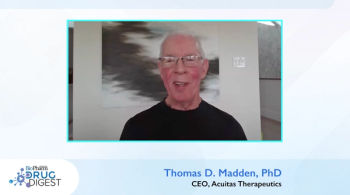
Acuitas CEO Dr Thomas Madden and NanoVation co-founder and president Dr Dominik Witzigmann discuss how LNP engineering is expanding genetic medicine applications to traditionally undruggable targets.
In the final part of an interview with Petra Dieterich and Jeffrey Mocny of Abzena, the current tariff situation in the United States and beyond is considered.
One of the major storylines of 2025 in the pharmaceutical industry was how companies and their leaders, in the United States and abroad, would respond to drastic
In the conclusion of a three-part interview with BioPharm International®,
“Abzena has everything in its network to be able to manufacture the whole molecule, so each part of the molecule can be manufactured in the US under the Abzena umbrella,” Dieterich says. “Of course, we go outside of the US to buy in, you know, starting materials, building blocks, they come from Asia. But you know, if push came to shove, we would be able to manufacture them.”
Dieterich and Mocny both make the point that if certain processes are established and run efficiently by a CDMO, that company should be able to withstand snags in the supply chain.
“[The] supply chain is like a stool,” Mocny says. “There are several legs to it. One of them is appropriate quality of material for the phase of development that a client may be in, and the requirement of the scientific needs to be supported by the material that is used in that work. So having, one, a solid supply chain with a clear picture of what is necessary to facilitate that scientific work, what those materials need to look like, is something that is a critical aspect of this.”
The final portion of BioPharm International®’s interview with Dieterich and Mocny can be viewed above. Parts one and two are available
Editor's note: This transcript is a lightly edited rendering of the original audio/video content. It may contain errors, informal language, or omissions as spoken in the original recording.
Petra Dieterich
When we talk about an ADC, Abzena has everything in its network to be able to manufacture the whole molecule, so each part of the molecule can be manufactured in the US under the Abzena umbrella. Of course, we go outside of the US to buy in, you know, starting materials, building blocks, they come from Asia. But you know, if push came to shove, we would be able to manufacture them. We don't right now, because it's not a cost-effective way of moving forward with our customers, but at the end of the day, we could do that, and obviously we could look to expand and build those capabilities in a cost-effective fashion.
And I think when we're building new medicines, it's having scientific processes and methodologies in place that are sound, robust, and capable of delivering, and I think, you know, it doesn't matter about supply chain if you have those in place and you're delivering good sound science. I think that's the most important thing when you're building a new modality and you build that really, really firm foundation, that's why you're creating value. That's what it's about.
For me, it's about creating value through using good scientific rationale, know-how, experimentation and building really, really strong data packages. Yes, we can manufacture in the US, in San Diego, in Bristol, Pennsylvania. I think we have everything in our wheelhouse to be able to put those molecules together. But I think even more important than that is having the really strong scientific foundation to build the methodologies. And I think that's where we add the value.
Jeffrey Mocny
Also, being pragmatic in this thinking around this, having a strong quality system to be able to support these activities and enable the scientific work that Petra has been driving at is an absolute critical component to that. And for example, a quality system involved with it is raw materials and vendor management.
Supply chain is like a stool. There are several legs to it. One of them is appropriate quality of material for the phase of development that a client may be in, and the requirement of the scientific needs to be supported by the material that is used in that work. So having, one, a solid supply chain with a clear picture of what is necessary to facilitate that scientific work, what those materials need to look like, is something that is a critical aspect of this.
One of the things that Abzena offers in our flexibility being a CDMO, we have a robust quality system that is flexible enough to accommodate multiple modalities of manufacturing campaigns, as well as being at different stages of development and still maintaining the appropriate level of control over those materials we acquire through our supply chain.
So there is a bit of business strategy, regulatory strategy, and analytical and scientific strategy that all come together as these legs of the stool if it were to be able to support the development programs going forward. And those are continuously evolving things, as you mentioned, with trade agreements and etc, which, frankly, we, I can't control that, nor can Petra. What we can do is make the best of what we have. So the key for us at Abzena, in my view, is that we've developed systems robust and flexible to accommodate the need.