

Feature|Videos|August 5, 2026
The Next-Generation Analytical Toolkit
Key Takeaways
- Identify emerging analytical approaches being developed to address current method limitations.
- Understand why MS based methods like SEC-MS and HIC-MS are expected to become more routine.
Our panel concludes by looking ahead to the next-generation tools and techniques shaping bioconjugate characterization.
Episodes in this series

Sponsored by Waters Corporation
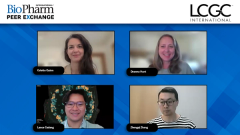
Existing approaches to analyzing chiral impurities and characterizing complex bioconjugates face limits in throughput, automation, and real-time applicability the field continues to address. Lance Cadang, Scientist, Synthetic Molecule Analytical Chemistry at Genentech, describes a new enzymatic, mechanism-of-action-reflective method his team developed to characterize chiral impurities in a citrate-based cleavable linker. This method moves beyond traditional normal-phase chiral chromatography to detect inversion at a chiral carbon. Zhengqi Zhang, Associate Principal Scientist at Merck & Co., anticipates that mass spectrometry (MS) based techniques such as high-throughput size exclusion mass spectrometry (SEC-MS) and hydrophobic interaction chromatography mass spectrometry (HIC-MS) will become more routine for release and quality control over the next several years. He also expects broader adoption of multi-attribute method testing and greater use of native MS, including hybrid platforms that couple MS with other techniques for deeper molecular understanding. As bioconjugate modalities continue to diversify, ensuring analytical capabilities keep pace with said complexity remains a challenge for development teams.
Related to this article
Sponsored
Meeta Gulyani, Ecolab Life Sciences, shares where biomanufacturing is headed next and why the relationship between drug developers and their suppliers is changing along with it.