

Feature|Videos|July 18, 2024
The Future of Manufacturing, Safety, and Collaboration
The panel highlights the need for continued research, collaboration between stakeholders, and a strategic approach to leveraging mRNA's capabilities to address unmet clinical needs.
Advertisement
Episodes in this series

The panel discussed the current state of mRNA medicine, highlighting gaps in research and development, and the need for continued innovation to improve safety and efficacy. The panelists also spoke on the importance of real-world clinical data and collaboration among stakeholders.
Discussion Topics
- 00:07 - Current state and future potential of the mRNA field
- 00:28 - Continued research needed to address gaps in mRNA technology, such as delivery mechanisms, immunogenicity, and long-term safety
- 01:18 - Importance of real-world clinical data and building trust through collaboration between stakeholders
- 03:37 - Need for a consortium of patient advocates, pharma, biotech, academia, and regulators to accelerate progress in mRNA medicine
- 03:45 - Excitement about the potential of mRNA technology and the need to use it wisely to push boundaries
Advertisement
Related to this article

The Skyrizi approval pairs an interleukin-23 antibody with an on-body injector for 720 mg subcutaneous induction in adults, per phase 3 AFFIRM data.

Gilead agrees to acquire PepStar’s oral IL-23R peptide program for $1.275 billion, Zymeworks licenses its DLL3-targeted trispecific T-cell engager ZW209 to Roche, and the US Treasury proposes adding biotechnology to its outbound investment restrictions.

FNIH CEO Dr Julie Gerberding will open the October 25-28 meeting with a talk on using AI, adaptive trials, and alternative methods in drug development.
Insilica's Dr Thomas Luechtefeld argues process traceability, not benchmark accuracy alone, determines whether AI toxicology decisions can be trusted.

Phase 1 HCXT-2001, an oral macrocyclic IL-23R peptide, could be paired with emvistegrast as a daily oral IBD treatment, according to Gilead.

Roche gains exclusive global rights to ZW209, a DLL3×CD3×CD28 trispecific T-cell engager designed for CD28 co-stimulation. A phase 1 study in small cell lung cancer and other neuroendocrine tumors is underway.

A Treasury proposed rule would restrict certain US investments in biotechnology in China and other countries of concern, raising questions about how cross-border licensing and joint venture deals will be treated.
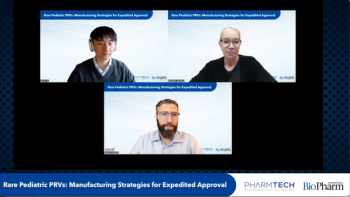
Nate Edwards of Arya Consulting moderates a discussion with Elisabeth Gardiner of Tevard Biosciences and Donny Xu of the RTW Institute about the regulatory and manufacturing hurdles facing rare disease drug developers.
Advertisement
Advertisement
Trending on BioPharm International
1
Gilead to Buy Oral IL-23R Peptide HCXT-2001 for $1.275 Billion
2
Treasury Proposes Adding Biotech to Outbound Investment Restrictions Under COINS Act
3
FDA Approves On-Body Injector Induction for Skyrizi in Crohn's Disease
4
Zymeworks Licenses DLL3-Targeted Trispecific T-Cell Engager ZW209 to Roche in Deal Worth Up to $813 Million
5