In this technical paper, Pete Makowenskyj, Sr. Director of Design Consulting at G-CON, explains how cleanroom facilities handling hazardous materials must balance patient safety, product sterility, and operator protection. The paper outlines the regulatory landscape, highlighting gaps between contamination-control guidance and containment requirements for high-risk agents such as ADCs, radiopharmaceuticals, and spore-forming organisms. It details key design considerations—including pressure schemes, HVAC zoning, filtration, and decontamination strategies—that ensure safe, compliant operations. The paper also emphasizes the value of prefabricated cleanroom solutions for achieving tighter environments, flexibility, and future-proofing.
Roche gains exclusive global rights to ZW209, a DLL3×CD3×CD28 trispecific T-cell engager designed for CD28 co-stimulation. A phase 1 study in small cell lung cancer and other neuroendocrine tumors is underway.
A Treasury proposed rule would restrict certain US investments in biotechnology in China and other countries of concern, raising questions about how cross-border licensing and joint venture deals will be treated.
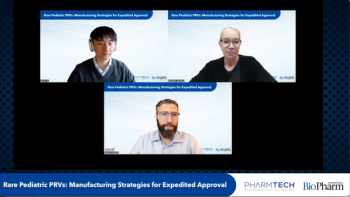
Nate Edwards of Arya Consulting moderates a discussion with Elisabeth Gardiner of Tevard Biosciences and Donny Xu of the RTW Institute about the regulatory and manufacturing hurdles facing rare disease drug developers.
Rohit Tripathi, vice president of industry strategy, consumer packaged goods, and manufacturing at RELEX Solutions, explains where cold-chain planning still breaks down and why biopharma supply chain leaders should use AI to act on data sooner, with humans making the final call.
The FDA grants accelerated approval to Ultomiris for IgA nephropathy, Alcon acquires Neurotech and its MacTel cell therapy for $550 million, and BioNTech and Bristol Myers Squibb add Trodelvy to a phase 3 trial in triple-negative breast cancer.