
"The Cell Shuttle System has already manufactured GMP drug product in an FDA-regulated clinical program, with doses meeting all release specifications, delivered on time and administered to patients."
— Cellares company statement, via BioSpace
News|Articles|September 14, 2026
As Companies Flee Ex Vivo Cell Therapy, Even Automated Manufacturing Platforms Face Validation Hurdles
Author(s)Emily Schoenthaler
Listen
0:00 / 0:00
Key Takeaways
- Bristol Myers Squibb ended a deal worth up to $380 million after determining Cell Shuttle was incompatible with commercial Breyanzi’s regulatory-approved manufacturing process, emphasizing product- and process-specific constraints.
- Workforce reductions at Cellares (~100 roles) follow the partnership loss, despite recent funding to enable commercial-scale production by 2027 and claims of prior GMP manufacture meeting release specifications.
Four cell therapy developers have pulled back from ex vivo manufacturing in the past month — ArsenalBio, TScan Therapeutics, and Cellectis all pivoted to in vivo approaches, while Bristol Myers Squibb terminated its manufacturing partnership with automation specialist Cellares after determining its platform couldn't meet requirements for commercial Breyanzi production, triggering layoffs.
Advertisement
Cell therapy developers have spent the past month pulling back from ex vivo manufacturing approaches, and the pattern extends even to companies built specifically to solve that category's cost and scalability problems. Bristol Myers Squibb has ended its cell therapy manufacturing alliance with Cellares after determining that the company's automated Cell Shuttle platform could not meet the requirements necessary to produce commercial Breyanzi (lisocabtagene maraleucel), BMS's CD19-directed CAR-T cell therapy for large B-cell lymphoma.¹ "Following a comprehensive evaluation, Bristol Myers Squibb determined that the Cellares-partnered Cell Shuttle system could not meet the necessary requirements to make commercial Breyanzi," a BMS spokesperson told BioSpace. "This determination is specific to Breyanzi and its established, regulatory-approved manufacturing process."¹ Cellares disputed that characterization: "The Cell Shuttle System has already manufactured GMP drug product in an FDA-regulated clinical program, with doses meeting all release specifications, delivered on time and administered to patients," the company said in a statement, adding that it "strongly disagrees" with BMS's characterization and does not discuss confidential customer program details publicly.¹
The loss of the contract has direct workforce consequences. Cellares CEO Fabian Gerlinghaus confirmed on LinkedIn that the company is laying off staff following the loss of a partnership with a large pharmaceutical company, without naming BMS specifically.¹ A WARN Act filing sent to BioSpace by California's Employment Development Department shows Cellares will permanently eliminate approximately 100 positions effective October 20, spanning roles from an alliance manager to a janitorial specialist to the company's vice president of commercial operations; more than half of the affected employees held "senior" titles across engineering, marketing, recruitment, and software.¹ The cuts come roughly 10 months after Cellares raised $257 million specifically to fund a path toward commercial-scale production in 2027.²
How significant was this partnership?
Post-approval manufacturing changes for cell therapies carry inherent risk regardless of the platform involved. Anna McMahon, Cellares' director of regulatory affairs, told BioSpace last year that switching manufacturing platforms after approval is "a significant investment," advising companies to "ensure that the new platform is sustainable and a long-term solution" before committing.¹ BMS currently produces Breyanzi through several internal sites plus external manufacturers including Oxford Biomedica.¹
Regulatory pathways built specifically for advanced manufacturing technologies add another layer to the dispute. Cellares has previously cited the FDA's Advanced Manufacturing Technologies (AMT) designation awarded to Cell Shuttle as a tool that could support manufacturing changes during development and after approval — the exact scenario at issue in the BMS dispute. Pierre-Alain Ruffieux, PhD, group executive of Bioprocess at Cytiva, addressed the broader regulatory gap facing this category of manufacturing in a
Timing matters as much as technology in these transitions. Alan K. Smith, PhD, executive director of global scientific portfolio management for cell and gene therapy at Charles River Laboratories,
Cell therapy manufacturing and capacity has been a recurring thread in recent coverage.
Why does this fit into a broader pattern this year?
This setback lands amid a string of announcements in which cell therapy developers have pulled back from established manufacturing approaches. In early September,
The underlying rationale for that shift had already been building industry-wide well before either company acted on it. In
That view isn't universally shared, however. Speaking at the 2026 ASGCT Annual Meeting,
The pattern has continued to develop even as this article was being reported. On September 14,
Cellares' setback is a different kind of story from any of these — a manufacturing technology dispute rather than a strategic pivot away from ex vivo production altogether — but it lands squarely in the same conversation. Where ArsenalBio, TScan, and Cellectis are walking away from ex vivo manufacturing or allogeneic cell therapy as a category, the BMS-Cellares dispute suggests that even automation-focused solutions built specifically to solve ex vivo manufacturing's cost and scalability problems face significant validation hurdles when applied to an already-approved, regulatory-locked production process. Ryan Larson, PhD, SVP, head of research at Umoja BioPharma, framed the underlying access problem driving much of this activity in a video interview with BioPharm International at the 2025 American Society of Gene and Cell Therapy annual meeting: "Access to ex vivo autologous cell therapies continues to be a challenge wherein a large fraction of patients that may be eligible for those therapies are not able to gain access to them for a variety of reasons."¹⁴
What happens next?
Cellares said it continues to support both clinical- and commercial-stage cell therapy programs beyond the terminated BMS relationship.¹ The company's layoffs take effect October 20; its next disclosed milestone is the commercial-scale production target it raised its $257 million Series round to support in 2027.²
References
- Taylor NP.
BMS Ends Cellares Pact Over Cell Therapy Production Problems, Triggering Layoffs . BioSpace. Published August 26, 2026. Accessed September 14, 2026. - Taylor NP.
BMS-Partnered Cellares Raises $257M for Cell Therapy Manufacturing Expansion . BioSpace. Published January 28, 2026. Accessed September 14, 2026. - Mirasol F.
Bristol Myers Squibb and Cellares Enter Into $380 Million Agreement for Technology to Manufacture CAR-T Cell Therapies . BioPharm International. Published April 23, 2024. Accessed September 14, 2026. - Mirasol F.
Cellares Expands Agreement with Bristol Myers Squibb for Second CAR-T Program . BioPharm International. Published October 13, 2023. Accessed September 14, 2026. - Markarian J.
Automation Aids Cell and Gene Therapy Production . BioPharm International. Published July 1. 2023. Accessed September 14, 2026. - Mirasol F, Pierre-Alain R.
Q&A: Cytiva's Pierre-Alain Ruffieux on Scaling Cell and Gene Therapy Manufacturing for Global Access . BioPharm International. Published July 24, 2026. Accessed September 14, 2026. - MIrasol F, Smith AK.
AI, Automation, and Early Planning Help Shape the Future of Advanced Therapy Manufacturing: a Q&A with Dr. Alan K. Smith . BioPharm International. Published May 26, 2026. Accessed September 14, 2026. - Schoenthaler E.
The BioPharm Brief: Cell Therapy, Capacity, and Contracts . BioPharm International. Published September 11, 2026. Accessed September 14, 2026. - Schoenthaler E.
ArsenalBio Sheds Most of Staff, Pivots Entirely to In Vivo CAR T . BioPharm International. Published September 2, 2026. Accessed September 14, 2026. - Schoenthaler E.
TScan Therapeutics Cuts 75% of Staff, Pivots to In Vivo TCR-T for Solid Tumors . BioPharm International. Published September 2, 2026. Accessed September 14, 2026. - Challener C.
Challenges to the Development of Emerging Therapies . BioPharm International. Published April 8, 2025. Accessed September 14, 2026. - Mirasol F, Stone E.
Why the Need to Expand Industry Focus Beyond Gene Editing Toward Scalable Cell Therapy Manufacturing? BioPharm International. Published May 19, 2026. Published May 19, 2026. Accessed September 14, 2026. - Mirasol F.
Cellectis Shifts to In Vivo Gene Editing With .HEAL-101, .HEAL-201 . BioPharm International. Published September 14, 2026. Accessed September 14, 2026. - Haigney S.
ASGCT 2025: Emerging Modalities for Cancer Treatments . BioPharm International. Published May 12, 2025. Accessed September 14, 2026.
Advertisement
Related to this article

Revakinagene taroretcel (Encelto), the only FDA-approved MacTel therapy, slowed photoreceptor loss by up to 54.8% vs sham in phase 3 trials.
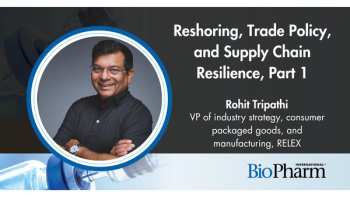
Rohit Tripathi, vice president of industry strategy, consumer packaged goods, and manufacturing at RELEX Solutions, explains what is driving biopharma reshoring, how USMCA uncertainty complicates sourcing for biologics, and where cold-chain visibility still breaks down.

In the phase 3 SHINE-2 trial, half of pediatric patients who responded to mirikizumab induction were in clinical remission at week 52. Lilly plans to file for a pediatric UC label expansion.

Roche gains exclusive global rights to ZW209, a DLL3×CD3×CD28 trispecific T-cell engager designed for CD28 co-stimulation. A phase 1 study in small cell lung cancer and other neuroendocrine tumors is underway.

A Treasury proposed rule would restrict certain US investments in biotechnology in China and other countries of concern, raising questions about how cross-border licensing and joint venture deals will be treated.

Rohit Tripathi, vice president of industry strategy, consumer packaged goods, and manufacturing at RELEX Solutions, explains where cold-chain planning still breaks down and why biopharma supply chain leaders should use AI to act on data sooner, with humans making the final call.

Zylidac will test whether optogenetic cell lines that hit 21 g/L in small-scale CHO runs can deliver higher-yield complex biologics at GMP scale.
Backed by €400 million (US$449 million) in EU-cleared German aid, the new Frankfurt facility is designed to secure insulin supply for people with diabetes from 2032.
Advertisement
Advertisement
Trending on BioPharm International
1
Gilead to Buy Oral IL-23R Peptide HCXT-2001 for $1.275 Billion
2
Treasury Proposes Adding Biotech to Outbound Investment Restrictions Under COINS Act
3
FDA Approves On-Body Injector Induction for Skyrizi in Crohn's Disease
4
The BioPharm Brief: Gilead’s Oral IL-23R Bet, Roche’s Trispecific Deal, and Treasury’s Biotech Investment Proposal
5