


Two facilities owned by Pharmasol Corporation were cited for violations of current good manufacturing practices in a FDA warning letter.
The digital transformation of quality-by-design assessment workflows can improve efficiency, reduce human errors, and facilitate integration within a much broader digital ecosystem.

The authors discuss subjectivity in the ICH Q9 (R1) guidance document.

Understanding how to apply phase-appropriate GMPs is crucial for achieving successful regulatory approval.

Two facilities owned by Pharmasol Corporation were cited for violations of current good manufacturing practices in a FDA warning letter.
Gene therapy development company, bluebird bio, has revealed that the European Commission has granted conditional marketing authorization for Zynteglo.
A US District Judge in the Southern District of Florida held that the US Stem Cell Clinic of Weston, FL and US Stem Cell of Sunrise, FL adulterated and misbranded a stem cell drug product made from a patient’s adipose tissue.
CDER’s KASA program seeks manufacturer data on drug attributes and risks to inform oversight.
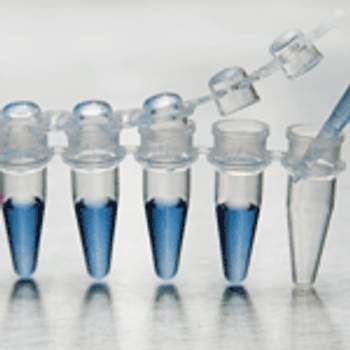
As SUS become prevalent in the biologics industry, the question of safety becomes increasingly important.
FDA’s annual manufacturing report card shows more quality compliance is needed.
A good working relationship between sponsor and contractor will become invaluable when an OOS occurs, says Susan J. Schniepp, executive vice-president of post-approval pharma and distinguished fellow, Regulatory Compliance Associates.

Quality by design brings both challenges and benefits to the development of downstream processes.

Making siloed data accessible across functions and to contract partners is the first step to facilitating continuous improvement and enabling use of artificial intelligence in manufacturing.
Stuart Jones, regulatory quality assurance professional in good laboratory practice (RQAP-GLP) and director of quality assurance at PPD Laboratories’ Bioanalytical Laboratory shared GLP best practices with BioPharm International.
Prestige BioPharma has announced that the EMA has accepted its marketing authorization application for HD201 (Tuzune) for review.
The company is voluntarily recalling Amikacin Sulfate Injection, USP, 1g/4 mL (250mg/mL), and Prochlorperazine Edisylate Injection, USP, 10mg/2mL (5mg/mL), to the consumer level because microbial growth was detected.
FDA is supporting the development and marketing of OTC therapies, including CBD products, by proposing new rules and an expanded review office and promoting digital technologies.
The company says it will work with payers to create payment options for its recently approved gene therapy, Zolgensma (onasemnogene abeparvovec-xioi), priced at $2.125 million.
The agency has approved Zolgensma (onasemnogene abeparvovec-xioi), the first gene therapy to treat pediatric spinal muscular atrophy.
The guidance discusses the design and evaluation of comparative analytical studies used to support the biosimilarity of a proposed therapeutic protein product to a reference product licensed under section 351(a) of the Public Health Service Act.
Violations found by FDA included a failure to test product for API identity and strength, failure to validate outsourced materials, and a lack of written cleaning procedures.
Inspectors found a lack of control over computer systems and a failure to follow equipment cleaning and maintenance procedures.
TraceLink will participate in the agency’s Pilot Project Program under the Drug Supply Chain Security Act.
The European Medicines Agency has issued a vacancy notice for the position of executive director.
FDA is examining and updating its programs for overseeing global operations and international affairs.
EMA has launched a social media campaign aimed at highlighting how the agency and its network maintain safety and efficacy of medicines available in Europe.
It has been confirmed that both Bulgaria and Cyprus will now be able to perform GMP inspections at a level considered equivalent to the United States
The guidance will assist sponsors in demonstrating a proposed therapeutic protein product is interchangeable with a reference product.
The agency approved Benlysta (belimumab) intravenous infusion for treatment of children with systemic lupus erythematosus.