
A new gene therapy can turn certain brain glial cells into functioning neurons, which could help repair the brain after a stroke or during neurological disorders like Alzheimer’s or Parkinson’s diseases, according to researchers at Penn State.
A new gene therapy can turn certain brain glial cells into functioning neurons, which could help repair the brain after a stroke or during neurological disorders like Alzheimer’s or Parkinson’s diseases, according to researchers at Penn State.
Researchers at Vanderbilt University Medical Center have isolated the first human monoclonal antibodies (mAbs) that can neutralize norovirus, a virus that causes acute gastrointestinal (GI) illness.
Researchers from Ruhr-Universität Bochum in Germany and the National Institutes of Health modified the protein Nurr1 to enter cells from the outside, possibly enabling the protein to become a drug development candidate for illnesses such as Parkinson’s disease.
National Institutes of Health researchers use genomics to show that squamous cell carcinomas differ from other cancers, which could advance treatments for head and neck and other cancers.
The pharma major will spin out six molecules in early stage inflammation and autoimmune programs into a new company called Viela Bio.
A Takeda and Denali collaboration includes three named programs for treating Alzheimer’s disease and other neurodegenerative diseases, using Denali’s antibody transport vehicle (ATV) technology to enhance blood-brain barrier penetration.
The companies aim to discover and develop locked nucleic acid oligonucleotides as orally available therapies for treating inflammatory bowel diseases.
The companies aim to develop a potential zinc finger protein transcription factor-based gene therapy for treating Lou Gehrig’s disease.
AstraZeneca and Champions will develop new cohorts of patient-derived xenograft models to be used in oncology programs in breast and lung cancer as well as for use in other academic and industry applications.
Biomedical researcher shares insights from a career dedicated to advancing therapeutic innovations for unmet medical needs.
The company has signed two separate agreements with the Agency for Science, Technology, and Research (A*STAR) and the Nanyang Technological University (NTU) to progress its therapeutic stem cell pipeline.
Human antibody for Zika virus could help in the treatment and prevention of the infection.
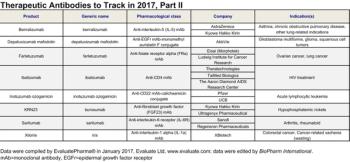
Evaluate and BioPharm International highlight the antibody-based therapeutics that may have 2017 launch dates in the United States.
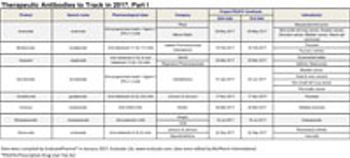
EvaluatePharma and BioPharm International highlight the antibody-based therapeutics that may gain United States Regulatory approval in 2017.
Researchers in the University of Dundee have discovered a new method of activating drugs to combat visceral leishmaniasis. The discovery could lead to better treatments for neglected tropical diseases.
The body’s over-editing of synaptic interactions is recognized as a probable cause of schizophrenia in a landmark study.
Scientists at Rice University have developed a method to control the infectivity of viruses and gene delivery to the nuclei of target cells.
MedImmune and 3M Drug Delivery Systems collaborate to develop toll-like receptor (TLR) agonists for immuno-oncology.
Six grants from the NIH will help identify variants in the genome’s regulatory regions that affect disease risk, using new computational approaches.
GSK announces it will invest $95 million to launch a US-based non-profit research institute, Altius, to research technologies and approaches in understanding gene control.
Treatment with monoclonal antibodies that inhibit the activity of PCSK9 was shown to significantly lower LDL cholesterol levels and have a strong cardiovascular benefit.
The agency will employ a ring vaccination method similar to the one used to eradicate smallpox.
MedImmune will provide funds and access to monoclonal antibodies to seven postdoctoral associates for the creation of protein measurement and characterization tools.
Mylan announced a partnership with Theravance Biopharma to develop and commercialize TD-4208, a novel investigational COPD treatment.
Syncona and Kite Pharma announced separate investments into T-cell therapies to fight cancerous tumors.