
"The lack or lower levels of funding have really made it so people are funding science instead of science fiction."
News|Videos|July 16, 2026
Thermo Fisher Scientific’s Paul Jorjorian Discusses Genetic Medicine Diversification, Partnership Trust, and Raw Material Risk in Biopharma Development
At BIO 2026, Thermo Fisher Scientific's Paul Jorjorian highlighted late-stage raw material switches as being among the most disruptive and underestimated risks in biopharma development.
Advertisement
In the interview, Jorjorian describes monoclonal antibodies (mAbs) and mAb variants, including antibody-drug conjugates (ADCs) and bispecific antibodies, as established and enduring modalities. He identifies
What are the most critical early decisions biopharma companies must get right to avoid late-stage development failure?
On partnerships, Jorjorian notes 2 factors that determine success. The first is that the partnership must deliver clear customer value, and the second is that it must be grounded in genuine trust between parties. He explains that legal agreements alone cannot capture the complexity of a productive partnership, rather, the working relationship itself must be aligned toward shared outcomes.
Jorjorian characterizes the current funding environment as more constrained than 4 to 5 years ago, but notes that lower funding levels have produced a filtering effect, directing capital toward stronger science rather than speculative programs.
"The lack or lower levels of funding have really made it so people are funding science instead of science fiction," Jorjorian states.
On development risk, Jorjorian identifies raw material selection as the single most consequential early-stage decision, particularly as molecules previously developed in China are being re-established in US-based workflows. Switching critical raw materials late in development, he emphasizes, can introduce significant delays and derail programs that are otherwise on track. This is a risk that is appearing with increasing frequency across the industry, he says.
About the speaker
Paul Jorjorian, Vice President, Development and Scientific Solutions, Thermo Fisher Scientific
In his role, Jorjorian is responsible for defining the R&D, process and analytical development, and manufacturing science and technology strategy for the Drug Substance business. Prior to that, he was responsible for 6 biologics drug substances manufacturing and development sites located globally as vice president Biologics. Additionally, he has held a number of roles with increasing responsibility in process development, manufacturing, and technology transfer. Before joining Thermo Fisher in 2014, Jorjorian worked for Gallus BioPharmaceuticals, Bristol-Myers Squibb and GE Plastics. He holds a B.S. in Chemical Engineering and Management from Purdue University, Ind., and a Masters in Chemical Engineering from Cornell University, NY.
Advertisement
Related to this article
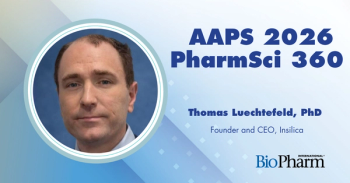
At PharmSci 360, Insilica CEO Thomas Luechtefeld will present on auditable agentic AI systems and how they are expanding computational toxicology beyond single predictive models.

FNIH CEO Dr Julie Gerberding will open the October 25-28 meeting with a talk on using AI, adaptive trials, and alternative methods in drug development.
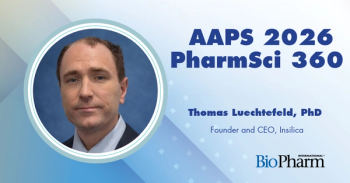
Insilica's Dr Thomas Luechtefeld argues process traceability, not benchmark accuracy alone, determines whether AI toxicology decisions can be trusted.

Zylidac will test whether optogenetic cell lines that hit 21 g/L in small-scale CHO runs can deliver higher-yield complex biologics at GMP scale.

Rohit Tripathi, vice president of industry strategy, consumer packaged goods, and manufacturing at RELEX Solutions, explains what is driving biopharma reshoring, how USMCA uncertainty complicates sourcing for biologics, and where cold-chain visibility still breaks down.

Dr Julie Gerberding and Dr David Berry will headline the October 25-28 New Orleans meeting, which adds a USP standards workshop and AI, organoid tracks.

EA2251, the 7th registrational trial of ivonescimab, will test it plus chemotherapy vs pembrolizumab or durvalumab regimens in first-line BTC.
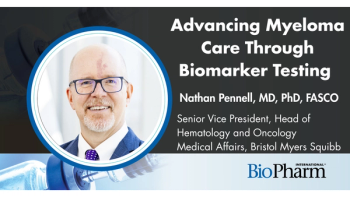
BMS's Dr Nathan Pennell outlines how biomarker testing barriers and trial diversity affect patient access to targeted oncology drugs.
Advertisement
Advertisement
Trending on BioPharm International
1
Treasury Proposes Adding Biotech to Outbound Investment Restrictions Under COINS Act
2
FDA Approves On-Body Injector Induction for Skyrizi in Crohn's Disease
3
Zymeworks Licenses DLL3-Targeted Trispecific T-Cell Engager ZW209 to Roche in Deal Worth Up to $813 Million
4
Rare Pediatric PRVs: Manufacturing Strategies for Expedited Approval, Part 2: CMC and Regulations
5