
“Uplizna offers a new approach to treating gMG by selectively targeting CD19-positive B cells, which play a key role in disease pathology. The approval provides both clinicians and patients a valuable new treatment option with the potential for long-term efficacy while addressing the challenges of long-term steroid exposure.”
News|Articles|February 12, 2026
European Commission Approves Uplizna as Add-On Therapy for Antibody-Positive Generalized Myasthenia Gravis
Author(s)BioPharm International Editors
Listen
0:00 / 0:00
Key Takeaways
- European authorization covers antibody-positive gMG (AChR or MuSK) as add-on to standard therapy, introducing a loading regimen followed by one maintenance infusion every six months.
- CD19-directed B-cell depletion provides a mechanistically distinct approach versus complement or FcRn strategies, aiming to suppress autoantibody production driving neuromuscular junction transmission failure.
The approval of Uplizna (inebilizumab) for adults with anti-AChR or anti-MuSK antibody–positive generalized myasthenia gravis is supported by Phase III MINT data demonstrating significant improvements in MG-ADL and QMG scores, with twice-yearly maintenance dosing following initial loading infusions.
Advertisement
The European Commission (EC) has approved Amgen’s Uplizna (inebilizumab) as an add-on to standard therapy for adults with generalized myasthenia gravis (gMG) who are anti-acetylcholine receptor (AChR) or anti-muscle specific tyrosine kinase (MuSK) antibody positive.1
The regulatory action, based on findings from the Phase III MINT clinical trial (NCT04524273), introduces a twice-yearly maintenance dosing option following two initial loading doses, offering a targeted approach for long-term disease control in this rare autoimmune condition.2
“This approval represents an important advancement for adults with gMG in Europe, helping address debilitating symptoms and potentially reduce the long-term use of steroids where clinically appropriate,” Cesar Sanz Rodriguez, vice president of Medical Affairs at Amgen, said in a company press release. “With convenient twice-yearly dosing and durable efficacy in people with anti-AChR and anti-MuSK antibody positive gMG, Uplizna brings a new first-in-class approach to managing this complex disease.”1
gMG gravis is a chronic, B-cell–mediated autoimmune disorder characterized by fluctuating muscle weakness that can significantly impair daily functioning and quality of life. The disease affects an estimated 56,000 to 123,000 individuals in Europe, with approximately 85% of patients developing the generalized form.
“Uplizna offers a new approach to treating gMG by selectively targeting CD19-positive B cells, which play a key role in disease pathology,” added John Vissing, MD, DMSci, professor of neurology and director of the Copenhagen Neuromuscular Center, Rigshospitalet, at the University of Copenhagen. “The approval provides both clinicians and patients a valuable new treatment option with the potential for long-term efficacy while addressing the challenges of long-term steroid exposure.”1
How does Uplizna work in generalized myasthenia gravis?
Uplizna is a humanized, afucosylated IgG1 kappa monoclonal antibody that was designed to target CD19 to induce rapid, deep, and durable B-cell depletion. By targeting these autoantibody-producing cells, the therapy aims to reduce immune-mediated damage at the neuromuscular junction. After two initial infusions, patients receive a single maintenance infusion every six months.
What evidence supported the EC approval?
The randomized, double-blind, placebo-controlled MINT trial evaluated the efficacy and safety of Uplizna in adults with gMG. The trial enrolled 238 patients, including 190 who were AChR-positive and 48 who were MuSK-positive.
Eligibility criteria included Myasthenia Gravis Foundation of America (MGFA) class II, III, or IV disease, defined thresholds for Myasthenia Gravis Activities of Daily Living (MG-ADL) and Quantitative Myasthenia Gravis (QMG) scores, and stable background steroid and/or nonsteroidal immunosuppressive therapy.
The primary endpoint was change from baseline in MG-ADL score at week 26 in the combined study population. Key secondary endpoints included changes in QMG scores and subgroup analyses in AChR-positive and MuSK-positive populations.
Key findings from MINT included:
Primary endpoint
- A 1.9-point greater improvement in MG-ADL score with UPLIZNA (-4.2) versus placebo (-2.2) at Week 26 (p<0.0001) in the combined population.
Key secondary endpoints
- A 2.5-point greater improvement in QMG score with UPLIZNA (-4.8) versus placebo (-2.3) at Week 26 (p=0.0002).
- A 1.8-point greater improvement in MG-ADL score in the AChR-positive cohort (-4.2 vs. -2.4; p=0.0015).
- A 2.5-point greater improvement in QMG score in the AChR-positive cohort (-4.4 vs. -2.0; p=0.0011).
- A 2.2-point greater improvement in MG-ADL score in the MuSK-positive cohort (-3.9 vs. -1.7; p=0.0297).
- A 2.3-point greater improvement in QMG score in the MuSK-positive cohort (-5.2 vs. -3.0); this difference did not reach statistical significance (p=0.1326).
Exploratory analyses at Week 52 in the AChR-positive population showed continued separation between treatment arms in both MG-ADL and QMG scores.
The trial also incorporated a structured steroid-tapering protocol. Among patients receiving steroids at baseline, 87.4% of those treated with Uplizna and 84.6% receiving placebo reduced their prednisone dose to 5 mg per day or less by week 26.
Findings from the trial, published in April 2025 in The New England Journal of Medicine, show that Uplizna could be an effective treatment option for B-cell depletion, pending long-term data, according to the trial investigators.3
“Treatment with [Uplizna], as compared with placebo, yielded clinical improvement in patient-assessed activities of daily living and in clinician-assessed disease severity in a combined population of participants with acetylcholine receptor antibody–positive and muscle-specific kinase antibody–positive [gMG] in this phase 3 trial, which included a prespecified glucocorticoid taper,” the study authors wrote. “Additional data are needed to confirm the long-term clinical benefits and safety of [Uplizna] in the treatment of patients with [gMG].”3
How does this approval fit into Uplizna’s broader regulatory profile?
The gMG approval expands Uplizna’spresence in rare autoimmune diseases in Europe. In November 2025, the EC approved Uplizna as the first and only treatment for adults with active immunoglobulin G4-related disease. The therapy is also approved as a monotherapy for adults with neuromyelitis optica spectrum disorder who are anti–aquaporin-4 immunoglobulin G seropositive.
Uplizna has received approvals across multiple indications from regulatory authorities including the FDA, Health Canada, and Brazil’s ANVISA, underscoring its expanding role in B-cell–mediated autoimmune conditions.
What are the clinical implications in Europe?
The approval provides clinicians across the EU with a new targeted, B-cell–depleting option for patients with antibody-positive gMG, a population that often requires chronic immunosuppression and prolonged steroid exposure. With twice-yearly maintenance dosing and demonstrated improvements in functional and muscle strength measures, Uplizna adds to the growing biologic landscape in gMG and reflects continued innovation in rare autoimmune neurology.
References
1. European Commission Approves Amgen's Uplizna® for Generalized Myasthenia Gravis. News release. Amgen. Published February 12, 2026. Accessed February 12, 2026.
2. Myasthenia Gravis Inebilizumab Trial (MINT). ClinicalTrials.gov. Updated February 20, 2025. Accessed February 12, 2026.
3. Nowak R., et al. A Phase 3 Trial of Inebilizumab in Generalized Myasthenia Gravis. N Engl J Med 2025. DOI: 10.1056/NEJMoa2501561.
Advertisement
Related to this article

The Skyrizi approval pairs an interleukin-23 antibody with an on-body injector for 720 mg subcutaneous induction in adults, per phase 3 AFFIRM data.
Gilead agrees to acquire PepStar’s oral IL-23R peptide program for $1.275 billion, Zymeworks licenses its DLL3-targeted trispecific T-cell engager ZW209 to Roche, and the US Treasury proposes adding biotechnology to its outbound investment restrictions.

FNIH CEO Dr Julie Gerberding will open the October 25-28 meeting with a talk on using AI, adaptive trials, and alternative methods in drug development.

Insilica's Dr Thomas Luechtefeld argues process traceability, not benchmark accuracy alone, determines whether AI toxicology decisions can be trusted.

Phase 1 HCXT-2001, an oral macrocyclic IL-23R peptide, could be paired with emvistegrast as a daily oral IBD treatment, according to Gilead.

Roche gains exclusive global rights to ZW209, a DLL3×CD3×CD28 trispecific T-cell engager designed for CD28 co-stimulation. A phase 1 study in small cell lung cancer and other neuroendocrine tumors is underway.

A Treasury proposed rule would restrict certain US investments in biotechnology in China and other countries of concern, raising questions about how cross-border licensing and joint venture deals will be treated.
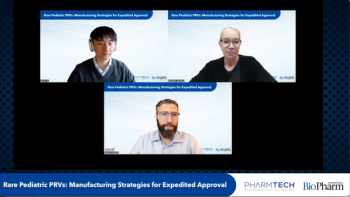
Nate Edwards of Arya Consulting moderates a discussion with Elisabeth Gardiner of Tevard Biosciences and Donny Xu of the RTW Institute about the regulatory and manufacturing hurdles facing rare disease drug developers.
Advertisement
Advertisement
Trending on BioPharm International
1
Treasury Proposes Adding Biotech to Outbound Investment Restrictions Under COINS Act
2
FDA Approves On-Body Injector Induction for Skyrizi in Crohn's Disease
3
Zymeworks Licenses DLL3-Targeted Trispecific T-Cell Engager ZW209 to Roche in Deal Worth Up to $813 Million
4
Gilead to Buy Oral IL-23R Peptide HCXT-2001 for $1.275 Billion
5