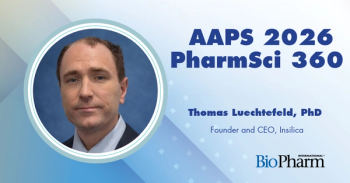
Insilica's Dr Thomas Luechtefeld argues process traceability, not benchmark accuracy alone, determines whether AI toxicology decisions can be trusted.
A new European Union regulatory framework known as MIDBA may streamline auto-injector approvals for biologics by reducing the need for repetitive pharmacokinetic (PK) bridging studies. Charles Theuer discussed how the model-based approach could accelerate drug-device combination development and potentially influence future FDA policy.
In an interview with BioPharm International covering AAPS NPC 2026, Charles Theuer outlined emerging regulatory changes that may significantly simplify the transition from prefilled syringes to auto-injector presentations for biologic therapies. Theuer presented on Wednesday, May 13, 2026, at a session called “
Theuer highlighted a newly emerging European Union framework known as the Model Molecule Independent Device Bridging Approach (MIDBA), which may reduce the need for repetitive PK bridging trials when established biologics are paired with previously validated auto-injector devices.
“Before MIDBA, every time you made a presentation change, you had to do another bioavailability equivalent study,” Theuer said.
Under the approach, regulators may permit extrapolation of existing device performance data if multiple comparable monoclonal antibodies have already demonstrated equivalent exposure profiles using the same auto-injector platform. According to Theuer, factors such as injection depth, device configuration, and molecular class similarity are considered in determining whether additional comparative PK studies can be waived.
Theuer characterized the framework as a major advance for biologic drug development because it could substantially reduce clinical trial requirements tied to presentation changes. He noted that the approach has already been implemented within the European Union and is now being evaluated for potential adoption by FDA.
The development reflects broader industry efforts to streamline drug-device combination product approvals and accelerate patient access to self-administered biologic therapies, themes explored in prior BioPharm International coverage of
Charles Theuer, MD, PhD
Dr. Charles Theuer has served as Chief Medical Officer at Halozyme since October 2024, leading subcutaneous drug development initiatives involving ENHANZE® technology and auto-injectors. Previously, he was CEO, CMO, and Director of TRACON Pharmaceuticals and held senior leadership roles at TargeGen, Pfizer, and IDEC Pharmaceuticals, contributing to the development of therapies including Inrebic®, Sutent®, Rituxan®, and Zevalin®. A board-certified general surgeon for more than a decade, Theuer earned degrees from MIT, UCSF, and UC Irvine, and completed training at Harbor-UCLA Medical Center and the National Cancer Institute.