Key facts
- Drug: JSKN016, TROP2/HER3 bispecific ADC
- Deal: Global licensing agreement, Pathos AI and Alphamab Oncology
- Territory: Pathos gets rights outside Chinese mainland, Hong Kong, Macau, Taiwan
- Terms: $125 million upfront, up to ~$2.1 billion in milestones, tiered royalties
- Origin: 4th clinical-stage asset identified via Pathos's Foundry AI platform
- Trials: Phase 3 in TNBC; phase 1b (China) and phase 1 (Australia) for subcutaneous formulation
Dr. Ting Xu, chairman and CEO of Alphamab Oncology, added in the release, “JSKN016 represents the best of our next-generation bispecific ADC platform … we are confident this collaboration will accelerate the global clinical advancement of JSKN016 and bring a potential breakthrough therapy to more patients with solid tumors."1
What does the licensing agreement cover?
Alphamab granted Pathos an exclusive license to research, develop, manufacture, and commercialize JSKN016 in territories outside the Chinese mainland, Hong Kong, Macau, and Taiwan, with Pathos assuming all related development and commercialization costs. Alphamab retains full and exclusive rights to develop, manufacture, and commercialize JSKN016 within the Chinese mainland, Hong Kong, Macau, and Taiwan.1
Under the agreement, Alphamab is entitled to a non-refundable upfront payment of $125 million and milestone payments of up to approximately $2.1 billion tied to development and commercialization milestones, plus tiered royalties at high-single-digit to low-double-digit percentage rates on aggregate annual net sales in Pathos's licensed territories.1
How was JSKN016 identified?
JSKN016 was identified and prioritized through Foundry, Pathos's proprietary AI-driven decision platform, which the company said uses thousands of AI agents working in parallel to analyze biological, clinical, and real-world data at scale, surfacing high-potential assets and helping design clinical trials and match patients to therapies.1 The candidate becomes the 4th clinical-stage program Pathos has advanced through the platform, expanding its pipeline to 4 assets across multiple solid tumor indications, including JSKN016; pocenbrodib, in development for metastatic castration-resistant prostate cancer and relapsed/refractory multiple myeloma; DO-2, for mesenchymal epithelial transition factor receptor-altered non-small cell lung cancer; and AZD4241, an estrogen receptor α proteolysis-targeting chimera for ER-positive, HER2-negative breast cancer being advanced with AstraZeneca.1
How does JSKN016 work, and where does its development stand?
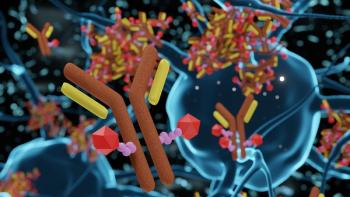
JSKN016 targets both TROP2 and HER3 on tumor cells, using a single-domain and bispecific antibody platform conjugated via site-specific glycosylation to produce a homogeneous, stable ADC with a drug-to-antibody ratio of 4. Upon binding, it blocks the corresponding signaling pathways and releases topoisomerase I inhibitors through cellular endocytosis.1
Multiple clinical studies of JSKN016 as monotherapy and in combination regimens are underway in lung cancer, breast cancer, and other indications, including an ongoing phase 3 study in triple-negative breast cancer, an ongoing phase 1b study of a subcutaneous formulation in China, and an ongoing phase 1 study of the subcutaneous formulation in Australia.1,2
What does this deal signal about AI-driven oncology licensing?
The agreement adds to a growing set of licensing deals in which Western biopharmaceutical companies acquire ex-China rights to clinical-stage oncology assets originated by Chinese biotechs, a pattern increasingly used to access differentiated ADC and bispecific antibody platforms.3 For Pathos, the deal also represents a test of whether an AI-driven asset-selection and portfolio-management approach can be applied systematically across in-licensing decisions, rather than a single one-off transaction, as the company frames Foundry as the basis for its broader pipeline strategy across 4 now-active clinical programs.
References
- Pathos AI. Pathos AI enters global licensing agreement with Alphamab Oncology on JSKN016, a first-in-class TROP2/HER3 bispecific ADC. Press release. August 3, 2026. Accessed August 4, 2026. https://www.pathos.com/pathos-ai-enters-global-licensing-agreement-with-alphamab-oncology-on-jskn016-a-first-in-class-trop2-her3-bispecific-adc
- Alphamab Oncology. Alphamab Oncology announces the first patient dosed in a phase III clinical study for triple-negative breast cancer of TROP2/HER3 bispecific ADC JSKN016. Press release. March 20, 2026. Accessed August 3, 2026. https://www.alphamabonc.com/en/html/news/2772.html
- Martz L. Bispecifics overtake ADCs in China deals. BioCentury. March 4, 2025. Accessed August 4, 2026. https://www.biocentury.com/article/655247/bispecifics-overtake-adcs-in-china-deals