

The company will add a new laboratory facility at its Shanbally, Co. Cork, Ireland, manufacturing site.
The company will add a new laboratory facility at its Shanbally, Co. Cork, Ireland, manufacturing site.

Cellipont Bioservices and Xiogenix Partner on Advanced Filling Systems The companies will offer Cellipont’s clients access to Xiogenix’ fill/finish system for cell therapy production.

Under the deal, Novartis will in-license PTC518, an mRNA splice modulator for the huntingtin gene, which has the potential to be the first oral disease-modifying therapy for Huntington's disease.
Lilly will expand its recently acquired manufacturing facility in Wisconsin with a $3 billion investment, and Amgen will expand its North Carolina facility with a $1 billion investment.

GSK’s Biologics License Application for belantamab mafodotin (Blenrep) as part of a combination therapy has been accepted by the US regulatory body for review.
The agency will review the company’s supplemental new drug application for vutrisiran, a treatment for ATTR amyloidosis with cardiomyopathy.
With FDA's clearance, Kedrion can manufacture Ryplazim (plasminogen, human-tvmh), the first and only FDA-approved therapy for treating PLGD-1, at its Bolognana, Italy, site.
The investment will allow Sanofi to strengthen antibody bioproduction at its Lyon Gerland site in France.
Eisai Europe and Biogen have received a positive opinion for the monoclonal antibody therapy to be used as a treatment of adult patients with early Alzheimer’s disease.
Under an agreement, Leads Biolabs has granted the new company, Oblenio Bio, an exclusive option to license LBL-051, a tri-specific T-cell engager antibody.
The collaboration aims to develop precision genetic medicines using ViaNautis’ proprietary polyNaut technology platform.
The companies expect to accelerate the clinical development of MRT-6160, a Phase I drug candidate, as well as explore further therapeutic opportunities across multiple indications.
Merck is acquiring the Yale-spinout, which develops direct DNA modification-enabled cancer treatments.
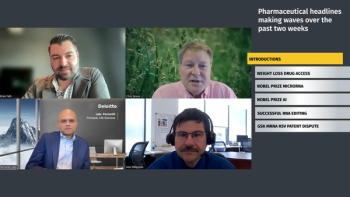
Laks Pernenkil, Brian Feth, and Alex Philippidis go behind the headlines to discuss the impact of recent news, including FDA’s drug shortage list update, Nobel prize winners in microRNA and AI, and a big-potential research win for RNA editing.
Pfizer’s bivalent RSV prefusion F vaccine has been approved by FDA to prevent lower respiratory tract disease resulting from the respiratory syncytial virus in adults 18 to 59 years of age who are at increased risk.

The Cambridge-GSK Translational Immunology Collaboration builds on an existing scientific relationship between the biopharma company and the university, with the aim of improving outcomes for patients.
The merger will create a specialty company, REGiMMUNE/Kiji TX, for regulatory T cells.
Through the collaboration, Merck will use Mestag’s proprietary RAFT platform to investigate the pathogenic role that fibroblasts play in inflammatory diseases.
The new center's design will prioritize integration of the entire supply chain, with the aim of accelerating product development and autonomous production capacity in alignment with EU priorities.
By approving EBGLYSS (lebrikizumab-lbkz), FDA has made available a new biologic treatment for moderate-to-severe atopic dermatitis that is not well controlled with topical treatments.
Lilly has increased its manufacturing investment for biologics in Limerick, Ireland, by $1 billion while launching its new $800 million facility in Kinsale.
The company said this new commitment to its facility in Germany goes hand in hand with its recently announced ReciPredict, an initiative intended to streamline the product development cycle.
Novo Nordisk will use Korro Bio’s OPERA platform to develop RNA editing candidates for two targets to treat cardiometabolic diseases.
FDA’s latest approval of Imfinzi (durvalumab) in combination with chemotherapy for treating resectable non-small cell lung cancer before and after surgery is based on Phase III trial results showing that the regimen reduced the risk of recurrence, progression, or death by 32%.
PiaSky (crovalimab) has previously been approved in countries such as the United States and Japan for monthly, subcutaneous use that may be self-administered with adequate training.
With the completion of its acquisition of Morphic, Lilly expands its immunology pipeline to include Morphic's oral integrin therapies to address inflammatory bowel disease.
Opaganib was given orphan drug designation for the treatment of neuroblastoma in children, which is rare, but the most common infancy malignancy.
In a 24-week study of patients with PAH, six-minute walking distance improved by an average of 40.8 meters, and risk of death or clinical worsening was reduced by 82%.
The collaboration builds on Novartis’ acquisition of Chinook Therapeutics just over a year ago.
The combination of Opdivo plus Yervoy is already established as a second-line treatment for patients with advanced hepatocellular carcinoma.