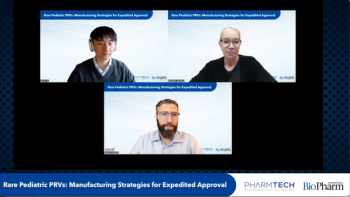
Nate Edwards of Arya Consulting moderates a discussion with Elisabeth Gardiner of Tevard Biosciences and Donny Xu of the RTW Institute about the regulatory and manufacturing hurdles facing rare disease drug developers.
Univercells, a business-to-business provider focused on biologics, has commercially launched its proprietary bioproduction system, NevoLine.
Univercells, a business-to-business provider focused on biologics, has commercially launched its proprietary bioproduction system, NevoLine, which was initially developed as part of a $12-million Grand Challenges grant from the Bill & Melinda Gates Foundation to deliver affordable inactivated polio vaccine (sIPV).
Scale-up of the bioproduction technology has been made possible through a $4-million grant extension that Univercells, along with consortium partner Batavia Biosciences, were awarded early this year, as reported in a Jan. 11, 2019
“This challenging two-year project aimed at delivering a new manufacturing system to drastically decrease cost, footprint, and time to market for vaccine manufacturers, and we are pleased to have met these goals,” Hugues Bultot, CEO and co-founder of Univercells said in a press release. “The NevoLine system is self-contained into a 6m² series of isolators. A facility designed with four NevoLine units would deliver up to 50 million sIPV doses per year for an estimated capital cost of $20 million. These breakthrough achievements further strengthen our dedication to innovating flexible, scalable, and accessible vaccines and biotherapeutics manufacturing solutions.”
Under the terms of the consortium, Univercells was responsible for the NevoLine system, Batavia Biosciences for the polio manufacturing process, and Merck Millipore (formerly Natrix) for the purification membrane. The first NevoLine system is set to be installed in Batavia Bioscience’s polio dedicated level 3 facility in Leiden, The Netherlands.
Source: