

“We further believe that this co-development agreement with Pfizer substantially enhances our long-term growth profile and positions the Company to participate in one of the most dynamic sectors of biotechnology."
— Raza Bokhari, M.D., executive chairman and chief executive officer, Medicus Pharma
News|Events|September 4, 2026
Medicus Pharma Licenses Pfizer's Discontinued CD228-Targeted ADC in Deal Worth Over $1 Billion
Author(s)Emily Schoenthaler
Listen
0:00 / 0:00
Medicus Pharma secured worldwide rights to PF-08046031 (CD228V), an antibody-drug conjugate targeting melanotransferrin that Pfizer discontinued earlier this year following its $43 billion Seagen acquisition, in a co-development and license agreement that could pay Pfizer more than $1 billion in milestones.
Advertisement
Medicus Pharma, through its wholly owned subsidiary Medicus Oncology, entered into a co-development and license agreement with Pfizer covering PF-08046031, also designated CD228V, an early clinical-stage antibody-drug conjugate (ADC) directed against melanotransferrin (CD228, also known as MELTF or MFI2).¹ The agreement grants Medicus an exclusive, sublicensable, worldwide license to develop, manufacture, and commercialize the asset, while Pfizer retains ownership of the underlying patent estate and a continuing oversight role; Medicus must share development plans and budgets with Pfizer for review, and Pfizer holds an option to fund all or part of future development once a pivotal trial begins.¹
Medicus paid Pfizer a $12 million upfront payment, with an additional $15 million due on the agreement's first anniversary, while Pfizer contributed $2 million in development funding to support early-stage advancement of the program.¹ Pfizer is eligible for development, regulatory, and sales milestone payments that could exceed $1 billion in aggregate, plus tiered, low double-digit royalties on net sales.¹
Raza Bokhari, MD, executive chairman and chief executive officer of Medicus Pharma, said the partnership "represents a defining milestone for Medicus and significantly expands our presence in precision oncology," adding, "We further believe that this co-development agreement with Pfizer substantially enhances our long-term growth profile and positions the Company to participate in one of the most dynamic sectors of biotechnology."²
Where did this asset come from?
PF-08046031 originated from
How does CD228V work, and why target melanotransferrin?
PF-08046031 is composed of hL49, a humanized IgG1 monoclonal antibody specific to CD228, conjugated to monomethyl auristatin E (MMAE) via a protease-cleavable valine-citrulline linker of the
The scientific rationale draws on peer-reviewed preclinical work describing SGN-CD228A, a related construct built on the same hL49 antibody backbone, which found the anti-CD228 antibody was efficiently internalized across multiple tumor cell types, with cytotoxic activity dependent on CD228 expression, internalization, and intrinsic MMAE sensitivity.⁴ That publication evaluated a different linker chemistry than the one used in PF-08046031, so the two should be understood as related but distinct constructs sharing a common antibody and payload class, rather than interchangeable descriptions of the same molecule.¹
Payload and linker design remain a central axis of competition across the ADC field more broadly. Dave Simpson, chief executive officer of Iksuda Therapeutics, told BioPharm International in a video interview that "the biggest innovation moving forward is on the payload side," pointing to payload design and antibody engineering, alongside linker and conjugation advances, as the areas most likely to shape the next generation of ADCs.⁵
What happens next?
Medicus said its near-term priorities include advancing CD228V through further clinical development under its own sponsorship, incorporating the manufacturing, regulatory, and budgetary planning processes specified in the agreement.¹ The company has characterized the transaction as a foundational addition to its oncology pipeline and a step toward building a broader portfolio of differentiated ADC programs.¹ As with any early-stage oncology asset transitioning between sponsors, the program's path forward will depend on the design and outcome of subsequent clinical studies; CD228V remains investigational, with safety and efficacy not yet established.¹
References
Medicus Pharma Secures Worldwide Rights to Pfizer's Discontinued CD228-Directed ADC in Deal Valued at Over $1 Billion . ADC Review. Published September 3, 2026. Accessed September 4, 2026.Pfizer offloads scrapped Seagen ADC to Medicus Pharma in up to $1B+ deal . Fierce Biotech. Published September 3, 2026. Accessed September 4, 2026.Pfizer to Acquire Seagen in $43 Billion Blockbuster Deal . BioPharm International. Published March 16, 2023. Accessed September 4, 2026.- Mazahreh R, Mason ML, Gosink JJ, et al. SGN-CD228A Is an Investigational CD228-Directed Antibody-Drug Conjugate with Potent Antitumor Activity across a Wide Spectrum of Preclinical Solid Tumor Models. Mol Cancer Ther. 2023;22(4):421-434.
doi:10.1158/1535-7163.MCT-22-0401 . Iksuda Wins FDA IND Clearance for CA242-Directed ADC IKS04 in GI Cancers . BioPharm International. Published July 30, 2026. Accessed September 4, 2026.
Advertisement
Related to this article

Nuravax will test AV-1959R in a 160-adult phase 2 trial to see whether the amyloid vaccine can prevent Alzheimer disease before symptoms begin.

Backed by €400 million (US$449 million) in EU-cleared German aid, the new Frankfurt facility is designed to secure insulin supply for people with diabetes from 2032.

In the phase 3 SHINE-2 trial, half of pediatric patients who responded to mirikizumab induction were in clinical remission at week 52. Lilly plans to file for a pediatric UC label expansion.

AVT29, a proposed aflibercept biosimilar to Eylea 8 mg, could extend retinal disease treatment intervals to 16 weeks, versus 8 weeks today.
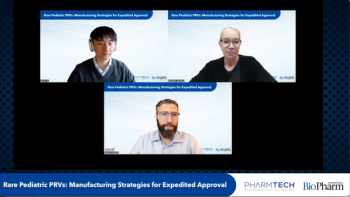
Nathan Edwards of Arya Consulting moderates a discussion with Elisabeth Gardiner of Tevard Biosciences and Donny Xu of the RTW Institute about rare disease treatment development and navigating the FDA’s Rare Pediatric Disease Priority Review Voucher Program.

As ArsenalBio, TScan, Bristol Myers Squibb, and others abandon ex vivo programs for in vivo engineering, early clinical data and platform differences point to both the promise and the unresolved safety, manufacturing, and regulatory questions of generating CAR-T cells inside the body.

Gilead will develop up to three PRO-XTEN T-cell engagers discovered by Vir Biotechnology for solid tumors in a deal worth up to $1.74 billion.

Rohit Tripathi, vice president of industry strategy, consumer packaged goods, and manufacturing at RELEX Solutions, explains what is driving biopharma reshoring, how USMCA uncertainty complicates sourcing for biologics, and where cold-chain visibility still breaks down.
Advertisement
Advertisement
Trending on BioPharm International
1
Nuravax Alzheimer Vaccine AV-1959R Earns FDA Fast Track Designation
2
Nano24's Inhaled EXO-CD24 Cuts ARDS Mortality in Phase 2b Trial
3
Akeso's Ivonescimab Enters Phase 2/3 Biliary Tract Cancer Trial in US
4
Geneos Launches Phase 2 IMPACT31 Trial of Personalized DNA Cancer Vaccine to Prevent Liver Cancer Recurrence
5