by Mary Sawyer, Masoud Hosseini, Carrie Schore, and Bennie I. Osburn from School of Veterinary Medicine, University of California, Davis, department of veterinary pathology, microbiology and immunology; Joseph Vu, Baxter biosciences division; Krystyna Trzepla-Nabaglo, Celilia Pina, and Manuel Lagunas-Solar from the laser unit, Crocker Nuclear Laboratory, University of California, Davis; and Wayne Smith, department of population health and reproduction at the University of California, Davis New evidence suggests the West Nile virus can be transmitted during blood transfusion from an asymptomatic donor. However, it is now possible to use pulsed ultraviolet laser light to inactivate viruses such as West Nile at large production scales. These experimental data show that using laser light on virus-treated media can render biological products free of contaminating viruses without compromising the biological activity essential to cell cultures.
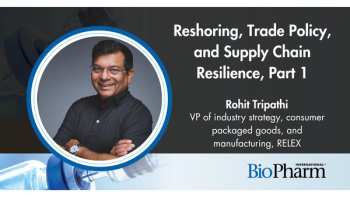
Rohit Tripathi, vice president of industry strategy, consumer packaged goods, and manufacturing at RELEX Solutions, explains where cold-chain planning still breaks down and why biopharma supply chain leaders should use AI to act on data sooner, with humans making the final call.
The FDA grants accelerated approval to Ultomiris for IgA nephropathy, Alcon acquires Neurotech and its MacTel cell therapy for $550 million, and BioNTech and Bristol Myers Squibb add Trodelvy to a phase 3 trial in triple-negative breast cancer.
BioNTech and Bristol Myers Squibb will replace chemotherapy with Gilead’s TROP2-directed ADC sacituzumab govitecan in the Phase 3 ROSETTA Breast-01 trial of PD-L1×VEGF-A bispecific pumitamig in PD-L1-low or -negative TNBC.
Alexion’s ravulizumab won accelerated approval to reduce proteinuria in adults with IgA nephropathy after the Phase 3 I CAN trial showed a 43.4% placebo-adjusted reduction at Week 34.
Sanofi breaks ground on an EU-backed insulin API plant in Frankfurt, Summit and ECOG-ACRIN launch a phase 2/3 trial of ivonescimab in first-line biliary tract cancer, and TaiMed’s anti-CD4 antibody TMB-365 lowers HIV viral load in phase 1.
Rohit Tripathi, vice president of industry strategy, consumer packaged goods, and manufacturing at RELEX Solutions, explains what is driving biopharma reshoring, how USMCA uncertainty complicates sourcing for biologics, and where cold-chain visibility still breaks down.