

In parallel, cell therapies themselves are becoming more sophisticated, with multi-targeting designs that improve specificity and reduce the likelihood of disease evasion. These innovations are driving a shift toward highly personalized treatments tailored to individual patient biology, particularly in oncology.
News|Videos|April 24, 2026
Drug Digest: Examining the Architecture of Next-Gen Biotherapeutic Modalities
Author(s)Feliza Mirasol, Eytan Abraham
Minaris Advanced Therapies’ Dr. Eytan Abraham joins the discussion on how the biopharmaceutical industry is revolutionizing the design, durability, and global scalability of new biotherapeutic modalities through innovations in molecule design and next-generation delivery platforms.
Advertisement
This episode of
According to Dr. Abraham, multifunctional approaches are expanding the capabilities of cell therapies by combining modalities such as antibodies or antibody-drug conjugates (ADCs) with
Digital tools are also playing a growing role in improving manufacturing efficiency and product consistency. Technologies such as artificial intelligence (AI), data analytics, and real-time monitoring are being applied to optimize processes, reduce costs, and enhance quality control, he explains. These approaches are particularly relevant as developers seek to scale production while maintaining regulatory compliance and product integrity.
How are multifunctional modalities and digital tools transforming cell therapy development?
Dr. Abraham explains that advances in proteomics and AI are improving understanding of cellular mechanisms of action, which is critical for both drug discovery and manufacturing. These insights support more effective potency assays and better donor selection for allogeneic therapies, reducing variability and improving clinical outcomes.
“The cell itself is a delivery platform,” Dr. Abraham highlights.
He also notes that future scalability will likely depend on regional manufacturing models rather than fully centralized or point-of-care approaches. While early-stage production may occur in academic or hospital settings, commercial-scale manufacturing is expected to require dedicated infrastructure with the flexibility to support broader patient populations.
Overall, Dr. Abraham emphasizes that integrating advanced analytics, programmable biology, and scalable manufacturing strategies will be essential to realizing the full clinical potential of next-generation biotherapeutics.
Interview featuring
Eytan Abraham, PhD, Chief Commercial and Technology Officer, Minaris Advanced Therapies
Dr. Abraham has more than 20 years of experience in cell and gene therapy and biomanufacturing. He leads global commercial strategy and innovation to help clients accelerate development and scale manufacturing. Previously, he held senior roles at National Resilience, Lonza, and Pluristem. Dr. Abraham earned his PhD from the University of Maryland and completed postdoctoral training at Harvard-MIT and Harvard Medical School.
Sponsors
This episode of Drug Digest is sponsored by:
- Cygnus Technologies
- FUJIFILM Biotechnologies
About BioPharm Drug Digest
BioPharm Drug Digest is a video series with the BioPharm International® editors, who conduct in-depth interviews with industry experts around the latest research and pipeline developments as well as emerging opportunities, obstacles, and advances in the biopharmaceutical industry related to the manufacturing, distribution, supply, and regulatory compliance of biopharmaceutical products.
Upcoming episodes
May 2026: Large Molecule Manufacturing
June/July 2026: Partnering for Biopharmaceutical Success
August 2026: Regulatory and Quality Updates in Biologic Drug Development
September 2026: Targeting the Undruggable
October/November 2026: The Future of Biopharma Operations and Supply Chains
*No December 2026 episode
Advertisement
Related to this article
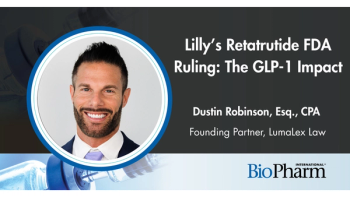
LumaLex Law's Dustin Robinson explains why retatrutide compounding remains illegal regardless of the Seventh Circuit's pending classification ruling.

Acuitas CEO Dr Thomas Madden and NanoVation co-founder and president Dr Dominik Witzigmann discuss how LNP engineering is expanding genetic medicine applications to traditionally undruggable targets.

CSL and Alentis will co-develop lixudebart, an antibody targeting claudin-1, across 3 rare kidney and liver disease indications.

AL050 aims to treat GBA1-driven Parkinson disease by delivering a GCase enzyme across the blood-brain barrier.
Manufacturing remediation, not efficacy or safety data, is delaying US approval of Novo's h+emophilia A therapy denecimig.

Doubled drug substance capacity at Alvotech's Reykjavik, Iceland, site aims to secure steady US supply of the Humira biosimilar Simlandi.

Artiva Biotherapeutics will present data on AlloNK, an allogeneic, non-genetically modified NK cell therapy given with rituximab, in refractory rheumatoid arthritis, Sjögren disease and systemic sclerosis at ACR Convergence 2026, ahead of a planned phase 3 trial in rheumatoid arthritis.

Novartis has secured an exclusive worldwide license to ABO2203, Abogen's investigational mRNA-encoded CD19xCD3 T-cell engager designed to produce the bispecific inside the body to reset B cells in autoimmune disease. The agreement also includes options on other programs built on Abogen's RNA platform.
Advertisement
Advertisement