
“I think we recognize there's a patient at the end of every one of these processes, and we need to be sure that we're doing the best we can for those patients.”
News|Videos|April 23, 2026
How AI-Driven Batch Review May Reduce Biomanufacturing Labor Burden
Author(s)Feliza Mirasol, Alan K. Smith

AI and automation may streamline cell and gene therapy manufacturing by reducing labor demands while improving efficiency and supporting scalable production, says Dr. Alan Smith of Charles River Laboratories.
Advertisement
Advances in
While current systems are not yet universally compatible with all CGT processes, ongoing technological development is expected to improve alignment between platform capabilities and manufacturing needs, Dr. Smith explains. These “plug-and-play” systems aim to reduce variability and increase efficiency, particularly as therapies progress from development to commercialization.
A key area of transformation that Dr. Smith notes is the integration of
How can AI and automation improve efficiency in CGT manufacturing?
The adoption of automation and AI is expected to reduce labor demands while improving consistency in
“I think we recognize there's a patient at the end of every one of these processes, and we need to be sure that we're doing the best we can for those patients,” Dr. Smith states.
In addition to automation, early and proactive planning was identified as a critical success factor. Aligning process development with future commercial requirements, while leveraging available digital tools, may help organizations avoid costly delays and redesigns.
As regulatory approvals for advanced therapies continue to increase, Dr. Smith expresses optimism that automation, AI integration, and forward-looking manufacturing strategies will support the continued growth and accessibility of life-altering and potentially curative treatments.
View more from Dr. Smith
About the speaker
Alan K. Smith, PhD, Executive Director, Global Scientific Portfolio Management, Cell and Gene Therapy, Charles River Laboratories
Dr. Smith has more than 40 years of experience in the cell therapy and gene therapy field with experience in a wide variety of cell types and viral vector platforms. He has extensive experience in research, process development, good manufacturing practice (GMP) manufacturing, quality control, quality assurance, analytical assay development, GMP facilities design, construction and operation, and GMP supply chain/procurement. He most recently served as chief technology officer (CTO) of Ambys Medicines, and before that as CTO at Akouos and was executive vice president, Technical Operations, at Bellicum Pharmaceuticals, among many other previous roles. Dr. Smith holds a Bachelor of Science in chemistry from Southern Utah University and a PhD in biochemistry from Utah State University.
Advertisement
Related to this article
Speaking at AAPS PharmSci 360, Dr Stephanie Johnson, a principal formulation scientist at Pfizer, details how platform formulations save time before commitment, shift risk downstream, and what AI tools need to earn trust.
Insilica's Dr Thomas Luechtefeld argues process traceability, not benchmark accuracy alone, determines whether AI toxicology decisions can be trusted.

At AAPS PharmSci 360, Thermo Fisher Scientific scientists described how predictive modeling guides technology selection for poorly soluble drugs, and outlined plans to bring solvent-free KinetiSol technology to commercial scale in 2027.

Anurag Rathore, PhD, professor of chemical engineering at IIT Delhi, explains how his team is making antibody manufacturing more efficient and replacing costly raw materials to cut monoclonal antibody costs to about $10 per gram.
Rohit Tripathi, vice president of industry strategy, consumer packaged goods, and manufacturing at RELEX Solutions, explains what is driving biopharma reshoring, how USMCA uncertainty complicates sourcing for biologics, and where cold-chain visibility still breaks down.
Dr Karunakar Sukuru of Catalent explains how lipid-based softgels address physiological barriers to oral peptide delivery as approvals increase.
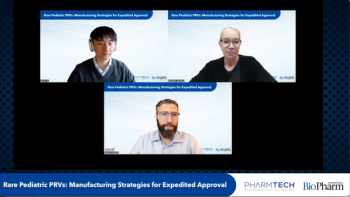
Nate Edwards of Arya Consulting moderates a discussion with Elisabeth Gardiner of Tevard Biosciences and Donny Xu of the RTW Institute about the regulatory and manufacturing hurdles facing rare disease drug developers.

Rohit Tripathi, vice president of industry strategy, consumer packaged goods, and manufacturing at RELEX Solutions, explains where cold-chain planning still breaks down and why biopharma supply chain leaders should use AI to act on data sooner, with humans making the final call.
Advertisement
Advertisement
Trending on BioPharm International
1
Merck and Kelun’s Sac-TMT Extends Survival by Nearly 7 Months in Pretreated Endometrial Cancer
2
BMS Reports Death in Phase 1 Zolacabtagene Autoleucel MS Study
3
The BioPharm Brief: Survival Gains, a Modest ADC Win, and CAR-T in Multiple Sclerosis
4
BioNTech’s HER2 ADC Hits Phase 3 Goal, but Companies See Limited Benefit
5