
Root causes trace back to gaps in corrective and preventive action effectiveness, inadequate deviation trending, and weak change control management. Dr. Jones urges firms to give quality assurance independent oversight authority, define root cause and effectiveness checks for every deviation, and, above all, trend data consistently to catch emerging problems before an inspection does.
News|Events|September 16, 2026
CDER, CBER Officials Outline GMP Compliance Trends
Listen
0:00 / 0:00
FDA's Francis R.W. Godwin (CDER) and Kathleen Jones, PhD (CBER) detail a record pace of drug warning letters and the CGMP deficiencies most commonly cited in biologics facility inspections.
Advertisement
At the
What is driving the record number of CDER drug warning letters?
Godwin opened the presentation by noting that OMQ, part of CDER's Office of Compliance, works to "shield the public from poor quality, unsafe, and ineffective drugs through proactive compliance strategies and risk-based enforcement action."¹
As of September 8, 2026, the office had issued 124 adulteration warning letters, putting the agency on pace for roughly 130 by the end of the fiscal year, a would be a record. Godwin attributes the increase to several converging factors including, an assertive enforcement push on ophthalmic drug products, both foreign and domestic, chronically high noncompliance rates in 503B pharmacy compounding, and a wave of new entrants into the OTC drug space.
Godwin points to FDA's progress clearing its Covid-era inspection backlog, which is allowing investigators to concentrate more inspections on higher-risk sites that are more likely to be out of compliance.¹ Deficient raw material testing under 21 CFR 211.84 remains a recurring theme, Godwin says, citing continued diethylene glycol and ethylene glycol substitution in components sourced from Asia and ongoing methanol substitution in high-alcohol-content drugs.¹
Why is FDA telling manufacturers now about the Red No. 3 phase-out?
Godwin used part of his time to flag a compliance deadline he says is still two conference cycles away but worth acting on early. Under 501(a)(4)(A) of the Food, Drug, and Cosmetic Act, a drug is adulterated if it bears a color additive that is unsafe within the meaning of Section 721, which requires an FDA regulation authorizing that color for use.¹ FDA announced the revocation of Red No. 3 back in January 2025, and manufacturers must reformulate away from it by January 2028, with any drug manufactured after that date containing Red No. 3 being considered adulterated.¹
FDA has issued a draft guidance on replacing color additives in approved and marketed drugs, and Godwin says the agency is already aware that some firms are reformulating components and finished products away from the dye.¹
What compliance issues is FDA seeing in APIs for pharmacy compounding?
During the presentation, Godwin describes pharmacy-compounding APIs as a high-focus area since they receive no premarket review or pre-approval inspection. ¹ Common findings include specifications benchmarked to foreign pharmacopeias rather than USP, missing endotoxin testing for APIs used in injectables, insanitary conditions, refusal to respond to records requests, and illegitimate facility registrations.¹
What sterile manufacturing trends is CDER watching?
Godwin closed his portion with a rundown of recent sterile-facility warning letter trends, covering topics such as poor aseptic technique tied to inadequate training or poor line ergonomics, which are lines that require operators to crawl on the floor or force first-air blockage during setup or interventions; inconsistent or absent visual particulate inspection and misclassification of extrinsic particulates as intrinsic, and recalls tied to hair, fiberglass, and stainless steel contamination.¹
He identifies data integrity around microbiological testing as the most concerning emerging trend, citing examples of personnel disinfecting fingertips with isopropyl alcohol immediately before a fingertip sampling test, labs undercounting colony counts to stay under action or alert levels, and outright falsification of results, including worksheets recording plates that were never actually incubated.¹
How does CBER structure its CGMP inspections?
Following Godwin, Dr. Jones took center stage to outline how OCBQ's Division of Manufacturing and Product Quality (DMPQ) oversees CGMP compliance for biologics, including vaccines, blood products, and cellular therapy products, across the product life cycle.¹
Dr. Jones structured her discussion around CBER's seven major inspectional systems, quality, facilities and equipment, production, laboratory control, materials, packaging and labeling, and donor eligibility, with three critical elements common to all of them: SOPs, training, and records.¹
What are the most common CBER inspection findings?
Dr. Jones calls the quality system foundational because, "if you have a failed quality system, that's going to be the hardest thing for you to overcome." She notes the most common deficiencies being quality check procedures not in writing or not fully followed, failure to thoroughly investigate batch or component failures, absence of adequate written processing control procedures, and failure to submit Biological Product Deviation Reports (BPDRs) within the required 45-day window.¹
Root causes trace back to gaps in corrective and preventive action effectiveness, inadequate deviation trending, and weak change control management. Dr. Jones urges firms to give quality assurance independent oversight authority, define root cause and effectiveness checks for every deviation, and, above all, trend data consistently to catch emerging problems before an inspection does.¹
On facilities and equipment, governed by 21 CFR 211 (parts 42–58) and EU GMP Annex 1, common findings included equipment not properly cleaned, maintained, or sanitized, inadequate computer controls over master records, HVAC systems without timely HEPA recertification, and missing pressure differential alarms.¹ Dr. Jones recommends maintaining a master equipment list with current qualification, maintenance, and calibration status, certifying HEPA filtration on the schedule recommended in aseptic guidance, and documenting and investigating every pressure differential alarm rather than silencing it and moving on.¹
On production, governed by 21 CFR 211.100–115 and Part 600–680, Dr. Jones cites incomplete or retroactively completed batch records, outdated or failed aseptic process simulations, missing smoke studies for Grade A areas, expired operator gowning qualifications, and process validation gaps such as insufficient PPQ lots or uninvestigated validation deviations.¹ Because sterility assurance represents the bulk of her division's product portfolio, she emphasizes enforcing concurrent batch record completion with documented justification for any correction, maintaining current gowning qualification records, and repeating smoke studies after any HVAC or facility modification.¹
On laboratory control, Dr. Jones describes a rising trend in microbial data integrity issues alongside more familiar findings including, lack of scientifically sound laboratory controls and specifications, OOS investigations that are not thorough or lack adequate root cause determination, analytical methods used without proper or current validation, and uncalibrated or unqualified laboratory instruments.¹ To help, she recommends a defined two-phase OOS investigation process, phase one laboratory-focused, and phase two a full manufacturing investigation, along with ongoing analyst proficiency qualification and complete raw data integrity with audit trails for electronic systems.¹
What happens after a CBER inspection, and how is FDA getting ahead of these issues?
Jones explained that pre-license and pre-approval inspections with no observations, or with acceptable resolution of all observations, lead to a compliance recommendation for approval, though that is only one input into the overall approval decision. Unacceptable resolution can lead to a recommended withhold or complete response for the BLA or supplement, while surveillance inspections with unresolved observations can result in regulatory meetings, untitled letters, or warning letters.¹ To help firms avoid 483s in the first place, Jones pointed to FDA outreach efforts including this conference, Type C facility meetings for firms with specific facility questions, and DMPQ's involvement in FDA's Pre-Check Pilot Program, a strategic initiative aimed at strengthening the domestic pharmaceutical supply chain by engaging with manufacturers earlier in the facility development process.¹
The PDA/FDA Joint Regulatory Conference 2026 is taking place September 14–16, 2026, in Washington, DC.
Reference
- Godwin FRW, Jones K. Current GMP compliance trends and topics. Presented at: PDA/FDA Joint Regulatory Conference 2026; September 14-16, 2026; Washington, DC.
https://www.pda.org/global-event-calendar/event-detail/pda-fda-joint-regulatory-conference-2026#agenda
Advertisement
Related to this article
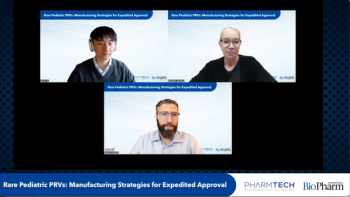
Nate Edwards of Arya Consulting moderates a discussion with Elisabeth Gardiner of Tevard Biosciences and Donny Xu of the RTW Institute about the regulatory and manufacturing hurdles facing rare disease drug developers.

At AAPS PharmSci 360, Thermo Fisher Scientific scientists described how predictive modeling guides technology selection for poorly soluble drugs, and outlined plans to bring solvent-free KinetiSol technology to commercial scale in 2027.

Speaking at AAPS PharmSci 360, Dr Stephanie Johnson, a principal formulation scientist at Pfizer, details how platform formulations save time before commitment, shift risk downstream, and what AI tools need to earn trust.

This year's PharmSci 360 will close with a plenary on fixing drug development economics given by Averin's Dr Berry.

Dr Karunakar Sukuru of Catalent explains how lipid-based softgels address physiological barriers to oral peptide delivery as approvals increase.

A patient with relapsing MS died of septic pneumonia 44 days after zola-cel CAR T infusion, as all 60 dose level 2 patients stayed off DMTs.

Anurag Rathore, PhD, professor of chemical engineering at IIT Delhi, explains how his team is making antibody manufacturing more efficient and replacing costly raw materials to cut monoclonal antibody costs to about $10 per gram.

FNIH CEO Dr Julie Gerberding will open the October 25-28 meeting with a talk on using AI, adaptive trials, and alternative methods in drug development.
Advertisement
Advertisement
Trending on BioPharm International
1
Merck and Kelun’s Sac-TMT Extends Survival by Nearly 7 Months in Pretreated Endometrial Cancer
2
BMS Reports Death in Phase 1 Zolacabtagene Autoleucel MS Study
3
The BioPharm Brief: Survival Gains, a Modest ADC Win, and CAR-T in Multiple Sclerosis
4
BioNTech’s HER2 ADC Hits Phase 3 Goal, but Companies See Limited Benefit
5