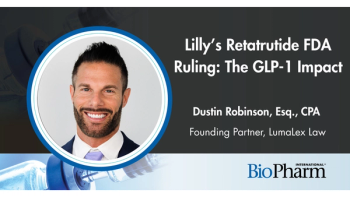
LumaLex Law's Dustin Robinson explains why retatrutide compounding remains illegal regardless of the Seventh Circuit's pending classification ruling.
In the second half of an interview with Lonza’s Carrie Mason, Mason discusses how cross-training scientists enables scale-up of AI-enabled bioprocessing.
*Full transcript available below
Continuing the Women in STEM discussion with BioPharm International®,
A central priority in these efforts is exposing nontraditional talent, especially computer science and computer engineering students, to biopharmaceutical environments early in their careers. Through internships that place these students directly into research labs, Lonza aims to demonstrate how AI, data, and computational tools can work hand-in-hand with bioprocessing and traditional wet-lab science. Mason also emphasizes that academic outreach with local colleges and communities reinforces this message, clarifying what modern biopharmaceutical roles look like and underscoring their hybrid nature at the intersection of science and engineering.
Mason explains that this cross-training philosophy extends beyond technical upskilling to mindset. Industry leaders stress that AI should be viewed as an enabling tool rather than a stumbling block, and that curiosity, agility, and comfort with emerging technologies are now core professional competencies, she notes, stating, “The only way we're really going to have that workforce of the future is if we expose people to that…and to bring people in."
Leadership itself is framed as a networked activity, Mason adds. Advancing biomanufacturing is portrayed as a collaborative effort that depends on strong internal and external partnerships. Effective leaders, therefore, are expected to be humble, to seek support from peers across the ecosystem, and to leverage their networks to align technology, talent, and strategy for the next generation of AI-enabled biopharma production, she concludes.
Carrie Mason, Head, Process Analytical Technologies (PAT) Center of Excellence, Lonza Integrated Biologics
Leveraging more than 25 years of industry experience, Mason leads a multidisciplinary team in the development and implementation of novel bioprocessing PAT solutions throughout the Lonza network. Prior to Lonza, she held roles at various healthcare companies, leading efforts to develop manufacturing strategies for therapeutic products. Mason is involved as a member of the National Institute for Innovation in Manufacturing Biopharmaceuticals and the BioInnovation Group, with a desire to drive forward innovations for the advancement of the biomanufacturing industry.
Editor's note: This transcript is a direct, unedited rendering of the original audio/video content. It may contain errors, informal language, or omissions as spoken in the original recording.
Speaker 1
So, a lot of ways we're doing it is we're do a lot of cross training within our organization. Lanza is a really large company that allows us to move within the company. So we see people that have supported research and development or supported manufacturing, and bringing those to various different parts of the organization, so we can develop those strengths. When I look at AI and bringing the skill sets necessary for the next generation of AI and biochemists and scientists alike, what that really looks like to me is people that are willing to use the technology right, willing to use AI as a way to get to the answers necessary. Sometimes it can be looked at as a stumbling block, but in essence, it's a great tool to be used, and we can use that with our scientists. Part of our strategy is we do internships where we bring people on board in order to bring them into our industry. One of the very first things that I did with my organization is look to see how we could be creative with those internships. And we actually brought in students that were in computer science and computer engineering into our research lab and introduced what pharmaceutical methodologies look like for them, so that they could see what AI and how computer science can work hand in hand with bio processing. So it's very critical to be, you know, when we're looking at people and bringing people to the table to utilize all these different types of skill sets they can bring, and the biggest thing we can do is showing that there's a fit, right? So when you look at a lot of people in computer science, I don't think many of them think about biopharmaceuticals, right? So you're thinking about other aspects of it, the larger companies that you think of as tech companies, but the need is strong in biopharmaceuticals for people that can actually do both. And the only way we're really going to have that workforce of the future is if we expose people to that all right? And to bring people in. A lot of academic outreach is important. So we do a lot of academic outreach with our local communities and our colleges in order to also express exactly what a pharmaceutical job looks like. And you're right, it is very hybrid, right? So there's a lot of interconnectivity between a true science role and an engineering role.
I think my advice would be to keep an open mind and to always be inquisitive and ask questions, right? And to be able to look at what technology is out there. Don't be afraid to find something that isn't necessarily exactly what we need, you know, being agile and being able to look at things and and really puzzled them out and say, Hey, how can we use this? What would this bring to our industry? Is very, very critical. So when I look at people leaders, I think it's critical for people to be able to see what's necessary and then see what else can be asked, right and so and also rely on your network right. As a leader, it is so critical to know people in the right places, and to be able to ask those questions of people and to connect them into your network in order to advance biomanufacturing, because it's not going to be done individually, right. So as much as I have a lot of industrial experience, I still rely heavily on my partners and other different aspects of our field in order to be successful. So as a leader, I think it's very critical to to be humble and to know when it's okay to ask for that support and get that that leadership from other people within your organization and even outside your organization, to build a much stronger network to get to a better state of where we need to be in.