

"We are grateful to the FDA for its leadership in advancing regulatory science to meet the urgency of this disease, and to the MHRA for its commitment to advancing rare disease treatments in the U.K. We look forward to working with both agencies as these applications progress."
— Matt Kapusta, chief executive officer, uniQure
News|Events|September 3, 2026
uniQure Submits BLA and MAA for AMT-130 Gene Therapy in Huntington's Disease
Author(s)Emily Schoenthaler
Listen
0:00 / 0:00
uniQure submitted a Biologics License Application to the FDA and a Marketing Authorisation Application to the UK's MHRA for ifezuntirgene inilparvovec (AMT-130), an AAV5 gene therapy for Huntington's disease, based on three-year Phase I/II data — a potential first disease-modifying treatment for a condition with no approved therapies that slow progression.
Advertisement
uniQure submitted a Biologics License Application (BLA) to the FDA seeking accelerated approval of ifezuntirgene inilparvovec (AMT-130), an investigational gene therapy for Huntington's disease, and simultaneously submitted a Marketing Authorisation Application to the UK's Medicines and Healthcare products Regulatory Agency (MHRA) for the same therapy.¹ The company has requested priority review for the BLA, which, if granted, would shorten the FDA's review cycle to six months following the agency's 60-day filing review period.¹ Both submissions are supported by the previously announced three-year data analysis from the ongoing phase 1/2 clinical study, compared against a propensity score-matched external control derived from the Enroll-HD natural history database.¹ uniQure intends to present a four-year data analysis from the same studies before the end of the current quarter.¹
Matt Kapusta, chief executive officer at uniQure, said, "The submission of licensing applications for ifezuntirgene inilparvovec represents an important milestone for the Huntington's disease community. We are grateful to the FDA for its leadership in advancing regulatory science to meet the urgency of this disease, and to the MHRA for its commitment to advancing rare disease treatments in the U.K. We look forward to working with both agencies as these applications progress."¹
What does the three-year data show?
In the high-dose cohort, patients treated with AMT-130 demonstrated a statistically significant 75% slowing of disease progression on the composite Unified Huntington's Disease Rating Scale (cUHDRS) compared with the external control (p=0.003), with mean cUHDRS decline of –0.38 in treated patients versus –1.52 in controls, according to data presented at the 2026 American Academy of Neurology Annual Meeting.² Investigators also reported reductions in cerebrospinal fluid neurofilament light chain, a biomarker of neurodegeneration, with no new long-term safety concerns emerging during follow-up.² This three-year dataset has been presented at scientific meetings and reported in topline form by the company, but has not yet appeared in a peer-reviewed journal publication — uniQure has said it intends to publish the full dataset in a high-impact venue.³
How is AMT-130 delivered?
AMT-130 uses uniQure's proprietary miQURE gene-silencing platform, incorporating a microRNA designed to silence the huntingtin gene and its potentially toxic exon 1 protein fragment.¹ Unlike AAV gene therapies delivered systemically or via intrathecal injection, AMT-130 is administered through targeted, MRI-guided, convection-enhanced stereotactic neurosurgical delivery directly into the striatum (caudate and putamen).¹
A single administration is intended to provide durable, long-term silencing of the disease-causing gene.
A recent peer-reviewed review of AAV-mediated gene therapy approaches specifically for Huntington's disease similarly notes that AAV vectors' non-pathogenic profile and capacity for sustained transgene expression have made them the most extensively employed and clinically validated platform for in vivo gene therapy, though the authors note AAV's potential for Huntington's disease specifically has remained comparatively underexplored relative to other rare genetic diseases.5
Why does this matter for Huntington's disease patients?
Huntington's disease is a rare, inherited neurodegenerative disorder affecting an estimated 75,000 people across the US, EU, and UK combined, with hundreds of thousands more at risk of inheriting the disease.¹ Despite a clear genetic cause, there are currently no approved therapies that delay onset or slow disease progression.¹ If approved, AMT-130 would be the first disease-modifying treatment for the condition; it is the first investigational Huntington's disease therapy to receive both Breakthrough Therapy and Regenerative Medicine Advanced Therapy (RMAT) designations from the FDA, and it also holds Fast Track designation.¹
What happens next?
The regulatory path here has not been straightforward: the FDA reversed its position multiple times over the past year on whether the existing phase 1/2 dataset was sufficient to support a BLA, before ultimately agreeing in June 2026 that the three-year analysis could serve as primary evidence.6 The FDA and MHRA will now conduct their respective filing reviews; if the FDA accepts the BLA for priority review, a decision could come within approximately eight months.
References
- uniQure N.V.
uniQure Announces Submission of Biologics License Application for Ifezuntirgene Inilparvovec (AMT-130) in Huntington's Disease . Press release. Published September 2, 2026. Accessed September 3, 2026. - Sung V. Understanding the 3-Year Findings Behind AMT-130 in Huntington Disease. Presented at: 2026 American Academy of Neurology Annual Meeting; Chicago, IL. Reported by NeurologyLive.
Gene Therapy for Huntington's Disease Faces New Regulatory Hurdle . Neurology Today. Published April 2, 2026. Accessed September 3, 2026.Comparing Viral Vectors for Gene Therapy Delivery . BioPharm International. Published August 8, 2024. Accessed September 3, 2026.- Moeini Gavgani P, García-Domínguez M. Revolutionizing Huntington's Disease Treatment: Breakthroughs in AAV-Mediated Gene Therapy. Cells. 2025;14(19):1514.
doi:10.3390/cells14191514 - uniQure N.V.
uniQure Announces Plan for BLA Submission for AMT-130 in Huntington's Disease . Press release. Published June 17, 2026. Accessed September 3, 206
Advertisement
Related to this article

The FDA has accepted Pierre Fabre Pharmaceuticals’ resubmitted BLA for tabelecleucel, an allogeneic T-cell immunotherapy for EBV+ post-transplant lymphoproliferative disease. The FDA’s target action date is March 31, 2027.

Interim phase 1/2 data presented at Retina in Rio 2026 showed sustained visual improvements with Opus Genetics’ AAV8 gene therapy OPGx-LCA5 and improved retinal sensitivity with OPGx-BEST1 in inherited retinal diseases.
Antisense oligonucleotides are reshaping drug design, from RNase H gapmers to inhaled delivery; this FAQ explains how they work and why trials still fail.

The FDA approved Roche's satralizumab (Enspryng), an IL-6 receptor-targeting monoclonal antibody, for adults with thyroid eye disease based on the Phase 3 SatraGO-1 and SatraGO-2 trials, giving patients the first at-home subcutaneous treatment option.
AVT29, a proposed aflibercept biosimilar to Eylea 8 mg, could extend retinal disease treatment intervals to 16 weeks, versus 8 weeks today.
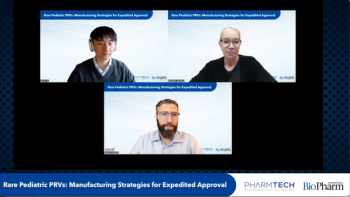
Nathan Edwards of Arya Consulting moderates a discussion with Elisabeth Gardiner of Tevard Biosciences and Donny Xu of the RTW Institute about rare disease treatment development and navigating the FDA’s Rare Pediatric Disease Priority Review Voucher Program.

As ArsenalBio, TScan, Bristol Myers Squibb, and others abandon ex vivo programs for in vivo engineering, early clinical data and platform differences point to both the promise and the unresolved safety, manufacturing, and regulatory questions of generating CAR-T cells inside the body.

FDA has accepted for review the biologics license application for FYB206, a proposed pembrolizumab biosimilar developed without a comparative phase 3 efficacy trial. A decision could come in the third quarter of 2027.
Advertisement
Advertisement
Trending on BioPharm International
1
Alvotech, Advanz Submit First Eylea 8 mg Biosimilar Bid
2
Lilly's Mirikizumab (Omvoh) Hits New IBD Remission Goals
3
Shift to In Vivo CAR T Will Reshape Facility Design, Says Arcadis’ Emily Heffernan
4
The BioPharm Brief: New Approvals, Biosimilar Competition, and Deeper Remission
5