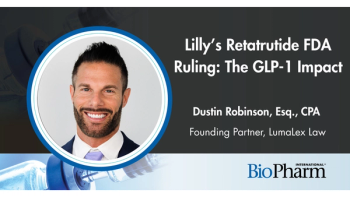
Former FDA oncology reviewer Paz Vellanki, MD, PhD, of Precision for Medicine, discusses how CDER's ARC program supports novel end points such as ctDNA for rare diseases and why sponsors should engage FDA early.
Chris Spivey explains how billions wasted on flawed near-infrared glucose sensing could have been avoided.
*Full transcript available below.
In the latest episode of the “Two-Minute Mysteries: BioPharma Stories” video series, Chris Spivey, Director of Industrial Relations and Strategic Partnerships, Industry Sciences One, MJH Lifesciences, explains the mystery of several billion investor dollars being lost without hope through attempts to non-invasively measure glucose via near infrared techniques. It’s all part of a 40-year attempt to non-invasively measure glucose levels (1).
Patients with diabetes have historically measured their blood glucose levels through finger prick testing, using strips and a glucometer. It is painful process that also creates an overall environment of mis-undertesting and inaccuracies. Some use wearable monitors that employ a subcutaneously inserted sensor; these sensors produce continuous glucose measurements from interstitial fluid; however, these require replacement every 10 to 15 days, cost more than their fingerpick counterparts, and have differing insurance reimbursement models.
The global diabetic finger rick and consumables market is projected to reach $30B by 2030 (2).
References
*Editor’s Note: This transcript is a direct, unedited rendering of the original audio/video content. It may contain errors, informal language, or omissions as spoken in the original recording.
Pulse oximeter was invented in 1972. Optical science quickly turned transmissive infrared light for non-invasively measuring blood glucose, seeking to replace the diabetic finger prick test strips currently valued around 30 billion annually. Ultimately, several billion R&D dollars were totally wasted.
None of those several billion dollars ever had any chance at all to succeed because 1) transmission spectroscopy light travels too far, picking up a lot of undesirable and pointlessly noisy information, but 2) mostly, the glucose molecule in the near infrared oscillates in the seventh harmonic; just a very pale, faint echo of the molecule itself. Far, far too little signal-to-noise. So, this approach never, ever, not possibly, could have worked.
Not convinced? If you take blood out of the body and try to accurately measure the glucose with near infrared, it doesn't work. “Not a satisfying mystery.” I hear you say. Gee, you are hard to please. Alright.
In that case, I'll tell you how to actually accurately, non-invasively quantitate glucose, but just keep it to yourself. It's a mysterious secret, if you will. You actually need to use mid-infrared. That's where the glucose molecule has its fundamental oscillation. So, okay, now that you know that, the smart among you have said, “Gee, but now you've ridiculously amplified the contribution of the skin signal, worsening an already tough signal-to-noise ratio.” So, what to do? If we pay attention to the paper by Schmidt and Kumar, we learn that, optically speaking, the skin reflects back smooth wavefront light.
So, how is that useful? Well, let's dive into the interstitial fluid [ISF], arguably the body's largest organ. We know very little about the ISF, but an adult has about two and a half to three gallons sloshing around. But let's not dive too deep into the ISF, just the first 100 or 200 microns or so. Then, you're gonna need to invent a binary phase mask to eliminate the smooth wavefront light.
You're left with a signal that can accurately measure glucose non-invasively as cross-referenced to the same patient's blood reading simultaneously taken through finger prick readings. And voila, a method to accurately, non-invasively measured glucose. But you could also monitor drug trial pharmacokinetics.
There's a host of possibilities as deep as the interstitial fluid itself.