

"I would frame it as, as research focuses on what the biology or the chemistry of a molecule requires, manufacturing can be responsive to that trial and error to be able to accelerate the molecule once we land on the particular process."
Commentary|Videos|November 17, 2026
Small-Molecule Agility Can Inform Biologics Manufacturing, Says Merck
Merck's Dr Dave Maraldo explains that small-molecule platform agility and flexible conjugation capacity can help biologics manufacturing respond to research needs.
Advertisement
In the second segment of an interview with BioPharm International®,
Dr Maraldo says small-molecule manufacturing offers lessons in platform agility for biologics.
How can capital investment keep bioconjugation flexible?
Asked whether this investment strategy amounts to a trial-and-error approach, Dr Maraldo says that it links to core technologies, and conjugation is key know-how. Many methods exist, he emphasizes. Manufacturers can conjugate in a stainless-steel reactor or in a
"I would frame it as, as research focuses on what the biology or the chemistry of a molecule requires, manufacturing can be responsive to that trial and error to be able to accelerate the molecule once we land on the particular process," he explains.
Some capabilities already overlap between the 2 worlds, he says. Many small-molecule programs, and the wider industry, use enzymes, and producing an enzyme involves an Escherichia coli fermentation, a form of cell culture. Dr Maraldo points out that those capabilities are quite analogous between small molecules and large molecules. Those shared capabilities show where learning can transfer, he adds.
Learn more from
About the speaker
Dave Maraldo, PhD, Executive Vice President and President, Merck Manufacturing Division
Dr Maraldo has responsibility for Merck’s worldwide human health manufacturing and supply operations across a global network of sites for pharmaceuticals, vaccines and biologics. Since joining the company as a project engineer in 1999, he progressed through a range of leadership roles across manufacturing, technical operations, commercialization and integrated development and supply. Building on that foundation, he led global biologics operations from 2022- 2025 and most recently served as senior vice president of human health manufacturing. Dr Maraldo earned his PhD and master of chemical engineering degrees from Drexel University, an MBA degree from Lehigh University and a bachelor of chemical engineering degree from Widener University.
Advertisement
Related to this article

Galinpepimut-S maintenance extended median overall survival to 24.0 vs 14.7 months in transplant-ineligible AML patients in second or later remission.
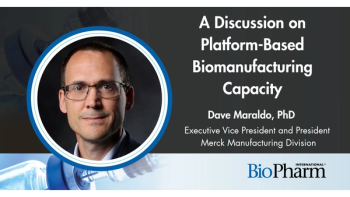
Merck's Dr Dave Maraldo outlines 3 principles for placing manufacturing capacity and how end-to-end ADC supply chains could shift platform thinking.

Donidalorsen sustained a 95% reduction in hereditary angioedema attacks over 2 years, and patients switching from other prophylaxis saw a 71% drop.

A single 240 mg dose of WVE-007 cut visceral fat while preserving lean mass for 1 year, as Activin E fell by up to 88% across INLIGHT dose groups.

This FAQ explains how aseptic processing, contamination control, and validation protect patients amid sterile injectable failures.

FDA approved Novartis’ secukinumab (Cosentyx) 150 mg for adults with polymyalgia rheumatica who respond inadequately to corticosteroids or cannot tolerate a taper. In the Phase 3 REPLENISH trial, secukinumab doubled sustained remission rates.

Obinutuzumab produced complete proteinuria remission in 36.1% of primary membranous nephropathy patients at 2 years vs 5.7% with tacrolimus.

Once-weekly self-injected gefurulimab improved daily-living scores in AChR-positive generalized myasthenia gravis in the 260-patient PREVAIL trial.
Advertisement
Advertisement
Trending on BioPharm International
1
FDA Approves AstraZeneca's Gefurulimab (Klygefa) for Generalized MG
2
FDA Rejects Summit’s PD-1×VEGF Bispecific Ivonescimab in EGFR-Mutated NSCLC, Citing Lack of Survival Benefit
3
Deals Roundup: J&J Buys Ollin, Lilly Adds Calytrix, and Novartis and Sanofi Strike Platform Pacts
4
The BioPharm Brief: FDA Rejects Ivonescimab, Gazyva Becomes the First Approved pMN Therapy, and a Nanobody Approval in Myasthenia Gravis
5