
“Incorporating a site‑centered model relies on greater standardization, earlier and more meaningful engagement, and the thoughtful use of automation to reduce administrative burden. Approached holistically, these individual elements accelerate activation without adding complexity for site teams.”
Commentary|Articles|May 21, 2026
Site-Centered Startup: Approaching Predictability in an Imperfect System
Author(s)Brian Mallon
Listen
0:00 / 0:00
Study startup delays persist due to multiple factors, with improved performance increasingly tied to aligning feasibility and activation planning with real-world site capacity, maintaining early momentum, and reducing operational friction through clearer coordination and enabling technologies.
Advertisement
Study startup delays are well known, perennial challenges across clinical research. Prolonged contract and budget negotiations, growing protocol complexity, and communication gaps are major factors that continue to delay activation and disrupt timelines.
Site activation is an imperfect science, to be sure. There are many moving, chimeric parts to the process and progress depends on sustaining momentum through this imperfect and interdependent system.
A site‑centered approach to feasibility, startup, and activation offers a more durable way to manage this reality by addressing constraints before they become bottlenecks. Leveraging opportunities in design, technology, and approach, we can shape downstream performance deliberately rather than reactively, improving predictability, quality, and speed across the continuum.
Striking a site focused balance
Site centricity and participant centricity are not competing priorities. Over the past decade, the industry’s advancements in patient centricity have yielded positive outcomes, though sometimes at the expense of site burden.
Sites translate protocols into practice, safeguard data quality, and enable patient access. When site needs are sidelined, the very outcomes sponsors seek to improve are put at risk.
Incorporating a site‑centered model relies on greater standardization, earlier and more meaningful engagement, and the thoughtful use of automation to reduce administrative burden. Approached holistically, these individual elements accelerate activation without adding complexity for site teams.
Momentum as a design principle
Momentum is one of the strongest predictors of success at startup, especially in a highly competitive research field in which sponsors and contract research organizations (CROs) are often vying for the same high-performing sites. Generating early momentum builds confidence, sustains engagement, and creates tolerance for the inevitable friction points.
Maintaining momentum requires site‑centered practices and strong bidirectional communication. Clear timelines, defined responsibilities, and realistic expectations allow sites to plan staffing, manage competing studies, and commit with confidence.
In contrast, ambiguity erodes early enthusiasm and disrupts planning. Momentum, once stalled, amplifies variability across regions and workstreams.
Accounting for capacity
Rising attrition and pre-selection decline rates signal mounting strain across the ecosystem. Pre-selection decline increased sharply in recent years, as sites are stretched by staffing shortages, administrative burden, and increasingly demanding protocols.
This execution burden impacts startup timelines, recruitment and enrollment, and participant engagement—if they don’t drop out altogether.
Aligning planned demand with capability and projected capacity is key to setting sites and studies off on the right foot. That alignment must be established before sites are selected, not after activation begins to falter.
Traditional feasibility validates interest, eligibility, capability, and experience. Capacity, however, accounts for when a site can realistically start and how much work it can absorb alongside existing obligations (remembering that sites often operate multiple studies at once on top of their regular duties).
Feasibility without capacity built in creates hidden constraints that surface only once contracts stall, reviews queue, and activation timelines slip. A site‑centered feasibility model reframes selection around readiness and sustainability.
It reflects a growing recognition that activation strategies must be sequenced around real‑world capacity rather than designed for simultaneous scale. In the short term, sponsors must recognize that site attrition and dropout rates are higher than ever and adjust accordingly with calculated over-selection strategies.
Faster feasibility and selection
Site networks and robust databases that catalogue real‑world performance enable faster and more confident selection decisions. Sponsors working with pre-qualified, well-supported sites benefit from smoother activations and higher retention because readiness is a known factor rather than an assumption.
It also avoids wasting site personnel’s time on unnecessary feasibility assessments by homing in on the right sites the first time. Layering performance data, digital tools, and human expertise into selection criteria provides balanced insight into patterns and risks.
Technology enables data-driven site selection for efficiency and consistency at scale while human judgement interprets capacity in context. Together, they can reduce attrition, stabilize startup, and accelerate enrollment without overwhelming site teams.
Protecting predictability with automation
Startup concentrates more operational demand into a shorter window than almost any other trial phase. Contracts, budgets, ethics submissions, training, and system access often progress in parallel.
This creates a sudden spike in demand across multiple constrained tracks. Beyond site selection, automation now plays a central role in addressing those perennial startup constraints.
AI enabled tools can support contracting, regulatory tracking, document management, and task automation. These tools reduce cycle times, improve accuracy, and enable more consistent delivery.
Predictive modeling and real‑time dashboards translate data into actionable intelligence that flags potential delays or bottlenecks so they can be addressed early. This transparency enables collaborative correction rather than reactive escalation and supports confident engagement with both sites and sponsors.
Site-centricity as cornerstone and catalyst
Momentum in feasibility, startup, and activation begins well before the first site is activated. Well maintained site networks and experienced independent sites enter feasibility with infrastructure, processes and relationships already in place, accelerating the process.
Industry data consistently show that repeat or familiar sites initiate faster than new relationships, not simply due to experience, but because organizational memory translates into operational capacity. Clear, bidirectional communication is vital for strong site relationships and is the top factor for smoother startup, as ranked in our recent
Communication translates to engagement, preserving sites’ commitment to the trial and facilitating problem-solving when delays and challenges arise. Digital platforms that integrate communication, training and documentation reduce administrative burden and error when they meet sites where they are, within existing workflows and systems.
Listening to sites and acting on insight positions them as strategic partners, strengthening engagement, protecting momentum and improving startup performance overall.
Feasibility by design
Feasibility is the earliest point at which predictability, quality, and speed can be intentionally shaped. Repositioning feasibility as a site‑centered, capacity-informed design phase reduces friction that otherwise compounds into delays.
In an industry where time lost early is rarely recovered, purposeful shifts at feasibility determine how studies start, how they perform, and how sites respond to future research opportunities. Designing with capacity in mind enables sites and sponsors to move forward quickly and with confidence.
About the Author
Brian Mallon is executive vice president of Sites, Patients & Study Start Up at ICON. Based in Dublin, he brings more than 15 years of experience at ICON, where he has held a range of senior leadership roles across legal, procurement, and commercialisation. Prior to his current role, Mallon led ICON’s Commercialisation & Outcomes division, overseeing global teams in Real World Solutions, Medical Device & Diagnostic Research, and Patient Centred Services. He is known for building high-performing teams and driving innovation across operational functions that support the delivery of clinical trials.
Advertisement
Related to this article

The Skyrizi approval pairs an interleukin-23 antibody with an on-body injector for 720 mg subcutaneous induction in adults, per phase 3 AFFIRM data.
Gilead agrees to acquire PepStar’s oral IL-23R peptide program for $1.275 billion, Zymeworks licenses its DLL3-targeted trispecific T-cell engager ZW209 to Roche, and the US Treasury proposes adding biotechnology to its outbound investment restrictions.

FNIH CEO Dr Julie Gerberding will open the October 25-28 meeting with a talk on using AI, adaptive trials, and alternative methods in drug development.
Insilica's Dr Thomas Luechtefeld argues process traceability, not benchmark accuracy alone, determines whether AI toxicology decisions can be trusted.

Phase 1 HCXT-2001, an oral macrocyclic IL-23R peptide, could be paired with emvistegrast as a daily oral IBD treatment, according to Gilead.

Roche gains exclusive global rights to ZW209, a DLL3×CD3×CD28 trispecific T-cell engager designed for CD28 co-stimulation. A phase 1 study in small cell lung cancer and other neuroendocrine tumors is underway.

A Treasury proposed rule would restrict certain US investments in biotechnology in China and other countries of concern, raising questions about how cross-border licensing and joint venture deals will be treated.
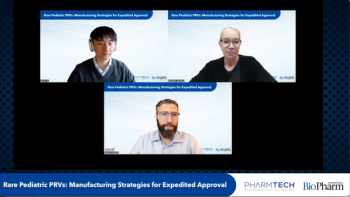
Nate Edwards of Arya Consulting moderates a discussion with Elisabeth Gardiner of Tevard Biosciences and Donny Xu of the RTW Institute about the regulatory and manufacturing hurdles facing rare disease drug developers.
Advertisement
Advertisement
Trending on BioPharm International
1
Treasury Proposes Adding Biotech to Outbound Investment Restrictions Under COINS Act
2
TaiMed’s Anti-CD4 Antibody TMB-365 Reduces HIV Viral Load in Phase 1, Supporting Long-Acting Combination Regimens
3
Gilead to Buy Oral IL-23R Peptide HCXT-2001 for $1.275 Billion
4
BioNTech, BMS to Pair Pumitamig With Trodelvy in Phase 3 First-Line TNBC Trial
5