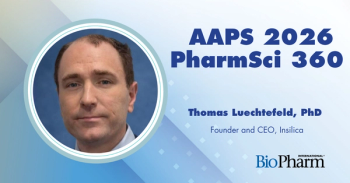
At PharmSci 360, Insilica CEO Thomas Luechtefeld will present on auditable agentic AI systems and how they are expanding computational toxicology beyond single predictive models.
Webinar Date/Time: This event is now available on demand
Stability screening in protein research is often limited by low-throughput tools that fail to capture the full stability profile. Join this webinar to see how Aunty—a combined DSF, SLS, and DLS platform—enables high-resolution, high-throughput stability analysis, and learn how Stanford Innovative Medicines Accelerator uses it to accelerate the translation of research discoveries into new medicines.
Register Free:
Event Overview:
Stability screening in protein research is slowed down by inflexible one-hit wonder instrumentation that does not give the full stability picture or that creates major bottlenecks because of seriously low throughput. Aunty is the first combined DSF, SLS, and DLS platform designed to rule protein stability with its SBS format 96-well plate that requires only 8 µL of each sample. Aunty delivers data at warp speed by reading the entire plate continually during the an experiment. Join our webinar for an introduction to Aunty and see how Stanford Innovative Medicines Accelerator (IMA) uses Aunty to accelerate the translation of Stanford research discoveries into new medicines, while expanding knowledge of human biology
Key Learning Objectives:
Who Should Attend:
Speakers:
Andre Mueller, PHD
Senior Product Manager, Aunty
Unchained Labs
Andre Mueller, PhD, is the product manager for Aunty at Unchained Labs. His expertise covers fluorescence, static, and dynamic light scattering for biophysical characterization of proteins. His research experience spans structural biology and plant physiology and labs in Germany, Sweden, Denmark, and the US. Mueller earned his PhD at the Carlsberg Laboratory and had a postdoctoral appointment at Stanford University.
Matt Armbrust
Research Assistant
Protein Engineering Knowledge Center (PEKC), Innovative Medicines Accelerator
Matt Armbrust is a research associate in the Protein Engineering Knowledge Center at Stanford CHEM-H Innovative Medicines Accelerator. He is an expert in protein production and biophysical characterization and has contributed to a range of disease-agnostic preclinical pipelines toward the development of novel biotherapeutics. Armbrust earned dual bachelor’s degrees in biological engineering and biochemistry at Utah State University and also performed undergraduate research involving the discovery and characterization of novel bacterial immune systems, such as CRISPR-Cas.Register Free: