Correct data is fundamental in a GxP quality system. This podcast will discuss what needs to be put in place to achieve data integrity and minimize the risk for an organization. We will discuss how to achieve data integrity and give real examples from FDA warning letters about the most frequent violations. To prevent violations, processes and systems should be designed to follow the ALCOA principles which will be explained in detail. We will review how a modern lab instrument can provide all the technical features which are needed to automate processes, ensuring that data integrity compliance issues are not created. As an example, we will present the functionalities of Cubis II, the 2nd generation premium laboratory balance from Sartorius. We will also discuss software applications for QC- or production-relevant applications like Tablet & Vial checker (Uniformity of dosage, USP chapter <905>), Loss on Drying (USP Chapter <731>), Standard preparation (USP Chapter <129>), Pharma Filling (Transfer of liquid products) or MYCAP CCX (Transfer of media and inoculum). The software applications safely guide operators through the workflow, automatically calculate the results and have conformity checks included.
Rohit Tripathi, vice president of industry strategy, consumer packaged goods, and manufacturing at RELEX Solutions, explains where cold-chain planning still breaks down and why biopharma supply chain leaders should use AI to act on data sooner, with humans making the final call.
The FDA grants accelerated approval to Ultomiris for IgA nephropathy, Alcon acquires Neurotech and its MacTel cell therapy for $550 million, and BioNTech and Bristol Myers Squibb add Trodelvy to a phase 3 trial in triple-negative breast cancer.
BioNTech and Bristol Myers Squibb will replace chemotherapy with Gilead’s TROP2-directed ADC sacituzumab govitecan in the Phase 3 ROSETTA Breast-01 trial of PD-L1×VEGF-A bispecific pumitamig in PD-L1-low or -negative TNBC.
Alexion’s ravulizumab won accelerated approval to reduce proteinuria in adults with IgA nephropathy after the Phase 3 I CAN trial showed a 43.4% placebo-adjusted reduction at Week 34.
Sanofi breaks ground on an EU-backed insulin API plant in Frankfurt, Summit and ECOG-ACRIN launch a phase 2/3 trial of ivonescimab in first-line biliary tract cancer, and TaiMed’s anti-CD4 antibody TMB-365 lowers HIV viral load in phase 1.
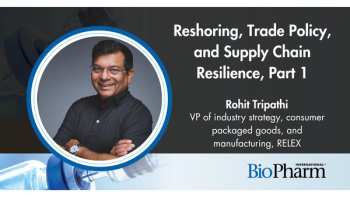
Rohit Tripathi, vice president of industry strategy, consumer packaged goods, and manufacturing at RELEX Solutions, explains what is driving biopharma reshoring, how USMCA uncertainty complicates sourcing for biologics, and where cold-chain visibility still breaks down.